LOST PINES, Texas–With the world on the cusp of a dramatically new era defined by artificial intelligence, credit union leaders were cautioned there is a rapidly developing AI-related development and threat they are likely completely overlooking—but they also have something in their back pockets that could help save them, according to one person
Dr. Lamont Black, associate professor, Department of Finance and Real Estate at DePaul University, and who also leads the consulting firm Wide Open Ventures and who does extensive work with credit unions, told Catalyst Corporate’s Strategic Summit that 2026 marks the end of the Information Revolution and the beginning a new chapter in human history, and he cautioned that if credit unions want to emerge from that history and play a role in the future it is imperative they understand exactly what’s taking place.
“We can debate what it’s going to look like, but I think we can all agree the world is changing and when I think about money 10 to 15 years from now it’s not something we touch–it’s going to be real time, seamless and autonomous,” Black said.
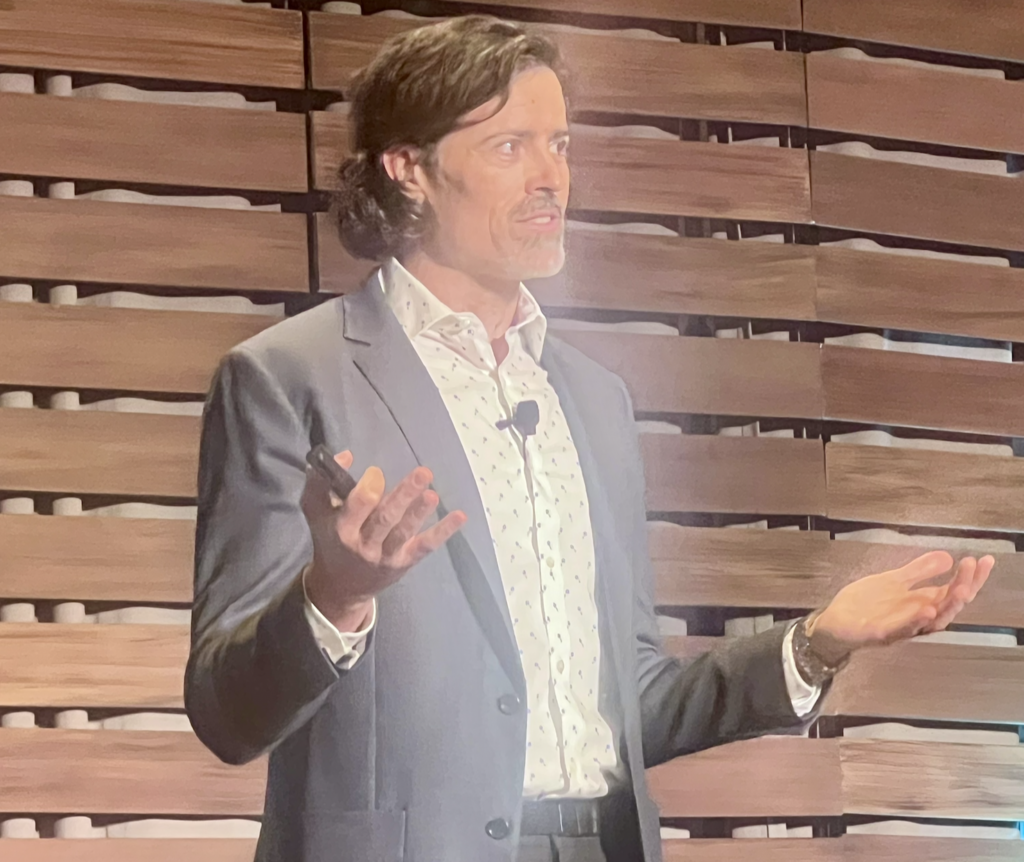
To put the revolution that is occurring into context, Black walked credit union leaders though a lesson on the history, present and likely future of money.
“This change we’re living through is a natural extension of the history we have already lived through,” Black said. “History doesn’t repeat but it does rhyme. We are living through a progression, and if you understand how we got here it’s just logical to understand where this is headed.”
The Past & How We Got Here
Looking to the history of money, Black said that fundamentally money is a technology, a way to store value, to transfer value. Its worth is utility, not substance, he said.
“Money was created as a way to record value and to send that value to someone else. Money is more of a social concept; it does not have value in and of itself,” Black said.”It only has value in that other people are willing to receive this and we agree that we will use this as money. Then, it will function as money.”
Black ran his audience through a history of money, from commodities such as rice and salt, to gold-backed paper currency to digital currencies. But people don’t trust digital money, which is the reason for the creation of stablecoin backed by fiat currency, he explained.
What’s taking place now began in the 1960s when money became data, according to Black, who reviewed how paper ledgers became digital ledgers and that led to the birth of the core system and ACH, which allowed for end-of-day clearing.
As the 1970s arrived, the credit card emerged and by the 1990s the Internet had developed into a public network. PayPal brought cards to the Internet, but the payment networks remain private. “That can feel frictionless,” observed Black, but it is not, as today’s payments systems still involve payments rails and accounts.
The Present
Money today is a means to an end, said Black, stating some may disagree but he believes people don’t want to think about money. Instead, people want to think about their lives, and invisible payments make that possible, Black told the meeting.
“We have now reached in 2026 and what I would say is the end of the Information Revolution and are beginning a new chapter in human history,” said Black. “We have entered the age of AI.”
And as part of that new chapter, “money is becoming invisible. FedNow is a step in that direction. It’s instant clearing between institutions. Before you get into stablecoins, you should figure this out.”
The Future
The Internet moved words. Now, it’s value, said Black. Email is a public protocol for words, but nothing existed for cash, Black observed. In 2008, the idea of “peer-to-peer electronic cash” was proposed in a white paper for Bitcoin. It represented the introduction of Blockchain.
“If you think about this idea of money as a token, now we can move money as digital tokens between wallets. Each is attached to an address on the blockchain. Now we have a database for distributing tokens, known as a distributed ledger. That is the protocol for distributing payments. This is a very important point: Bitcoin is a speculative investment. But the technology behind Bitcoin is very important, because what it set up is this thing called stablecoins. I want you to think of stablecoins as the killer app for blockchain. They transfer value but they are not speculative because they are pegged to the dollar. This is real-time, wallet to wallet. This is consumer-facing technology. Now I can use the Internet to move money on the Internet just like I use email to move words.”
The GENIUS Move to Create Trust
Stablecoins have existed for years, noted Black, but they always lacked trust. The recently passed GENIUS Act now provides that trust, according to Black.
Black said there is strategic risk to credit unions from stablecoins in that money can be moved off the balance sheet as payments exit the traditional rails.
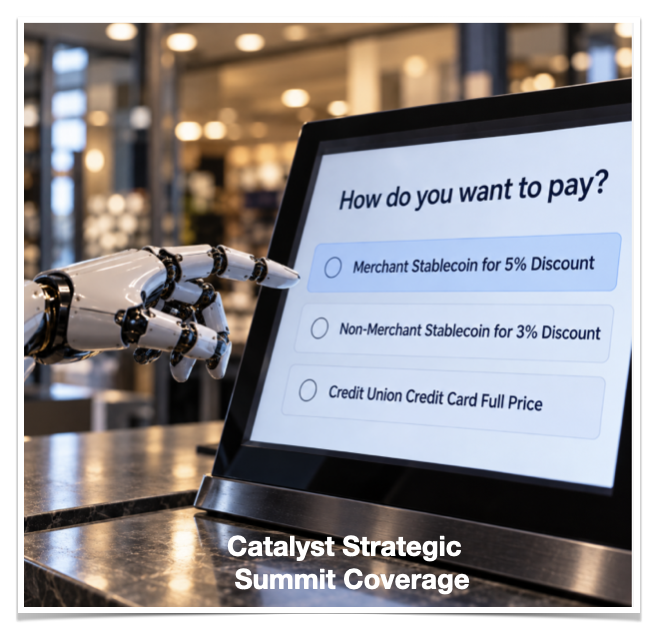
“The action is going to come from the merchants. The thing all of you should be paying attention to is what is Amazon is doing, what Walmart is doing,” Black said. “The GENIUS Act has created an alternative to cards. If your member has the option to use stablecoins, what are they going to do? Do you think Amazon is motivated to try to reduce that merchant processing fee? What is Amazon going to do to incentive your member to use that alternative? Ever see a gas station with two prices, one based on cash, the other on credit? I fully anticipate Amazon is working on this right now. Your members might love you and your card, but if they start getting a price discount, are they going to shift away from you?”
What to be Watching in AI
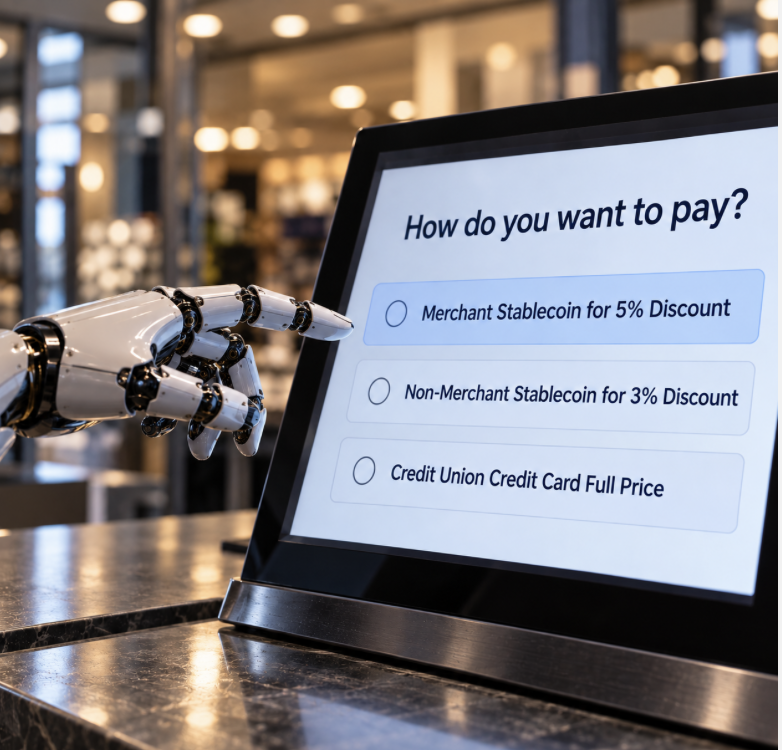
Meanwhile, while there is much attention on the broad application of artificial intelligence taking place, Black urged credit union leaders to specifically pay attention to agentic AI and not just AI for backoffice efficiencies and use-cases.
The “age of consumer agents” has arrived, he said. “This is something many credit unions are not thinking about enough. Think about what this means to changing the nature of shopping; Typically, buying online begins with the shopping experience. The trend you should be focused on is what happens when the agents are paying on behalf of the consumer. This is not people buying stuff.”
Black compared where money is headed to self-driving cars. Driving is a means to an end, he said, and so is money. “Welcome to self-driving money,” Black stated. “It is not me managing my money; it is an agent managing it on my behalf.”
How will agents pay? Optimally, according to Black, who noted:
- Agentic AI has no habits and no loyalty
- Cheapest and fastest wins. “Agents will be ruthless in that respect.”
- Agents will drive stablecoin adoption.
The risk to the credit union is that the entire member’s payment life shifts away and credit unions revert back to again being more of a savings and loan model, he said.
Reason for Optimism
So, do credit unions have a role in 2040? Black said he very much believes they do, stressing that his message is not one of “doom in gloom.” Instead, he’s optimistic because “trust is the foundation of money” and “trust is the credit union value proposition.”
But that optimism requires credit unions to recognize this evolution, Black advised, urging CU leaders to “wake up” to the dramatic change that is occurring.
“If you see where this is headed, start with anonramp,” Black recommended.
The first step for a credit union is not to issue a stablecoin, Black said. Instead, it’s about integrating with stablecoin through some sort of on-ramp in which the credit unions starts on the backend and the member never sees it. This is to ensure if the member is shopping online using stablecoins, the stablecoins are sent from the credit union.
The Road Ahead for CUs
“There is very much a road ahead for you.” Black said.
And if that payment option becomes member-facing, it can show up in the mobile banking app, Black said, so the member can interact with it in a “seamless way.
“Your mobile app is your ATM for digital dollars,” Black said, suggesting branches may not go away but the days may be limited for ATMs as more members spend digital cash/stablecoins.
Black urged credit unions to:
- Study agentic commerce
- Understand APIs matter more than marketing
- Join a cohort and run a pilot.
- Understand that learning leads to planning.
“The question isn’t just what is the money of the future, but what does the credit union of the future look like?” Black said.