

By Doug Wadsworth

Small credit union board members, this article is for you (not the CEO).
Let’s hope you aren’t reading this because your credit union has reached a dead end, with no good options. I realize the word “moral” sounds judgy and may not apply – because sometimes crap happens (and it’s nobody’s fault). There are truly instances when a merger might be the best solution for your credit union and your members.
Enough about that. Let’s talk about mergers that may not be warranted. Small credit unions are the heart and soul of this cooperative movement. We are the hyper-local lifelines that make a difference for unique memberships, communities, and often the underserved—those overlooked by large institutions. When a small credit union dies, those members can be left at the mercy of non-local “big banks.” If your members are going to lose their hyper-local little credit union, is the trade-off going to be worth it?
What to be Considering
Consider the following:
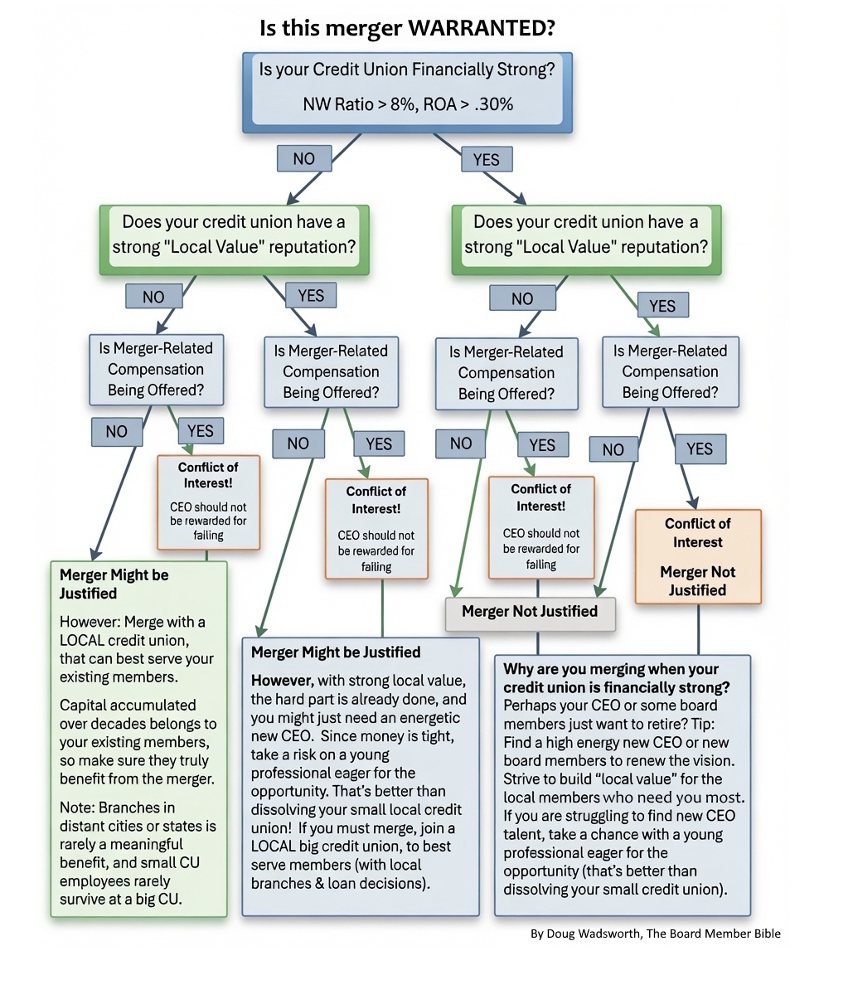
- Is the CEO getting a merger-related payout? That’s potentially a conflict of interest.
- Does the small credit union already have a strong “local value” reputation?
- Is the small credit union healthy with a NW Ratio over 10%? Heck, over 8% is healthy! This probably means you have extra capital that could be invested in evolving and improving (IE: You don’t need to merge).
- Exactly what are new products the big credit union will provide, that aren’t already available?
- Are those “expanded services” really just branches in distant locations (that your members will never use)?
- Is the big credit union going to provide the same level of friendly local service, especially for those of modest means?
No Consolation Prizes
Nobody should be rewarded for failing. You hired your CEO to keep your credit union healthy and independent while giving unique and superior value back to your members and community. If your credit union is struggling (and fault can be traced to the CEO), why should they receive a merger-related payout? The CEO should be rewarded for keeping the credit union healthy and independent, not for merging it out of existence.
Perhaps you just need to replace your CEO with someone who is young and passionate about the movement. Have you considered hiring a recent college graduate, eager to show what they can do?
Who Owns What
Part of understanding the ethics and morality around mergers, is recognizing ownership. Who does the credit union belong to? As financial cooperatives, our members are literally the owners. Your credit union capital (the money you have been savings up ever since your doors were opened), came from them. It’s like you have treasure chest in the vault that your members have been slowly filling up, for years. We are obligated to return excess profits back to those members, whether that means better rates, lower fees, better service or whatever.
That’s literally the reason we are tax-exempt.
When you merge with a big credit union that isn’t local, where does that member money go? Is it going for new branches and advertising in a distant city or state? How does that benefit your local members?
An Alarming Trend
In recent years the number of mergers has become alarming, and I have heard industry professionals admit that half of these mergers aren’t justified. When healthy small local credit unions disappear it doesn’t just disadvantage the members who lose their local institution—it also puts our entire movement at risk. The public generally sees large credit unions as indistinguishable from banks. If we allow all the small credit unions to disappear, the likelihood that our entire movement (including the tax exemption) will be lost, seems almost certain.
Perhaps you have more options than you realize, and you don’t have to merge. Small local credit unions are the heart of this cooperative movement. They make a difference for the people who need it most, especially those underserved by big banks. Keep it local. Keep it moral. Keep serving the members who own that credit union and thank you for your service!
If you found this useful, the full treatment (including practical guidance on board governance, financials, deciphering NCUA exam results, CEO oversight, and more) is in my new handbook written specifically for board members of small credit unions:
The Board Member Bible: For Small Credit Union Officials, available now on Amazon.
Doug Wadsworth is CEO of Tri-Cities Community Credit Union in Kennewick, Wash. Doug Wadsworth is also the president of a new non-profit advocacy group exclusively for small credit unions, the Endangered Small Credit Union Defense (www.endangeredsmallCUdefense.org). He can be reached at [email protected] or on LinkedIn here.




11 Responses
Thanks for saying the quiet part out loud. Finally someone who is willing to say what has needed to be said for years. One of the challenges is the CEOs who are coasting will not want their board to get this information. Sad but true in many instances.
So true, that is the real challenge here: getting this information in front of the boards that need it most!
-Doug
This is a very narrow, non-strategic and backward-looking decision frame. So, no circumstance that a merger is justified is if your ROA is over .30%? The most justified and strategic mergers are among financially healthy credit unions that ask themselves prospectively – do we have the products and services to serve our members’ future needs as they evolve? Are retaining members and are they satisfied? If not, why not? Do we have the capital to make those investments (and no, 8.01%) isn’t it. Do we have the talent and capability to govern and manage the organization? Can we afford to comply with regulations? There are many questions that drive whether a merger makes sense and they are all prospective, not whether last year’s earnings against assets were better than .30%.
CEO’s getting paid in a merger is not a bad thing. In a justified merger, when the CEO or others lose their jobs, they don’t deserve severance? CEO pay in a merger should not be a driver as to whether a merger is done or justified, rather it defines whether the terms of the merger are acceptable to both sides. It’s also in no way a formal conflict of interest. A CEO cannot approve a merger – the Board and membership does. Yes, there have been examples of excess pay, but that’s a breakdown in board governance, not a CEO conflict of interest. Sure, failure shouldn’t be rewarded, but if the Board doesn’t deal with a failing CEO, they’re going to end up paying him or her to leave with a termination without cause. Regarding pay, where is the question in this model or decision tree about whether the membership gets part of their capital paid out during the merger? That’s a far more relevant question than whether a CEO gets a reasonable payout.
I think most in the movement would agree small credit unions can serve consumers better than banks. That’s not the question. There is no case or proof that members and consumers can’t be better served by a larger credit union once they merge. In fact, the opposite is true.
So industry people say 50% of mergers are unjustified, eh? Funny how people are in a position to judge what’s best for someone else’s credit union. That comment and this model is a not-so-subtle dig on small CU Boards, and an afront to members of small credit unions who vote to approve mergers. Isn’t it up to members of acquiring credit unions to decide whether a merger is justified or not?
Finally, the whole premise that a chart drawn in crayons has to be provided to small credit union boards to educate them to prevent unjustified mergers in order to save the movement and tax exemption is wrong. There are indeed some large CU’s that don’t seem to align to the CU purpose, but the fraud and negligence among small CU’s while there is advocacy for more lax regulations is far bigger threat to the movement than anything else. Ask Senator Warren, and the ABA and ICBA, who haven’t missed the opportunity to exploit the fraud issue, as well as the most recent out of state purchase of a bank. CU’s wouldn’t need to buy banks, if more small CU’s took a long-term strategic view and properly assessed their long-term independent viability.
Hooray, my anonymous anti-small credit union troll is back!
I’m glad you liked my crayon flowchart. As acknowledged in my introduction: “There are truly instances when a merger might be the best solution for your credit union and your members.”
And it actually it isn’t just up to the members to vote, *first* it is up to the board of directors – who yes, need to be better educated and more aware of conflicts of interest, IMO.
Interesting you think members will be better served by big credit unions than small ones. While sometimes that is surely true (and the small CU should merge), that’s not what I have seen or experienced personally (having worked at both big and small CUs). Have you ever worked at a small credit union? I get the vibe you have not?
Thanks for the feedback though, always valuable to see other perspectives!
-Doug
I didn’t say it was only up to members. As I said, there is a dig here on small credit union boards that vote to merge and to bring to member vote.
Some data points. As of 3/2026, there were 2,466 credit unions with <=$100 million in assets. Of those, only:
*48% offer credit cards
*57% offer mortgages
*50% offer a home equity product
*13% offer business accounts
*17% offer their members point-of-sale auto financing (therefore making it less convenient)
*91% have 3 or less branches, while 45% have only 1 branch.
So less convenient and fewer products and services than larger CU's, and members are forced to split their banking relationship for core products (hint, this is one reason why small CU's have a hard time growing membership and assets)
And the human member experience? Large credit unions offer dog treats and balance old ladies checking accounts too. They're also when they answer the phone. Larger CU employees find purpose and fulfillment in their work, they build brand through community engagement, etc. It's easy to just declare that small credit unions can serve members better than larger ones, but are there objective facts and data to suggest that is true? It certainly isn't member retention and growth. Loyalty? Well, perhaps – members of small credit unions will be loyal and stick with their small CU, if they happen to offer the product they need.
Purpose driven leaders and employees are the heart of the movement, and they work in both large and small credit unions. It's not about asset size. Claiming the purpose high ground of the movement, while questioning larger CU's ability to serve their members just as well as smaller credit unions is divisive and unproductive. Why can't we all focus together on making sure all credit unions remain true to the movement, which is about purpose, but also includes having the capability to serve their members' financial needs?
Sure, most big credit unions are fantastic, and are vital to the movement, and if the small credit union simply is unable to provide good value that those members want, then merging might be best. Yep.
There is just no avoiding nature though – growing very big results in becoming more less personal, less local, less flexible, and less “Special Sauce” (NCUA Chairman Hauptman’s words, not mine).
For some specific examples of small credit union value (that sometimes beats large institutions) see here: https://www.endangeredcudefense.org/tiny-but-mighty
One of my supervisory auditors worked for a small credit union, she used to spend 30 minutes a month helping a special needs elderly woman balance her checkbook. Her small CU merged into a big one, and the big credit union told her that wasn’t allowed anymore, she was only allowed 2 minutes per member, and had to turn this old woman away. Yep, much of this is anecdotal. And most of the stories like this come from small credit unions – pretty much everybody acknowledges that (except you)?
I have worked at big and small Credit Unions, and this is the reality I have observed. Have you ever worked at a small credit union? I realize you don’t believe there is a credit union movement, as to you this is just an “industry” (as you admitted earlier), so I imagine we will never see eye-to-eye on this issue.
-Doug
That’s the big myth – that’s it’s by nature that CU’s become less personal, local or flexible as a function of size, like it’s linear or there is some arbitrary asset size where that happens. It’s not about where HQ is, it’s about impact in whatever community a CU serves. Less flexible, we not really sure how you can conclude or measure that. Go ask that small CU’s that fail for making bad loans because they were flexible, thought they really knew the member, didn’t treat them like a number like big CU’s so and all of that. I respect Kyle’s role as a regulator, but it’s true “because Kyle says so” is not persuasive in the least. Tell him to go lead a credit union for five years and we’ll listen.
For every story about how a small credit union serves its members – apparently in a way other CU’s can’t, there are 10 stories about how members are better served by the large CU they joined. After all, you are losing members, and they gotta go some where, right? Statements like “Pretty much everyone acknowledges that” is the problem. Was that from your survey of the 2,000 credit unions over 100 million in assets? Or is it true just because you said so?
I was in Rep Maxine Dexter’s office during GAC a few months ago and I was talking to one of her staffers about the small credit union difference. The staffer then told me personal story about how their small CU got merged into a big one, and how frustrating and sad it was, because the big CU just couldn’t replace the unique and personal touch they had loved at their small one. So, there’s that.
-Doug
I don’t know what a moral merger is, but there’s no such thing as an immoral merger that member owners vote to approve.
Doug, I love that you wrote this and your simple crayon chart is brilliant.
The anonymous troll’s argument that execs should get some sort of “severance” if they lose their job in a merger is laughable. Because, as you so eloquently crayoned out, a CEO should not be PAID to merge their credit union away. Period. It’s a conflict of interest and shame on the board that votes that in.
Here’s a radical idea. Let’s take that member capital that has been built up for decades and spread the love with a member dividend! And as far as severance, how about taking care of those tellers that are making minimum wage that are surely going to lose their jobs. You know, the ones that know the member’s by name, went to school with their daughter, babysit their kids……geez. The greed in this so called financial cooperative system is outrageous and disgusting.
I still can’t get over what the CEO of Wings Credit Union walked away with in that totally unnecessary merger.
Making millionaires with members’ money – merge your credit union today!
Denise
Merger-related pay for CEO’s and other execs is not inherently a conflict of interest. The NCUA recognizes CIC agreements as a common tool and there member disclosure requirements of pay. It’s simply a governance topic. There have cases of excess pay, but the cause is a breakdown in board governance and a breach of board fiduciary duty, not a CEO inflict of interest – those are two very different things.