WASHINGTON–There were three separate developments of interest to credit unions on Tuesday in Washington, including the president’s State of the Union address, a new bill to give CUs more access to the FHLBs, and a CU rep’s testimony during a hearing on auto loans and tax deductibility under a new law.
Below is a look at each:
Trump Touts New Accounts for Children During SOTU; ACU Urges CU Inclusion
During his State of the Union address, President Donald Trump addressed the so-caled “Trump accounts,” which were created by 2025’s H.R. 1 and which are tax-advantaged investment accounts that allow up to $5,000 in annual contributions, with a $1,000 federal pilot grant for eligible children born between Jan 1, 2025, and Dec 31, 2028. The parents of older children can also open accounts, but they won’t get the $1,000 bonus.
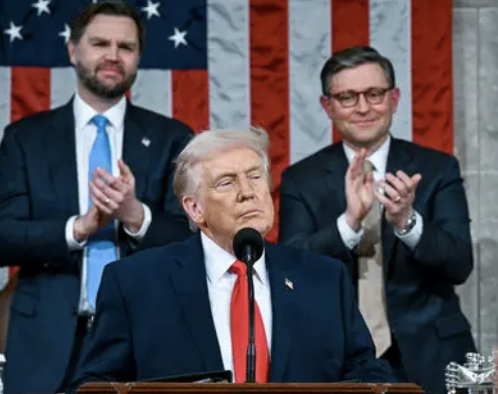
The money is to invested in the stock market by private firms and select banks, and the child can access the funds when they turn 18. Credit unions are currently not eligible to offer the accounts.
“America’s Credit Unions supports the President’s desire to increase affordability for working class families across our country. (Tuesday’s) address highlighted the importance of expanding access to safe, affordable financial tools that help Americans build stability over time,” America’s Credit Unions Simpson said in a statement. “Proposals like Trump Accounts reflect a growing recognition that long term financial security begins with access to trusted, community-based institutions. Credit unions stand ready to partner in these efforts by helping families save, borrow responsibly, and plan for the future with people-first financial services designed to prioritize their consumer members, not shareholders.”
Retirement Accounts Also Announced
Separately, Trump also announced a plan to offer retirement accounts matched by the federal government to workers without access to employer-matched plans during his State of the Union address.
“Half of all of working Americans still do not have access to a retirement plan with matching contributions from an employer,” Trump said. “To remedy this gross disparity, I’m announcing that next year my administration will give these oft-forgotten American workers, great people, the people that built our country, access to the same type of retirement plan offered to every federal worker. We will match your contribution with up to $1,000 each year, as we ensure that all Americans can profit from a rising stock market.”Legislation that would allow more CUs to join the FHLB system has been introduced in Congress, while separately a representative from credit unions testified before an IRS hearing on the deductibility of auto loan interest.
Bill Would Give More CUs Access to FHLBs
Reps. Vicente Gonzalez (D-TX) and Brian Fitzpatrick (R-PA) have introduced legislation that would allow more credit unions to join the Federal Home Loan Bank system.
America’s Credit Unions noted FHLBank members have access to reliable, low-cost liquidity, as well as financial and community services and products. Currently, FHLB member financial institutions must hold 10% of their assets in residential mortgage loans, but community financial institutions (CFIs) are exempt from the requirement.
The bill would specifically include credit unions in the CFI definition, expanding eligibility for FHLBank membership for more than 1,800 credit unions to join their regional FHLBank, according to America’s Credit Unions.
‘Common Sense Solution’
“America’s Credit Unions welcomes bipartisan legislation from Congressmen Vicente Gonzalez and Brian Fitzpatrick that would enhance credit unions’ ability to access the Federal Home Loan Bank system,” America’s Credit Unions President/CEO Scott Simpson said in a statement. “This bill is a common-sense solution that affirms what Congress has known for years, and that the Government Accountability Office recently confirmed: access to the FHLB system for small financial institutions improves their access to liquidity, lowering rates for consumers while maintaining their safety and soundness.
“Ultimately, expanding access to the FHLBs would benefit thousands of community-based credit unions and give them a powerful, safe tool to support homeownership, strengthen local communities, and help more people build financial security,” Simpson added.
View From Texas, Pennsylvania
Leaders of CU associations representing Pennsylvania and Texas also issued statements:
- “We appreciate the leadership of Reps. Vicente Gonzalez and Brian Fitzpatrick in recognizing that credit unions are vital community financial institutions,” Jim Phelps, executive vice president and chief advocacy officer with the Cornerstone League, said in a statement. “Access to the Federal Home Loan Bank system strengthens our ability to provide mortgages, manage liquidity, and serve members in good times and bad.”
- “We commend Representatives Fitzpatrick and Gonzalez for sponsoring this important legislation as a step toward ensuring credit unions have fair access to the Federal Home Loan Bank system,” Patrick Conway, president/CEO CrossState Credit Union Association, said in a statement. “When credit unions can fully participate in the FHLB, they are better positioned to expand mortgage lending, support local housing markets, and deliver long-term stability for the members and communities who rely on them. Expanding access strengthens not just credit unions, but the communities they serve.”
CU Rep Testifies During Hearing on Auto Loan Interest
Separately, delivering the credit union perspective directly to the Internal Revenue Service (IRS) and the Department of the Treasury to a public hearing regarding the implementation of auto loan interest tax deductions in H.R. 1, was America’s Credit Unions Head of Regulatory Advocacy James Akin.
The hearing addressed the proposal created by the legislation that implements the temporary federal income tax deduction for interest on certain passenger vehicle loans for tax years 2025–2028.
“America’s Credit Unions supports the statutory objective of providing targeted tax relief…[h]owever, without targeted refinements, the proposed rule risks imposing substantial implementation burdens on credit unions while creating uncertainty for borrowers attempting to claim the deduction.” Akin said.
Other Concerns Shared
The trade group said Akin reiterated concerns America’s Credit Unions detailed in written comments filed earlier this month on the proposal, most notably that the proposal would require credit unions to determine whether a loan is covered by the statute, even though they may not have all the information needed to make the determination. Instead of placing this requirement on lenders, Akin stated that borrowers should be responsible for determining whether a vehicle loan qualifies.
America’s Credit Unions said another significant concern raised is that the proposed exclusion of negative equity from qualifying indebtedness is unworkable for lenders and Akin urged the IRS to remove it entirely.