
ORLANDO, Fla.–The CEO of one company that provides a digital banking platform and other services has shared some insights into what he said has become a “turning point” in what members and consumers are looking for in their digital interactions, as well thoughts on where credit unions have the opportunity to now fit among tier one banks, neo-banks and other providers.
Brendan Tansill, CEO of Candescent, told attendees at the company’s AXIS Conference that the Atlanta-based that it’s that evolution that has led to the company’s pivot toward “Intelligent Banking” (see related story).
Three Dynamics
Tansill touched on three theme driving the change.
“The first is rising expectations,” Tansill said. “Customers and members expect their banks and credit unions to understand them, to anticipate needs, and to act in the moment. People expect intelligent financial experiences that match the best consumer experiences anywhere. For regional financial institutions, this expectation goes over even deeper.”
Tansill said the second dynamic is intensifying competitive pressure institutions as the result of competition on speed experience and relevance, from megabanks, neo banks and new models.
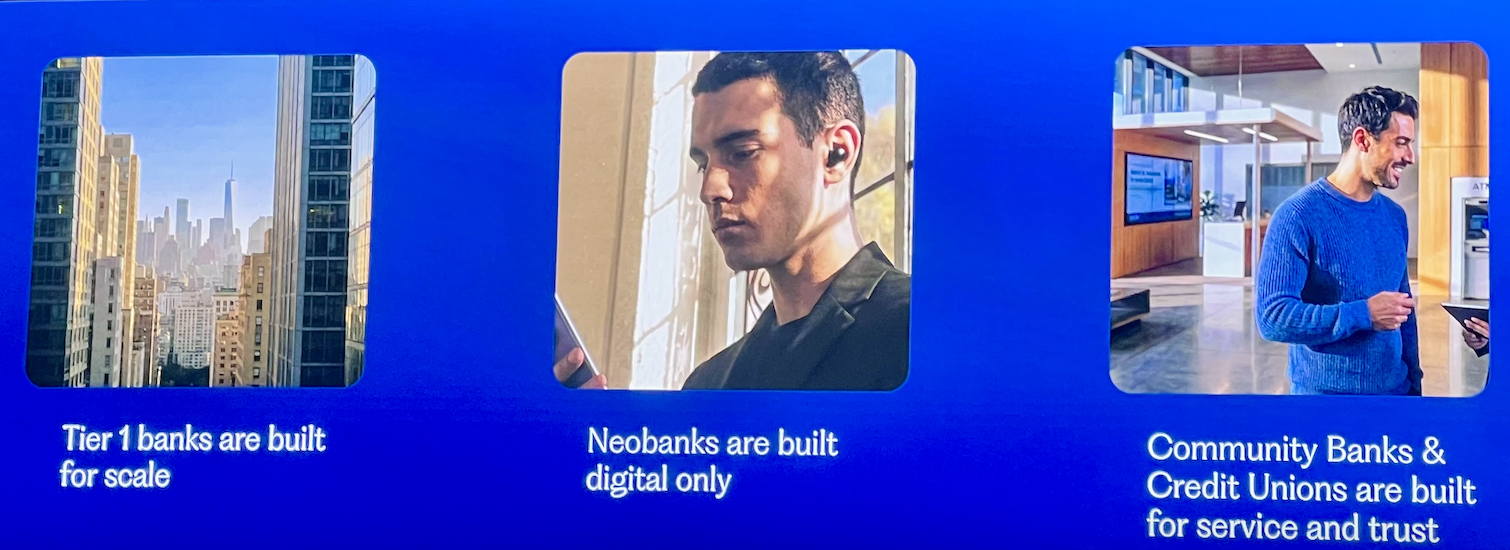
“I want to spend a moment on this topic,” said Tansill. “Tier one banks were built to scale across products markets and regulations. Neobanks were built to be digital only, optimized for speed and simplicity. Community banks and credit unions were built to serve. They are rooted in trust relationship and human service.
No Longer Forced to Choose
“The tier one banks deliver reliable and efficient but largely undifferentiated experiences,” Tansill continued. “Neo banks deliver fast, intuitive service, but it’s mostly transactional experiences. Community banks and credit unions deliver high trust, but lack the digital scale to keep pace, and as a consequence of all, and for too long choosing between the community bank or a credit union has meant compromising. Digital customers have been forced to choose between trust and technology.”
The third change-driver is artificial intelligence, Tansill told the meeting.
“AI is becoming foundational, not as a feature but as a core capability,” he said. “What took years can now be delivered in months. AI is raising the bar for personalization service and relevance.”
A Turning Point
Together, all of those forces mark what Tansill called a “turning point” in the marketplace.
“The shift that’s happening across our industry sets the stage for what comes next,” Tansill said. “This is intelligent thinking. The data relation and platform depth built over the last three decades make intelligent banking possible. This is where the playing field begins to level, where banks and credit unions can compete on experience relevance and intelligence, and not just size. It’s where technology becomes an equalizer, not a divider.”