BOSTON — Credit card issuers are increasingly capturing consumer demand for installment payments, outpacing standalone buy now, pay later providers by integrating similar payment options directly into existing credit card accounts, according to new research from PYMNTS Intelligence.
The findings, published in the firm’s latest “Pay Later Ecosystem Report,” suggest that while consumers continue to embrace installment payments, many are choosing to finance purchases through their credit cards rather than through traditional buy now, pay later (BNPL) providers.
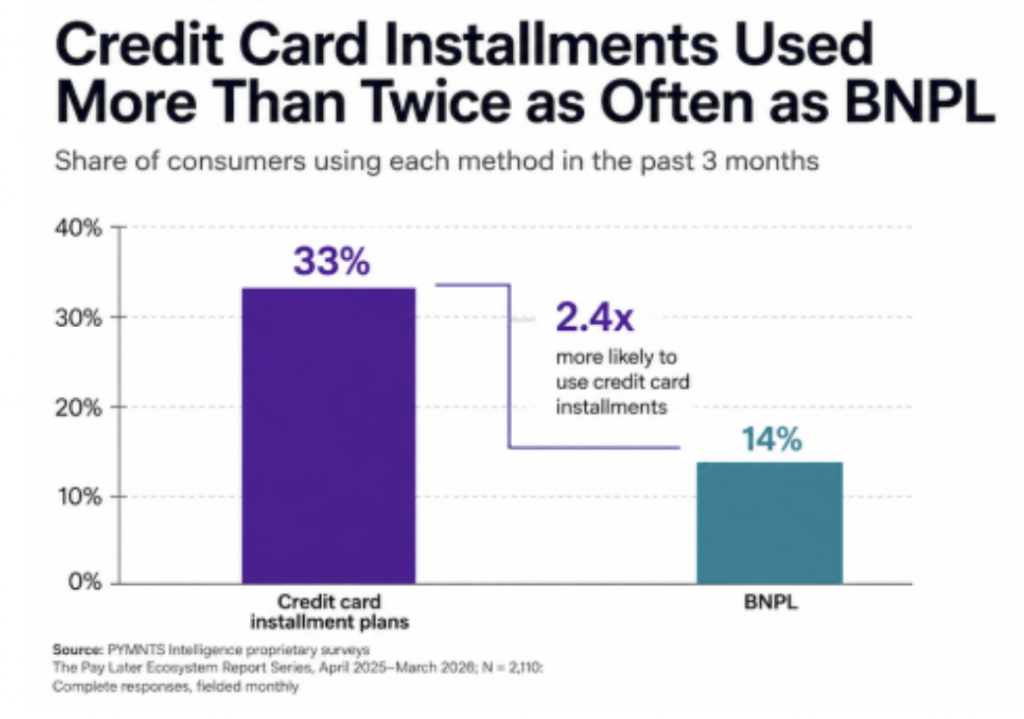
According to PYMNTS Intelligence, 33% of consumers reported using credit card installment plans in March 2026, up from 23% in April 2025. By comparison, BNPL usage edged down slightly to 14% from 15% over the same period.
Twice the Rate
The report found consumers used credit card installment plans at more than twice the rate of standalone BNPL services across eight separate surveys.
PYMNTS Intelligence said the trend reflects consumers’ preference for accessing installment payment options through financial relationships they already have rather than adopting an additional payment provider. Many credit card issuers now offer the ability to convert eligible purchases into fixed monthly payments directly within existing card accounts.
The shift was especially pronounced among younger consumers. Nearly half, or 47%, of Generation Z respondents reported using credit card installment plans in March, compared with 23% who used BNPL services. Gen Z adoption of credit card installments increased from 31% in April 2025, while BNPL usage among the group rose only modestly from 21% to 23%, according to the report.
Millennials and so-called bridge millennials showed similar adoption patterns, the research found.
Perception Challenged
The report also challenged the perception that BNPL is primarily a tool for lower-income households. According to PYMNTS Intelligence, 20% of consumers with annual incomes of at least $150,000 used BNPL services in March, compared with 10% of consumers earning less than $50,000. In November, those figures were 22% and 7%, respectively.
The findings suggest consumers increasingly view installment payments as a budgeting and cash-flow management tool rather than solely a source of short-term financing, PYMNTS Intelligence said.
The findings are based on surveys of approximately 2,500 U.S. adults conducted by PYMNTS Intelligence.