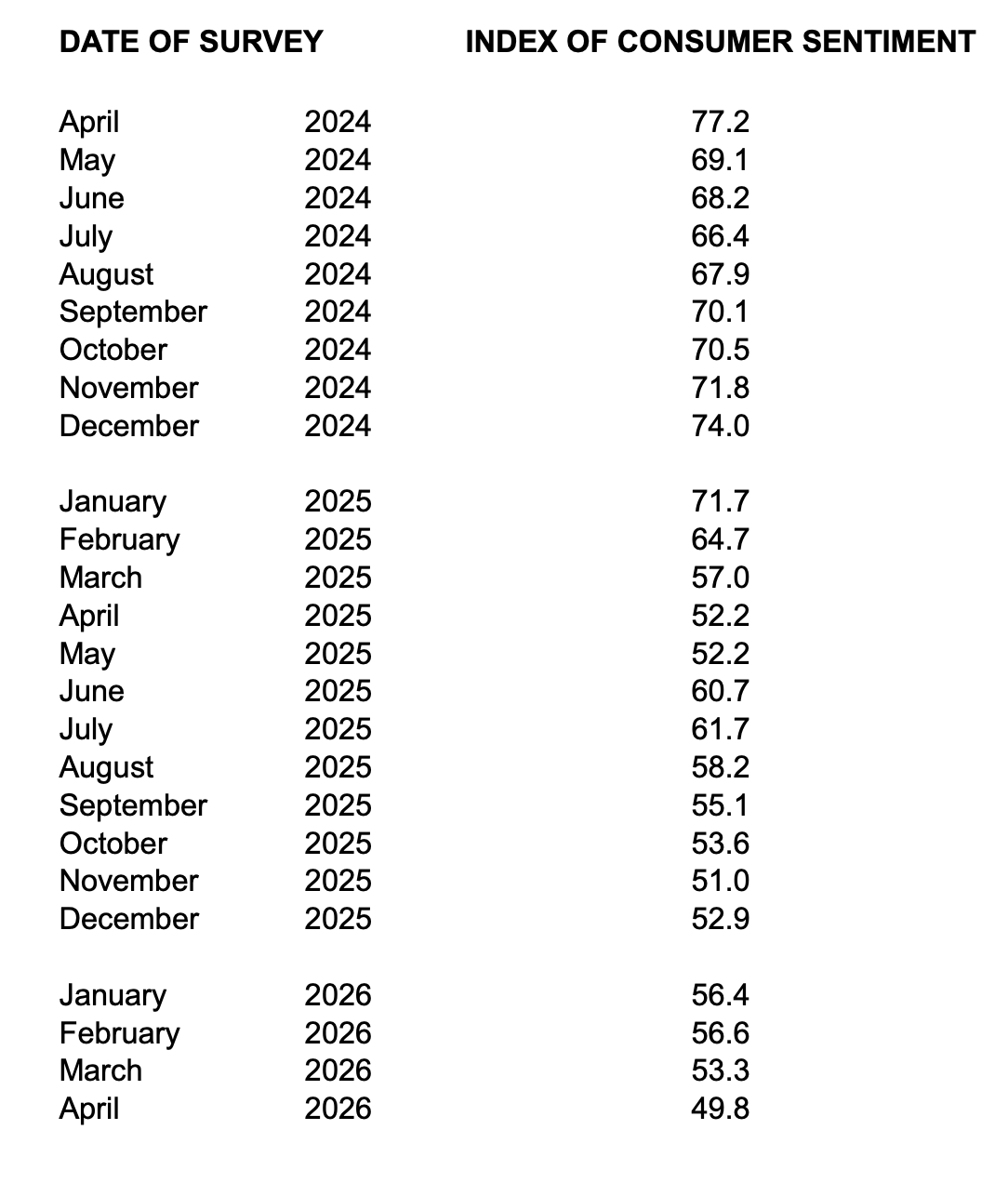
ANN ARBOR, Mich.—Rising gasoline prices tied to the Iran conflict pushed U.S. consumer sentiment in April to the lowest level in more than seven decades, according to the University of Michigan’s latest Index of Consumer Sentiment.
The index fell 3.5 points to 49.8 in April, marking the lowest reading in the survey’s 73-year history, according to the university’s Surveys of Consumers.
“The Iran conflict appears to influence consumer views primarily through shocks to gasoline and potentially other prices,” Surveys of Consumers Director Joanne Hsu said in the report. “In contrast, military and diplomatic developments that do not lift supply constraints or lower energy prices are unlikely to buoy consumers.”
The report found a clear link between gas prices and sentiment during the month. A temporary easing in fuel prices following the announcement of a two-week ceasefire earlier in April coincided with a modest improvement in consumer sentiment, before declining again as prices rose.
Broad-Based Decline
April’s drop in sentiment was broad-based, cutting across political affiliation, income levels, age groups and educational backgrounds, the survey said.
Consumers also grew more pessimistic about the economic outlook. Expectations for business conditions in both the short and long term fell to levels roughly comparable to those seen a year earlier when tariffs were implemented, according to the survey.
Inflation expectations increased sharply. Year-ahead inflation expectations jumped from 3.8% in March to 4.7% in April, the largest one-month increase since April 2025. Long-run inflation expectations rose to 3.5%, the highest level since October, the report said.
A Mixed Picture
A separate measure from The Conference Board showed a more mixed picture earlier in the period. Its Consumer Confidence Index, released March 31, found consumer confidence edged higher in March despite rising costs linked to tariffs and the war.
While those cost pressures were not fully reflected in headline or component indexes, they were evident in consumers’ inflation expectations over the next 12 months, which climbed to their highest level since August, the organization said.
“Consumers’ write-in responses on factors affecting the economy continued to skew towards pessimism,” Dana M. Peterson said in a statement. “Comments about prices and the cost of goods suggest that the cost of living remained at the top of consumers’ minds.”