

TAMPA, Fla.– Transactions and purchases for April remained strong for both debit and credit, according to the May edition of Velera’s Payments Index.
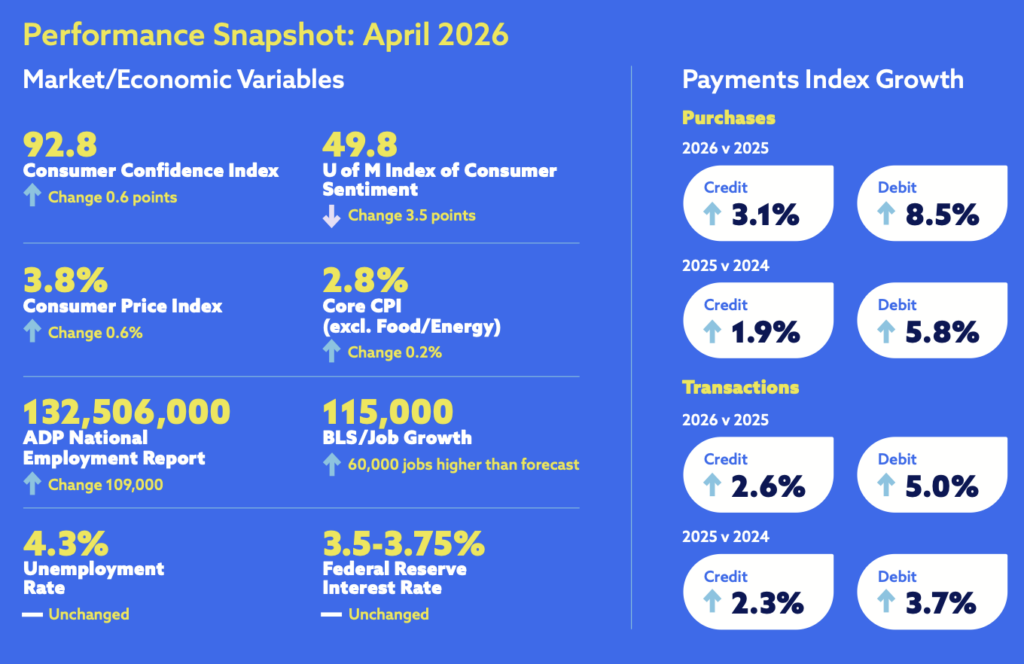
The new report, which takes a deep dive into digital payments, found debit purchases increased by 8.5%, with the Money Services, Goods and Gasoline sectors accounting for three-quarters of that growth. Credit purchases were up 3.1%, with Gasoline accounting for 35% of the entire increase. In April, debit transactions were up 5%, and credit transactions rose by 2.6%, Velera said.
In addition, the data reveal digital wallets continued to gain momentum. Year to date through April, digital wallets accounted for 12% of all debit transactions, up from 9% a year earlier, and 7% of all credit transactions, up from 6%, according to Velera.
Foot on the Gas
“Despite a sharp increase in gasoline prices, consumers kept spending in April, posting strong growth in debit and credit card transactions and purchases,” Velera reported. “As of May 11, the average price for a gallon of gasoline was $4.50 – 44% higher than a year ago and 53% higher (or $1.56) since the war with Iran began on Feb. 23. On April 30, President Trump signed into law a measure that funded Homeland Security, which includes TSA but excludes Immigration and Customs Enforcement (ICE) and part of Customs and Border Protection (CBP). TSA funding arrives in time for the start of the summer travel season, which kicks off with the Memorial Day holiday at the end of the month.”
Other Data & Findings
The new Velera Payments Index offers an update on numerous areas, including:
Consumer Sentiment Declines
- For April 2026, the University of Michigan Index of Consumer Sentiment dropped 6.6% from March (53.3), to 49.8. Velera noted the reduction was apparent across all demographics (age, income, education and political party). The war in Iran continues to influence consumer sentiment, as it affects gasoline prices and overall inflationary pressures. In preliminary May results, the Index of Consumer Sentiment lightly softened 1.6 points to 48.2. For April, the Conference Board reported that consumer sentiment in the Consumer Confidence Index edged up 0.6 points to 92.8. Despite notable concerns over gasoline prices, overall sentiment remained about the same for April.
The Jobs Picture
- The Bureau of Labor Statistics (BLS) reported that jobs grew by 115,000 positions in April. The unemployment rate remained unchanged at 4.3%, or 7.2 million people. Jobs grew by more than twice the estimate of the WSJ poll of economists to 55,000 positions for the month. April job gains were noted in health care, transportation and warehousing, and retail trade. Job losses in federal government positions continued in April.
The April ADP jobs report, which tracks changes in U.S. private employment, reported an increase of 109,000 jobs. Increases were posted in the education and health services, trade, transportation and utilities, construction, and financial activities sectors. Job reductions were noted in the professional and business services sector. Most of the growth was found in small-sized companies (1-49 employees) and large-sized companies (500+ employees) within the ADP payroll population, which represents more than 26 million U.S. private-sector employees.
The Pace of Inflation
- For April, the BLS reported a 0.6% increase in inflation, raising the 12-month Consumer Price Index (CPI) to 3.8%. The Energy index was again the largest contributor to the monthly increase, up 3.8% and accounting for 40% of the overall increase. Also increasing for April were the shelter and food categories. Core CPI, which excludes food and energy, rose 0.4% in April, finishing the month at 2.8%.
Categories contributing to the Core CPI increase included household furnishings and operations, airline fares, personal care, apparel and education. Reductions were recorded in the new vehicle, communication and medical care indexes for April.

Interest Rates
- Interest rates were left unchanged from the FOMC meeting that ended on April 29. This most recent Federal Reserve meeting was the last under Jerome Powell’s leadership as the Chair, as his term expired on May 15. He is expected to remain on the Board of Governors, where his term runs through January 2028.
President Trump’s nominee to succeed Powell, Kevin Warsh, cleared the Senate Banking Committee vote on May 13 and was confirmed as the new Chair of the Federal Reserve by a mainly partisan vote of 54-45, with one Democrat voting for Mr. Warsh. This marked the narrowest of margins since Senate approval was established in 1977. The next scheduled FOMC meeting is set to conclude on June 17.
‘Familiar But Important Theme’
“April’s data reinforces a familiar but important theme: even as higher gas prices and renewed inflation pressures weigh on sentiment, consumer spending behavior has remained steady,” Cody Banks, SVP, product experience & enablement with Velera, said in a statement. “Debit and credit activity continued to grow, with an increasing share of that activity shifting toward digital and tokenized payment experiences. While factors such as tax refunds provided near‑term support, the broader takeaway is the continued adaptability of consumers and the growing role digital payments play in how everyday spending is managed. For credit unions, this underscores the importance of closely monitoring where spend is evolving and ensuring digital capabilities keep pace with changing consumer expectations.”
The full report is available for download here.



