

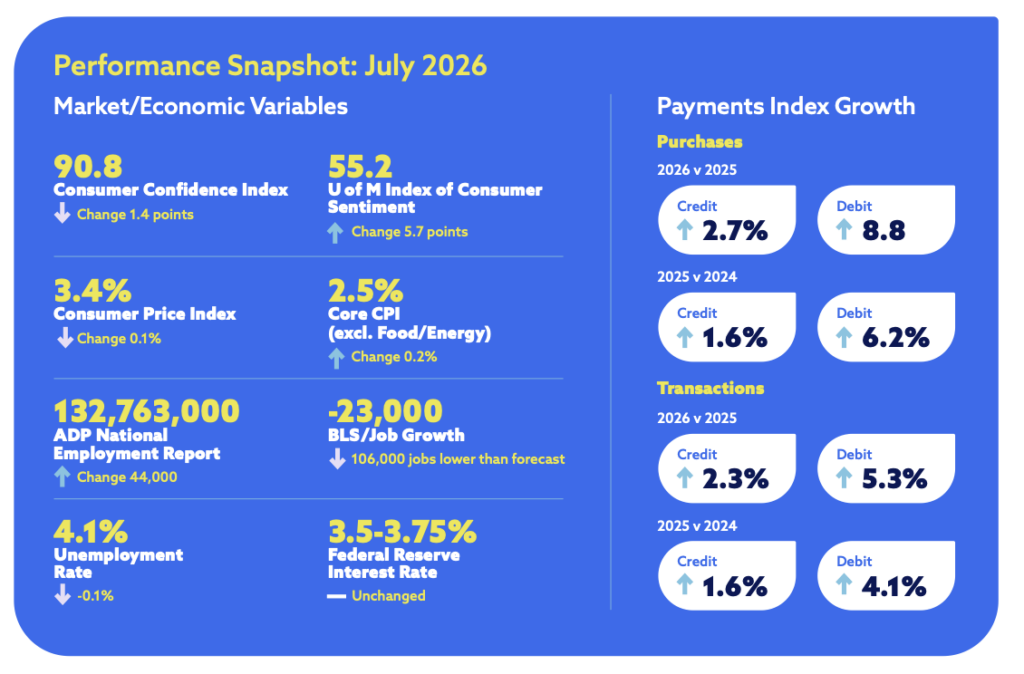
TAMPA, Fla. — Debit card purchases grew 8.8% year over year in July, more than three times the 2.7% increase in credit card purchases, as consumers continued spending despite signs of a softer labor market and lingering concerns about the economy, according to new data from Velera.
The payments CUSO’s August Payments Index found debit continued to lead card spending growth during the month, while credit purchase growth remained positive but moderated from recent highs.
Early back-to-school shopping helped support July spending, Velera said, although year-over-year comparisons were affected by Amazon and other major retailers shifting promotional sales events that occurred in July 2025 into June this year.
Key Card Findings
Among the key July card-spending findings:
- Debit purchases increased 8.8% year over year, with Money Services, Goods and Gasoline among the primary contributors to growth.
- Credit purchases increased 2.7% year over year, with Gasoline and Services among the leading contributors.
- Early back-to-school shopping helped offset some of the impact from major promotional retail events moving from July last year to June this year.
- Business credit cards represented just 3.2% of overall credit transactions and 8.4% of credit purchases year to date, but outperformed consumer credit cards in transactions per account, purchases per account, average purchase amount and average interchange rate.
- At the smaller financial institutions studied, business cards accounted for 25.8% of credit card transactions and 42.7% of credit card purchase volume year to date, suggesting a potentially larger opportunity for credit unions serving small and midsize businesses.
Why Findings are Significant
Velera said the business card findings are significant because business cards represent a relatively small portion of the overall card market but generate greater activity on several measures than consumer credit cards.
“Business cards may represent a smaller share of overall card activity, but they point to a meaningful opportunity for credit unions,” Sheba Carnes, vice president of product management at Velera, said in a statement.
Carnes said small businesses can represent highly engaged relationships for credit unions, particularly as companies grow and need additional payment and financial-management services.
“As these businesses expand, credit unions have an opportunity to grow with them by offering the payment solutions, expense management tools and financial support that help them manage cash flow, separate business and personal spending, and deepen the relationship over time,” Carnes said.
Economic Picture Remains Mixed
Velera said July’s spending growth occurred against a mixed economic backdrop that included improving inflation data and some measures of consumer sentiment, but weakening employment conditions.
Supporting findings include:

- The University of Michigan’s Index of Consumer Sentiment increased to 55.2 in July, up 11.5% from June and marking a second consecutive monthly increase, according to data cited by Velera. Sentiment, however, remained 11% below its year-ago level.
- The Conference Board’s Consumer Confidence Index moved in the opposite direction, declining 1.4 points to 90.8 from an upwardly revised 92.2 in June.
Velera said lower gasoline prices and resilient consumer spending contributed to the improvement in the University of Michigan measure, although elevated prices continued to weigh on households’ views of the economy.
Labor Market
The labor market showed signs of weakening in July. The Bureau of Labor Statistics reported a loss of 23,000 jobs, compared with economists’ expectations for an increase of 83,000, according to data cited by Velera.
The unemployment rate declined to 4.1%, while the labor force participation rate slipped to 61.4%. Wage growth moderated to 3.15%.
Employment declined in local government, education and retail trade, while health care added jobs, Velera said.
Separately, ADP reported private-sector payrolls increased by 44,000 jobs in July, although hiring slowed from the previous month and came in below expectations. Employment gains were concentrated in education and health services, financial activities and professional and business services.
Inflation Eases Slightly
Inflation provided a somewhat more favorable backdrop for consumers in July, according to the index.
The Consumer Price Index increased 0.1% for the month, bringing the annual inflation rate to 3.4%, down from 3.5% in June. Shelter accounted for roughly two-thirds of the monthly increase, while medical care, airline fares and food away from home also rose.
Declines in energy and motor vehicle insurance helped offset those increases. Core CPI, which excludes food and energy, rose 0.2% after being unchanged in June.
Upcoming Fed Meeting
Velera noted the Federal Open Market Committee is widely expected to leave interest rates unchanged at its Sept. 15-16 meeting. The meeting is also scheduled to include an updated Summary of Economic Projections outlining policymakers’ expectations for economic growth, inflation, unemployment and interest rates.
Velera is a payments CUSO and financial technology solutions provider serving credit unions and other financial institutions.
For the full report, go here.



