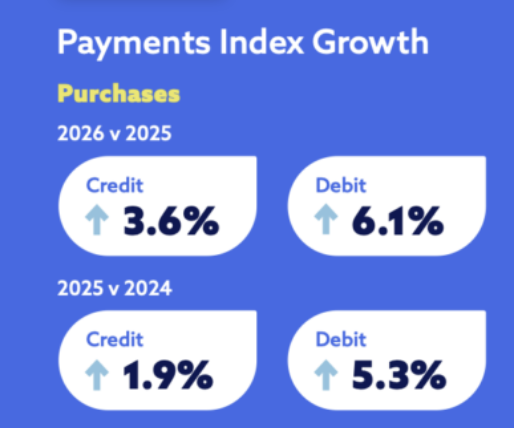
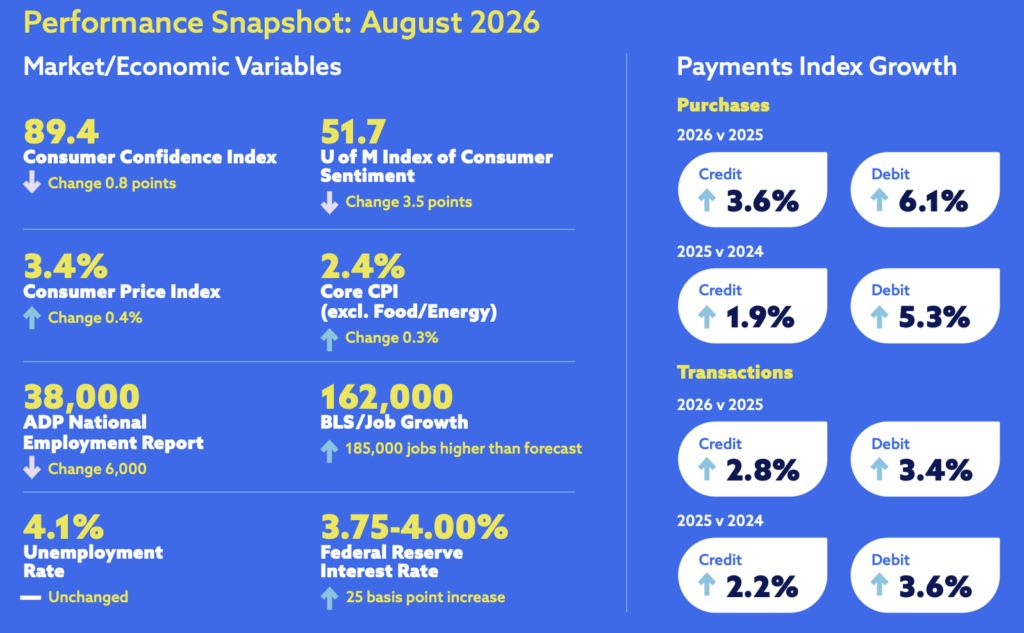
TAMPA, Fla.—Debit card spending among credit union members continued to significantly outpace credit card growth in August, with debit purchases rising 6.1% from a year earlier compared with a 3.6% increase in credit purchases, according to the latest Velera Payments Index, which also takes a deep dive into the use of credit union cards in prediction markets and online gambling.
Velera said debit transactions increased 3.4% year over year during August, while credit transactions rose 2.8%. The results indicate consumers continued to spend despite persistent inflation, higher gasoline prices and weakening measures of consumer confidence.
The September Payments Index is based on activity at credit unions processing with Velera and represents 3.8 billion credit and debit transactions totaling $196 billion during the 12 months ended in August. Velera uses a “same-store” population of credit unions to make year-over-year comparisons.
Velera said debit purchase growth accelerated from the 5.3% year-over-year increase recorded in August 2025, while credit purchase growth strengthened from 1.9% a year earlier.
The money services, goods and gasoline categories were the primary contributors to debit purchase growth in August. Gasoline was the largest contributor to credit purchase growth, followed by goods and services. Goods remained the leading contributor to transaction growth across both debit and credit cards, supported in part by back-to-school spending.
Gambling and Prediction Markets Gain Ground
The report also examined what Velera described as the rapidly growing use of credit union debit cards for online gambling and prediction markets, particularly among younger consumers.
Although those transactions remain a relatively small portion of overall card activity, Velera said their growth is substantially exceeding broader consumer spending trends.
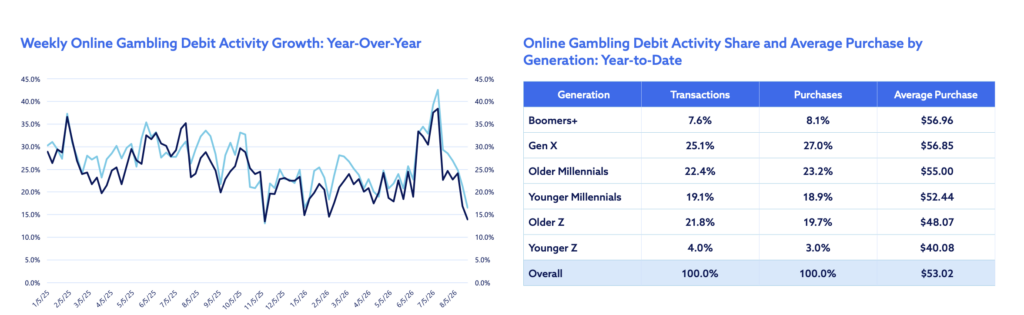
Through August, online gambling debit transactions were up 21.8% year over year, while purchases increased 25.4%. Activity received an additional boost during the FIFA World Cup, which was held in North America from June 11 through July 19.
Normally, Velera said, online gambling activity declines during the summer before increasing with the start of college and professional football. That seasonal decline was delayed this year as World Cup wagering kept activity elevated through July before it dropped in August.
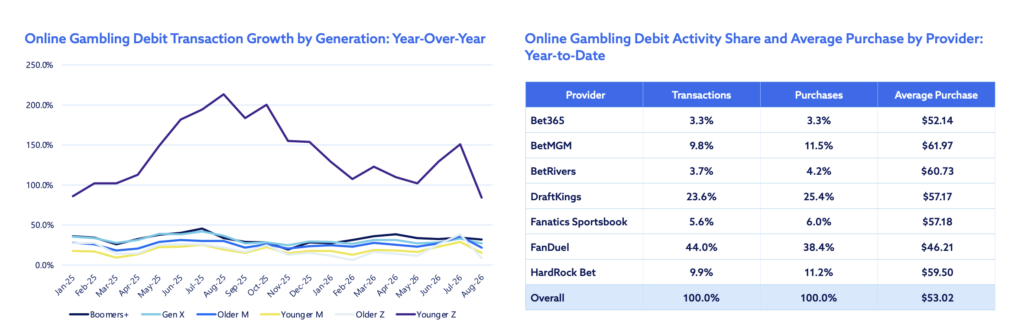
FanDuel and DraftKings together accounted for roughly two-thirds of year-to-date online gambling debit activity. FanDuel represented 44% of transactions and 38.4% of purchases, while DraftKings accounted for 23.6% of transactions and 25.4% of purchases. The average online gambling debit purchase across providers was $53.02.
Gen Z Driving Prediction Markets
Growth was even more pronounced in prediction markets, where consumers buy and sell contracts tied to the outcomes of future events.
Velera found Gen Z consumers accounted for nearly two-thirds of year-to-date prediction market debit transactions and purchases. Younger Gen Z alone represented 36.6% of transactions and 26.9% of purchases, while older Gen Z accounted for another 29.8% of transactions and 31.2% of purchases.
The younger consumers, however, tended to make smaller wagers. Younger Gen Z had an average prediction-market debit purchase of $42.82, compared with $98.33 among baby boomers and older consumers, Velera found.
Kalshi dominated the activity tracked by Velera, accounting for 87.8% of prediction-market debit transactions and 83.5% of purchases year to date. Polymarket US represented 6.8% of transactions, DraftKings Predictions 4.8% and FanDuel Predicts less than 1%.
Prediction-market activity increased sharply around the World Cup. Velera said weekly debit activity at one point exceeded 700% of the level recorded during the first week of 2026, with particularly strong activity during the tournament’s knockout rounds.
What It Means for Credit Unions
Velera said the growth of gambling and prediction markets creates new issues for credit unions involving fraud prevention, financial wellness and member education.
“Online gambling and prediction markets are a small share of overall card activity, but they’re moving into the mainstream faster than many financial institutions expected, particularly among younger consumers,” Karen Postma, Velera’s senior vice president of risk solutions, said in the report.
Postma said the concentration of prediction-market activity among Gen Z, combined with changing regulation and risks associated with market manipulation, means credit unions should understand the activity appearing in members’ accounts and consider whether fraud strategies and financial education efforts are keeping pace.
Velera recommended credit unions use transaction data to identify changing member financial behavior and consider responding with budgeting tools, savings incentives, financial wellness information and personalized guidance.
The company also said prediction-market platforms increasingly market themselves as investment and wealth-building products rather than gambling. That creates potential competition for younger consumers’ wallet share and gives credit unions an opportunity to emphasize savings, investment and wealth-management alternatives, Velera said.
Higher Rates Add Another Consideration
The report also urged credit unions to pay attention to their deposit mix and funding structure following the Federal Reserve’s Sept. 16 increase in interest rates.
Velera said a rising-rate environment can initially benefit earnings because assets typically reprice faster than deposits. Over time, however, deposit and other funding costs catch up, putting pressure on margins, particularly at credit unions holding fixed- or non-variable-rate credit card portfolios.
The company recommended credit unions evaluate deposit pricing and stability, reliance on higher-cost funding and the effects of rising funding costs on loan pricing and portfolio returns. It also recommended scenario planning around different interest-rate paths, deposit movements and changes in member behavior.
The September Payments Index comes as consumers continue to contend with elevated prices. Velera cited an annual inflation rate of 3.4% in August, with gasoline accounting for more than one-third of the monthly increase in consumer prices. At the same time, the University of Michigan’s consumer sentiment index declined for a second consecutive month, while the Conference Board’s Consumer Confidence Index also edged lower.
Despite those pressures, Velera said the August card data indicate credit union members continued to spend, with debit cards showing particularly strong growth.