
MINNEAPOLIS — Small business owners remain optimistic about growth despite economic pressures, rising costs and increased competition, with younger entrepreneurs showing a greater willingness to pursue aggressive expansion strategies, according to a new survey released by U.S. Bank.
The bank’s fourth annual Small Business Perspective survey found that 68% of small business owners reported growth over the past year, down from 88% in 2025, while 83% said they are optimistic about the next 12 months, compared with 93% a year earlier.
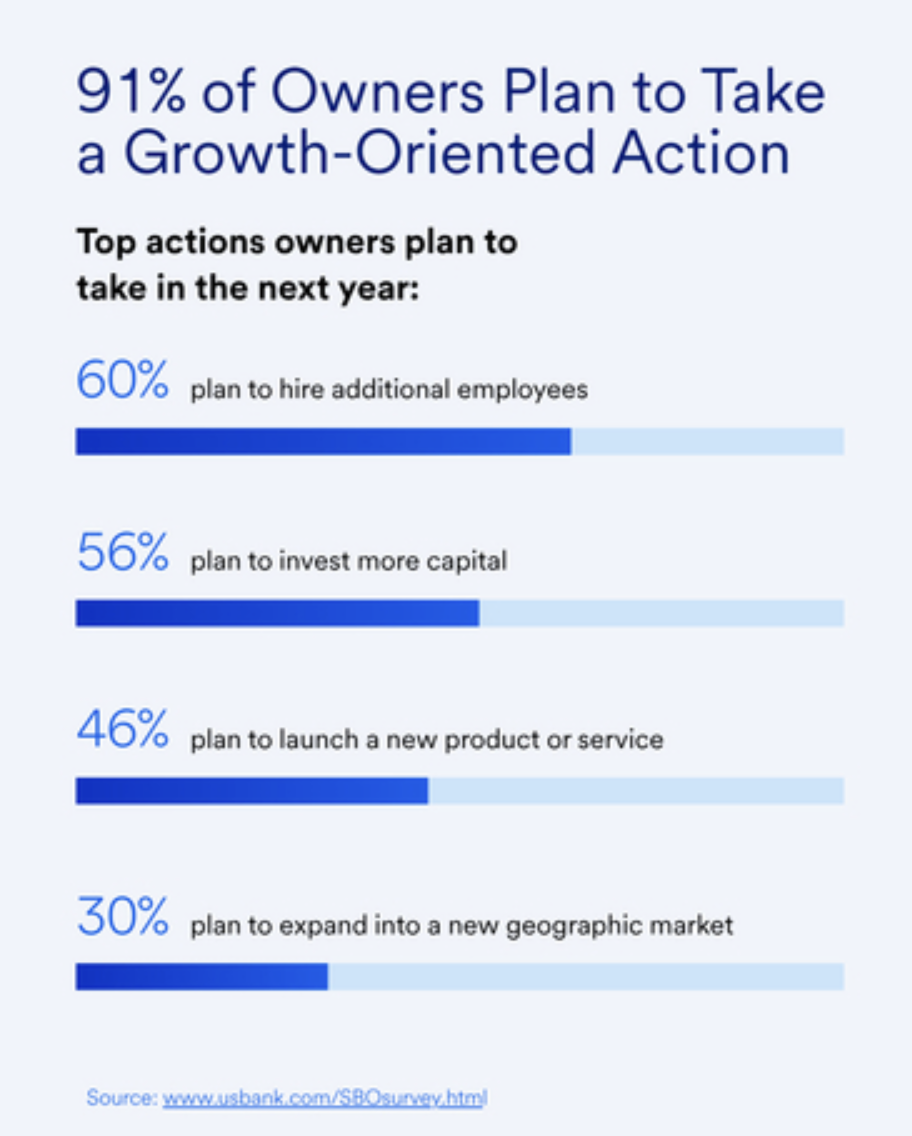
Still, 91% of business owners said they plan to take at least one action aimed at growing their businesses over the next year.
‘Not Pulling Back’
“Growth may not be as widespread as it was a year ago, but small business owners are not pulling back,” Shruti Patel, chief product officer for business banking at U.S. Bank, said in a statement accompanying the report. “That speaks to the resilience of this community and their determination to keep building for the future.”
The survey, which included 1,000 U.S. small business owners and an oversample of 200 Generation Z business owners, found younger entrepreneurs are approaching business growth differently than previous generations.
The Findings
Among the findings, according to U.S. Bank:
- Gen Z owners are more likely than older business owners to pursue what the bank described as calculated but ambitious growth opportunities. Nearly three-quarters, or 74%, reported business growth during the past year, while 47% said they experienced significant growth, the highest percentage among all generations surveyed.
- Many Gen Z entrepreneurs are launching businesses from passion projects or side hustles rather than purchasing existing companies. The survey found 63% started businesses based on personal interests and 49% evolved side ventures into full-time enterprises.
Growth Requires Sacrifices
That growth-oriented approach often comes with personal and financial sacrifices, according to the report. Thirty percent of Gen Z owners said they have delayed purchasing a home, while 25% postponed having children and 21% delayed marriage to focus on their businesses.

The survey also found that 38% of Gen Z-owned businesses generate less than $100,000 in annual revenue, and 87% said a three-month decline in revenue would affect their personal finances.
Across all generations, owners cited economic conditions, inflation and rising costs as their biggest challenges. Ninety percent reported strain from the broader economic environment, 88% pointed to inflation and rising costs, 82% cited competition and 71% identified access to capital as a concern.
Despite those challenges, 87% of owners described their businesses as successful, though that figure was down from 96% in last year’s survey.
Continuing to Invest
Many owners said they plan to continue investing in growth.
- 60% expect to hire additional employees
- 56% plan to invest more capital in their businesses
- 46% intend to introduce new products or services.
- Only 3% said they expect to sell their businesses within the next year.
The survey also found a growing divide between businesses that are expanding and those that are not. Growing businesses were less likely to report concerns about economic conditions, consumer spending and access to capital. They were also more likely to adopt artificial intelligence tools.
Small Business and Gen AI
Generative AI usage among small business owners rose to 75%, according to the report. Owners most frequently use AI for marketing and sales, data analysis, content creation and automation.
Among AI users, 98% said the technology has had a positive impact on their business, while 89% reported measurable value and 84% said it has helped reduce costs.
“However, adoption remains uneven,” U.S. Bank reported. “One-quarter of business owners said they do not use AI, citing concerns over relevance, return on investment and trust. Even among users, 53% reported experiencing negative effects, including added complexity and benefits that failed to meet expectations.”
Beyond AI, owners reported increasing use of payment-processing tools, digital payment platforms and accounts payable and receivable systems as they seek greater efficiency.
Cost Predictability an Issue
Cost predictability remains a major factor in purchasing decisions, according to U.S. Bank. Ninety-two percent of owners said they prefer business tools with consistent and predictable fees, while 78% said fees influence how they pay bills and 65% identified fees as a significant frustration.
At the same time, 83% said they are willing to pay fees if they receive convenience and value in return.
When evaluating financial institutions, owners said human support, mobile banking capabilities and fraud protection were among their top priorities.
The survey also found growing interest in digital currencies. While only 28% of owners currently accept digital currencies such as cryptocurrencies, stablecoins or tokenized deposits as online payment, 53% of those who do not currently accept them said they are likely to do so within the next five years.
Additional Findings
Additional findings from the survey include:
- 24% of Gen Z owners said they pursue bold growth opportunities, compared with 21% of Millennials and 13% of Gen X and Baby Boomer owners.
- Businesses experiencing growth were less likely to report pressure from the economic environment (88% versus 94% among non-growing businesses).
- Growing businesses were less likely to cite consumer spending as a challenge (75% versus 85%).
- Growing businesses were less likely to identify access to capital as a concern (67% versus 80%).
- 81% of growing businesses use generative AI, compared with 64% of businesses that are not growing.
- The most common uses of AI were marketing and sales (56%), data analysis (51%), content creation (51%) and automation (44%).
- Adoption of operational technology continues to increase, with 60% using payment-processing solutions, 53% using digital payment tools and 53% using accounts payable and receivable platforms.
- Human support from financial institutions was cited as essential by 91% of owners.
- Mobile banking access was considered essential by 90% of respondents.
- Fraud protection ranked as essential for 88% of business owners.
The findings are based on a 20-minute survey conducted among 1,000 U.S. small business owners.
For the full survey, go here.