

POIPU, Kauai — Artificial intelligence has the potential to turn ideas into results at credit unions, but only if its real benefits are understood and leaders ask the right questions, CU board members were told here.
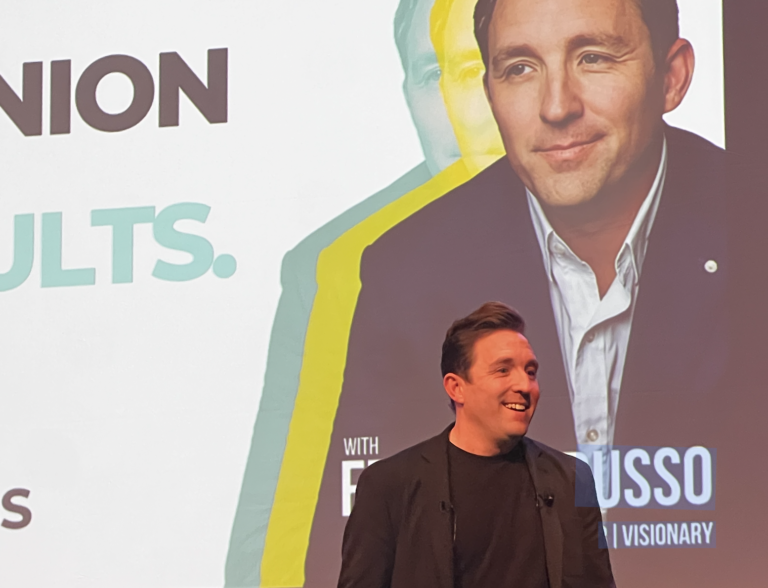
Speaking at Rochdale’s Volunteer Leadership Institute, Frankie Russo, an author and entrepreneur who works with organizations to foster innovation through authenticity and purpose, challenged credit union board members and executives to rethink how they perceive and use artificial intelligence. He also urged leaders to recognize that people bring different levels of fluency — and comfort — to the technology.
“There is an emotional connection to AI first, and a need to acknowledge where we are all at,” Russo said.

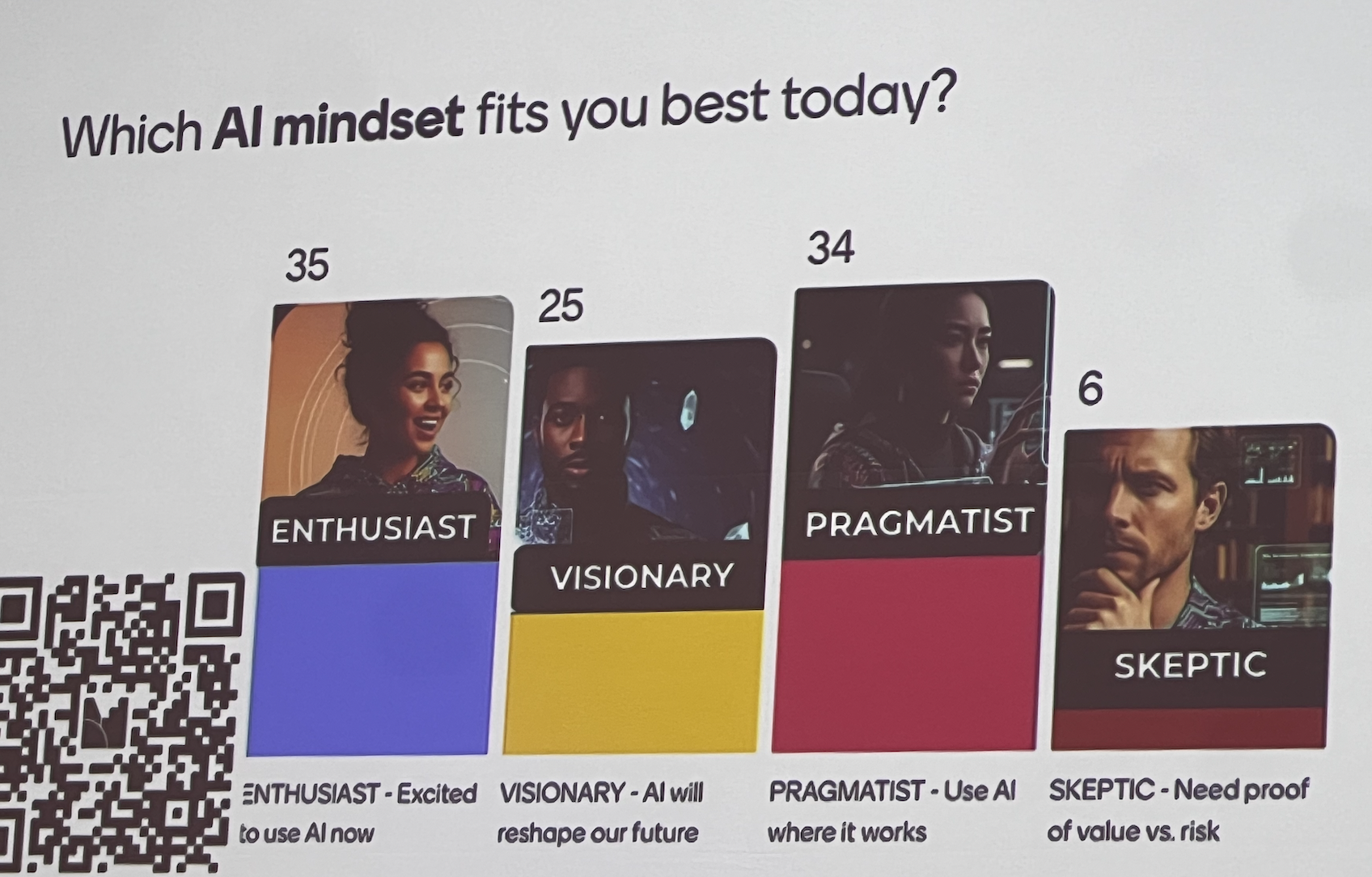
When attendees were polled on how they would describe themselves in relation to AI — enthusiast, visionary, pragmatist or skeptic — the results were nearly evenly split. Pragmatist edged out enthusiast by one vote, with visionary close behind.
Russo said all four perspectives should apply.
“The correct answer is all of the above,” he said. “Being an equal amount of excited and scared is where we should be living. You don’t want to be too much one way or another.”
What worries you?
When audience members were asked to share their specific concerns, several themes emerged:
- A belief that anything shared with AI is owned by the AI company and can be redistributed. Russo said that is not the case, adding that information shared with AI is about as secure as information sent by email. “Embrace AI, but be proprietary about it,” he advised.
- Concerns about job disruption and the environmental impact of data centers.
- The challenge of preparing people to compete with disruption rather than becoming subservient to it.
The Big Worry: Jobs
Not surprisingly, the impact of artificial intelligence on employment — including at credit unions — was a central topic.
“A lot of the members we serve are in front-line roles, roles that early AI might change,” Russo said. “A lot of people try to whitewash this. It might create more jobs than it deletes, and it might not — at least temporarily.”
He added that some skepticism about AI is rooted in fear.
“A lot of people are looking for a reason to say AI isn’t going to work, that it’s not good enough, just to make themselves feel better,” Russo said. “This thing is inevitable. The way I feel about it is irrelevant. You may not realize it — I hate AI. I hate digital. I wish we could go back to the ’80s.”
Making the Wrong Assumption
Russo cautioned against assuming that AI adoption will follow the same trajectory as the internet.
“Thirty years ago, the internet was relatively limited,” he said. “Today, if the internet goes out at home, it creates a mental health crisis.”
The key difference, he said, is the speed of change.
“The issue isn’t if it’s going to change — it’s the rate at which it will change, and the unforgiving nature of that,” Russo said. “When we least expect it, it will make a jump we aren’t prepared for, and that jump will likely come next year.”
He said 2026 presents an opportunity for organizations to step into that transformation, even as many are still finishing digital transformation efforts.
“There is a rhythm to transformation,” Russo said. “We call it the ‘growth loop.’ It’s about inflection points and transformation without burnout.”
Empowering Management
Russo said AI can help address a long-standing reality at credit unions: no institution ever has enough resources to serve all members in the way and at the pace they would like.
“AI now empowers management,” he said.
“I hear the same thing over and over: ‘I have this huge list and I can’t get it done,’” Russo said. “This isn’t about replacing humans with AI. It’s about taking the burnout and the work that never gets done — and getting it done. It’s about augmenting people.”
Three Things to Think About
To respond effectively to AI’s opportunities, Russo outlined three priorities:
- Get honest about the problem.
- Imagine a new solution.
- Collaborate without boundaries or silos, in a safe way.
Get Honest
Many people, Russo said, approach AI by asking what they need to learn.
“It can be so overwhelming that we do nothing,” he said. “Right now there are too many options. One of the most important things about AI is that 80% of the work is understanding the problem you’re trying to solve.”
An Out-of-This-World Example
Russo cited the Apollo 13 mission as an example of reframing a problem. While it is often remembered as a race to get astronauts home with limited fuel and power, he said the real challenge was excess carbon dioxide — and building a CO2 scrubber from square parts to fit a round opening.
“It’s not about what did we design this for, but what can it do,” Russo said. “People who had never thought about this problem came together from different departments.”
He urged leaders to ask what not adopting AI could cost their credit unions.
“A lot of what happens in a credit union comes down to alignment,” he said.
Three Areas of Alignment
Russo said organizational growth and transformation typically hinge on alignment in three areas:
- Positioning
- People
- Product
At the center, he said, are stakeholders — members, colleagues and the community.
When polled, attendees most often selected positioning or market share as the most important factor, narrowly ahead of product.

“All three work together,” Russo said. “Your people are part of the product — if not the product — and part of the positioning.”
He added that AI can help free employees from non-member-facing work.
“What if AI gave your people more bandwidth to do the things that actually build market share?” Russo said. “When you’re thinking about your problem, ask your people.”
Governance
Russo said credit unions must establish AI policies — but warned against overly restrictive approaches.
“If your policy is zero tolerance, you have no policy,” he said. “There is shadow AI. People are using AI at work; they’re just not talking about it.”
He said governance must strike a balance.
“If we make it too big, we get burned. If we make it too small, we get burned,” Russo said. “Avoiding AI because of concerns about sensitive data — that has to end today.”
Imagine the New Solution
Imagination, Russo said, depends on what he called a “governance playground.”
“It’s not ‘why?’ — it’s ‘what if?’” he said.
Russo cited research showing the average child asks 329 questions per day, while adults ask just five.
“We’ve been conditioned not to ask,” he said. “Or we think we already know.”
When attendees were asked what they wished AI could do for their teams, the most common responses were efficiency, growth, automation and streamlining.
Russo also warned that AI can produce incorrect or fabricated answers.
“This is why governance is critical,” he said. “AI is total crap if all you do is ask it questions. It’s just another search engine — and not a reliable one.”
He encouraged leaders to feed AI richer inputs, such as meeting transcripts.
“Give it more up front, and you’ll get a lot more back,” he said.
Collaborate Without Boundaries
Russo said many organizations currently limit AI use to marketing or communications.
“But Claude, ChatGPT, Copilot — that’s not AI, that’s a chatbot,” he said. “The power of AI is bringing the generalist together.”
For the first time, he said, people can build technology using plain English prompts.
“With AI, one plus one plus one plus one equals 1,000,” Russo said.
Building Tools
“The most valuable feature of AI right now is the ability to build tools that let us step into our genius,” Russo said.
“For many of you, your ‘why’ is the same,” he said. “What’s different is what’s unique to you. AI should take away the burnout and the mundane. There are a lot of activities at work we were never designed to do in the first place.”
Focusing only on efficiency, he added, misses the point.
“If you’re just thinking efficiency, it’s like delivering pizzas with a Ferrari,” Russo said. “The real question is how we compete — how we excel. That’s where AI becomes a true genius multiplier.”



