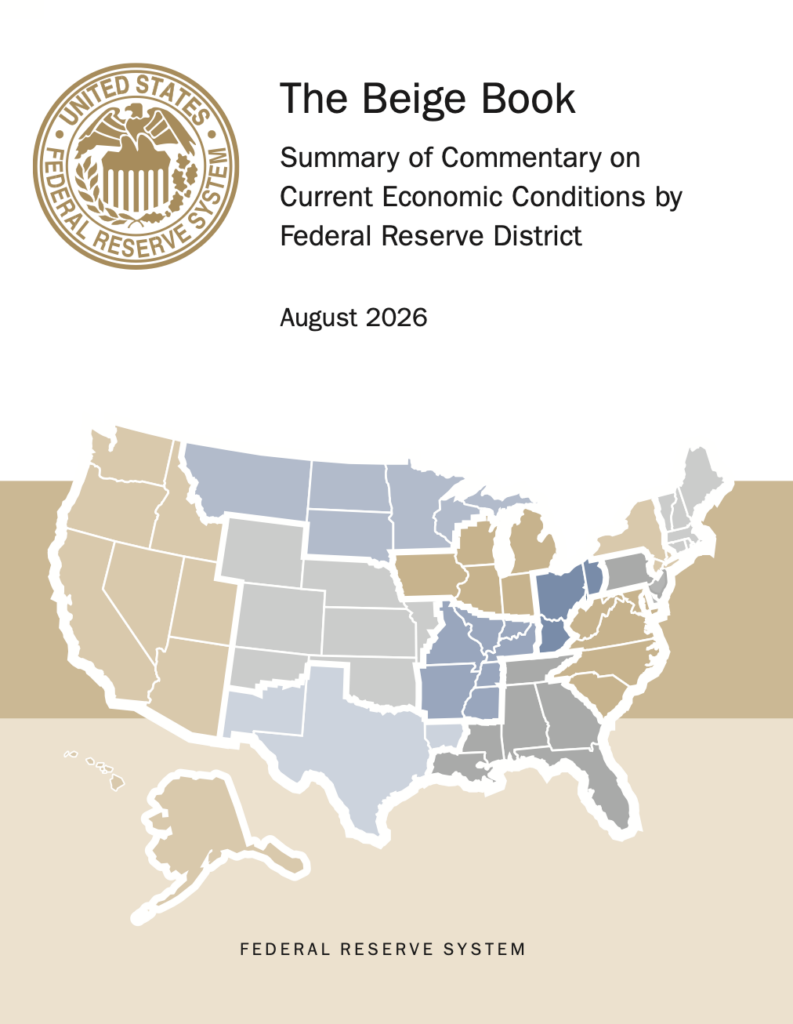
WASHINGTON — U.S. economic activity grew modestly during July and August, but consumers became increasingly sensitive to higher prices as elevated energy costs, tariffs and rising borrowing costs weighed on household spending, according to the Federal Reserve’s latest Beige Book.
Ten of the Fed’s 12 districts reported economic growth ranging from slight to moderate, while two reported no change. The report, based on information collected through Aug. 24, found the outlook for coming months remained generally positive, although businesses cited increased uncertainty surrounding energy prices, government policy and international conflict.
The Beige Book is based largely on interviews, surveys and other information gathered from businesses and organizations throughout the Fed’s 12 districts. The findings represent comments from outside the Federal Reserve and are not the views of Fed officials.
Consumers Grow More Price-Conscious
Consumer spending increased slightly overall, but the Fed found an increasingly divided picture.
Higher-income consumers continued to spend on luxury goods, travel and other experiences, while other households became more cautious. Auto sales were generally subdued because of weak consumer confidence, high fuel prices and rising financing costs. Tourism increased, with airlines reporting strong demand despite higher fares.
Evidence of consumers trading down appeared in several districts. In the Chicago Fed district, contacts reported more consumers choosing lower-cost options, with discount stores and warehouse clubs benefiting. Even some higher-income shoppers were moving toward discount retailers.
Financial pressures were particularly evident in the Minneapolis district, where contacts said the cost of living had become less affordable for many workers. A large retailer reported purchases shifting from cash and debit cards toward credit, while a wealth management professional said some lower-income consumers were supporting spending through additional borrowing, including loans against 401(k) accounts.
Inflation Pressures Remain Broad
Prices increased moderately in eight districts, modestly in two, slightly in one and robustly in another.
The pace of price increases was unchanged from the previous reporting period in eight districts, slower in three and faster in one.
Manufacturers and construction companies reported particularly strong cost pressures from energy, transportation and raw materials, including metals and petrochemicals. Businesses in several districts also continued to report tariff-related cost increases, while health care and insurance costs remained significant sources of pressure.
But businesses did not always have the ability to pass those costs along. The Fed said heightened price sensitivity among consumers was limiting pricing power for some companies.
Hiring Inches Higher, AI Has Mixed Effect
The labor market remained relatively stable.
Employment increased only “very slightly” nationwide. Three districts reported modest employment growth, four reported slight increases and five reported no change.
Manufacturing, construction and some service industries had the strongest demand for workers, while labor demand weakened in retail and hospitality. Skilled tradespeople and technical workers remained difficult to find, contributing to larger wage increases in some construction and manufacturing jobs. Overall wage growth remained modest to moderate.
The Fed also found AI is beginning to have contrasting effects on employment.
Some businesses are hiring workers to expand AI capabilities, while others are reducing administrative and entry-level positions through automation. A Philadelphia district banking contact, for example, reported reducing back-office hiring through automation while emphasizing customer-facing and revenue-producing positions.
Manufacturing, Data Centers Provide Bright Spots
Manufacturing activity strengthened across most of the country, with defense spending and the construction of data centers emerging repeatedly as important sources of demand.
The Cleveland district reported robust manufacturing demand driven by defense and data centers even as consumer spending declined for a fourth consecutive reporting period.
Data centers also were a major source of nonresidential construction activity. In the Minneapolis district, construction was heavily concentrated in infrastructure and data center projects, with builders reporting higher costs for aluminum and steel.
Residential construction, by contrast, declined nationally as elevated mortgage rates, affordability pressures and construction costs continued to constrain housing.
Lending Remains Relatively Solid
Financial conditions improved slightly nationwide as loan volumes remained solid or increased in most Fed districts, according to the report.
Conditions varied considerably by region and loan type.
New York-area regional banks reported slightly weaker business loan demand but increases in consumer and residential mortgage demand. Banks tightened standards slightly on business loans and commercial mortgages while easing them for residential mortgages.
The New York district also reported rising delinquencies across most loan categories. One senior loan officer said deteriorating consumer credit quality was constraining loan growth, while auto lenders were increasingly concerned about delinquencies and defaults.
Minneapolis district bankers reported slight loan-demand growth, led by commercial real estate, while consumer and residential lending remained soft. Some bankers expected consumer loan quality to deteriorate because of weakness in auto lending.
The overall picture painted by the Fed was of an economy that continued to expand but faced increasingly visible pressure from higher costs: businesses were paying more for energy, transportation, insurance and materials, while many consumers were becoming more selective about what they bought and, in some cases, increasingly relying on credit to maintain spending.