BOSTON — Large U.S. companies are continuing to increase spending on artificial intelligence, with financial services firms leading the way as they shift AI from experimentation to enterprise-wide deployment, according to a new report from PYMNTS Intelligence.
The report, “The Enterprise AI Benchmark Report: Financial Services Pulls Ahead in the Enterprise AI Race,” is based on a March survey of 60 senior technology executives at U.S. companies with at least $1 billion in annual revenue.
According to PYMNTS Intelligence, financial services and insurance companies are investing in AI to improve productivity, strengthen their competitive positions and reduce risk, while healthcare organizations remain focused on pilot projects and media companies continue expanding AI initiatives despite placing less emphasis on immediate financial returns.
The report said the findings suggest enterprise AI has entered a more practical phase, with organizations increasingly directing meaningful capital toward initiatives that demonstrate business value rather than simply testing the technology.
Key Findings
Among the key findings:
- 85% of financial services and insurance companies plan to increase AI budgets during the next 12 months, the highest percentage among the industries surveyed.
- 80% of media and advertising firms expect to increase AI spending.
- 60% of healthcare and medical organizations plan to raise AI budgets.
PYMNTS Intelligence found that financial institutions are pursuing AI investments for both operational and strategic reasons.
Among financial services firms:
- 65% cited productivity and efficiency gains as a primary reason for investing in AI.
- 65% also said improving strategic or competitive positioning was a key motivation.
Results from Other Industries
Media and advertising companies also identified productivity as a major driver, with 65% citing efficiency improvements. However, only 25% said monetary return on investment or other financial metrics were a primary justification for increased AI spending, the lowest percentage among the industries surveyed. According to the report, that suggests many organizations in the sector are moving forward with executive support while still developing a long-term business case.
Healthcare organizations showed a different pattern. While fewer firms plan to increase spending, 60% reported funding AI pilot projects without requiring formal return-on-investment metrics. PYMNTS Intelligence said the trend reflects an industry seeking operational improvements amid workforce shortages and fragmented technology systems.
The report also found that increased spending alone is unlikely to determine which companies gain the greatest advantage from AI adoption.
FIs ID Data Quality Issues
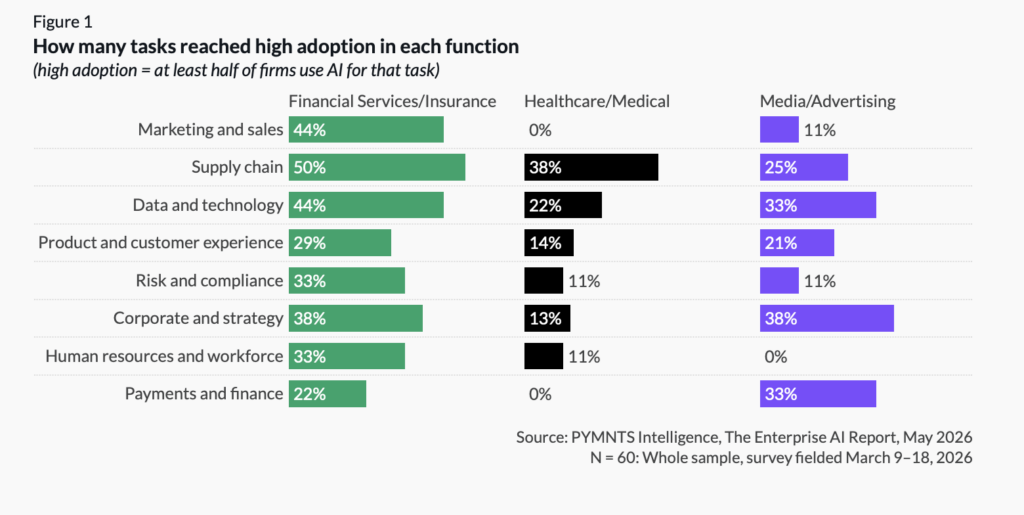
Financial services firms have deployed AI across more business functions than organizations in the other industries surveyed, but 30% identified data quality and fragmented data systems as the biggest obstacle to expanding AI implementation.
Healthcare organizations reported similar challenges, with 30% citing system integration issues and another 30% identifying data quality as their primary hurdle.
Media and advertising firms reported a broader range of barriers, including workforce skills shortages, governance concerns and leadership alignment, according to the report.
Despite the accelerating pace of investment, executives across all three industries generally said they expect AI to enhance, rather than replace, human decision-making.
Between 80% and 85% of executives surveyed said they believe AI will augment human decision-making over the next five years, pointing toward a future in which organizations use AI to improve employee performance rather than automate human judgment entirely, according to PYMNTS Intelligence.