
WASHINGTON — Federal banking regulators should strengthen the way they identify and eliminate outdated or unnecessarily burdensome regulations, as current review processes make it difficult to determine whether required regulatory reviews produce meaningful changes, according to a new report from the U.S. Government Accountability Office.
The report examines the agencies’ implementation of the Economic Growth and Regulatory Paperwork Reduction Act of 1996 (EGRPRA), which requires the Federal Reserve, the Federal Deposit Insurance Corp. and the Office of the Comptroller of the Currency to review their regulations at least once every 10 years and identify rules that may be outdated, unnecessary or unduly burdensome for insured depository institutions. The agencies are currently conducting their third decennial review.
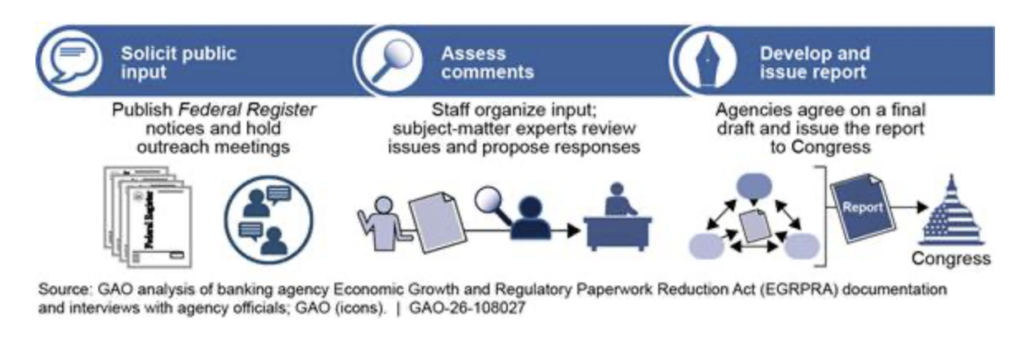
GAO found that while the agencies solicit public comment and issue joint reports to Congress as required, they lack documented procedures for determining which regulations warrant further review and whether concerns raised during the process should result in regulatory changes. As a result, it is often unclear whether actions described in the agencies’ reports were prompted by the EGRPRA review itself or by other legislative or regulatory initiatives.
What Was Missing in Earlier Reviews
The watchdog said previous reviews did not consistently demonstrate how agencies evaluated public feedback or prioritized regulations for retrospective analysis. GAO also found the agencies have not systematically incorporated leading practices for retrospective regulatory reviews, including formal frameworks for prioritizing rules, conducting cost-benefit analyses and assessing the cumulative burden of regulations.
To address those shortcomings, GAO issued six recommendations—two each for the Federal Reserve, FDIC and OCC. The recommendations call on each agency to establish documented procedures for identifying outdated or unnecessarily burdensome regulations and to incorporate structured frameworks for prioritizing reviews, evaluating costs and benefits, and assessing cumulative regulatory burden where feasible.
Steps Being Taken
According to GAO, the banking agencies outlined steps they have taken to improve their review processes but neither agreed nor disagreed with the recommendations.
The report does not evaluate the substance of individual banking regulations. Instead, it concludes that improving the review process would make it more likely that future EGRPRA reviews achieve the law’s objective of identifying and reducing unnecessary regulatory burdens while maintaining safety and soundness standards for federally insured financial institutions.