
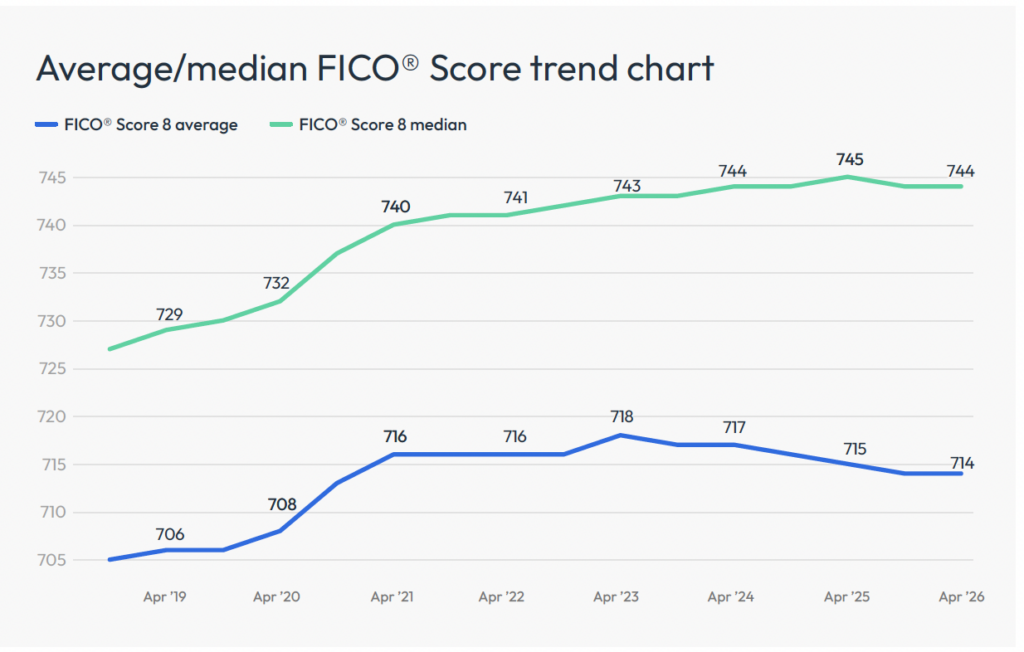
SAN JOSE, Calif. — The average U.S. FICO Score held steady at 714 in April, but rising housing and vehicle payments, growing debt balances and financial strains among younger and lower-scoring consumers point to mounting affordability pressures beneath otherwise stable credit performance, according to FICO’s Fall 2026 FICO Score Credit Insights report.
The average score was unchanged from FICO’s previous report in October 2025 and down one point from April 2025. The median FICO Score stood at 744, also one point lower than a year earlier.
FICO said delinquency rates generally stabilized or improved across mortgages, auto loans, bankcards and personal loans, suggesting consumers overall continue to meet their obligations despite higher costs.
But the company cautioned that national averages mask substantial differences among borrowers based on credit score, age and type of debt.
“Affordability pressure is real across mortgage, auto, bankcard, and personal loans, and its weight falls unevenly by score band and life stage,” FICO said.
Delinquencies Show Broad Stability
FICO reported:
- Mortgage 30-day delinquency declined to 1.35% from 1.42% a year earlier.
- Auto 30-day delinquency declined about 5 basis points to 2.64%.
- Bankcard 30-day delinquency remained approximately 2.7%.
- Personal loan 30-day delinquency remained at 1.9%.
The stability comes even as housing and vehicle payments have increased faster than inflation and bankcard and personal loan balances continue to rise.
FICO said the results suggest consumer credit is not experiencing broad deterioration, but risks are increasingly concentrated within certain borrower groups.
Consumers Cutting Spending, Relying on Others
FICO supplemented its credit-file analysis with a consumer survey conducted by The Harris Poll July 20-22 among 2,078 U.S. adults.
The survey found 89% had taken at least one action during the previous year to improve their financial health. Among the findings:
- 56% checked their credit score.
- 43% changed purchasing habits to spend less.
- 37% rely on continuing financial support from other people.
- 20% made less than the minimum payment or skipped a credit card or loan payment during the previous year.
- 30% said a job or income loss caused them to rely on credit cards to make ends meet.
- 30% said medical expenses caused them to rely on cards.
- 28% said unexpected caregiving responsibilities or support for dependents led them to rely on credit cards or personal loans.
Younger Consumers Show Growing Divide
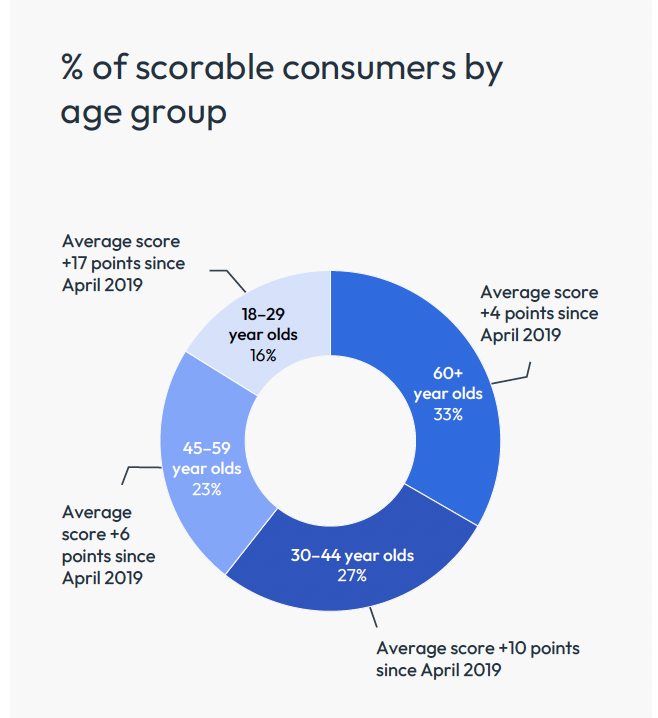
Credit scores have improved substantially among younger consumers since before the pandemic. Average scores for consumers ages 18 to 29 have increased 17 points since April 2019, while scores among those ages 30 to 44 are up 10 points.
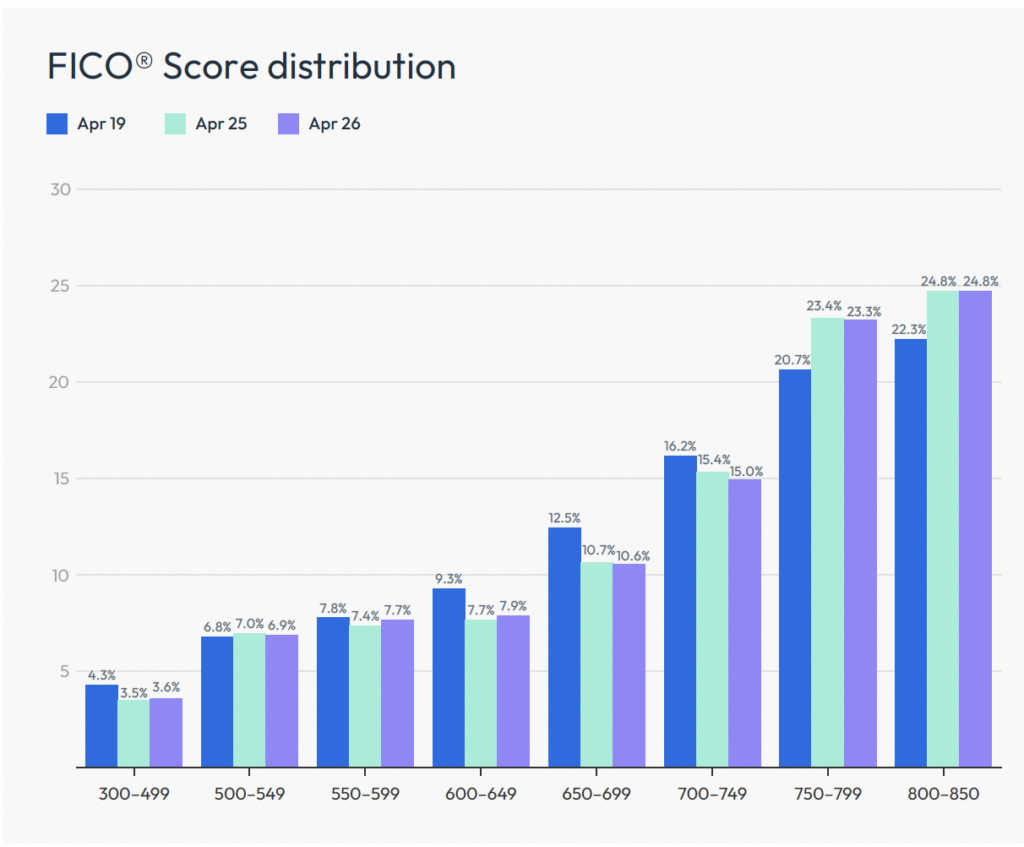
But FICO found consumers ages 18 to 29 are increasingly moving toward both ends of the credit spectrum, with larger shares appearing in higher and lower score ranges rather than the middle.
Financial dependence is also considerably higher among younger adults.
FICO’s survey found 74% of Gen Z and 50% of Millennials receive ongoing financial support from others, compared with 28% of Gen X and 9% of Baby Boomers.
Housing costs are also hitting younger homeowners harder. Sixty-eight percent of Gen Z homeowners and 54% of Millennial homeowners said monthly housing costs made it harder to meet other expenses, compared with 40% of Gen X and 28% of Baby Boomers.
Mortgage Costs Up 57% for First-Time Buyers
Housing remains one of the clearest sources of affordability pressure.
The average monthly mortgage payment for a first-time homebuyer reached $2,563 in April, up 57% from $1,635 in April 2019, substantially exceeding the roughly 30% increase in inflation over the same period.
FICO’s survey found 43% of homeowners said total monthly housing costs made it harder to keep up with other expenses.
Mortgage performance nevertheless showed signs of stabilization. Early-stage delinquency fell year over year, but performance varied significantly by loan type.
FHA 30-day delinquency remained approximately three times the rates for VA and conventional mortgages.
Credit profiles also varied considerably among new borrowers. The average FICO Score for newly issued FHA mortgages was 691 in April, compared with 721 for VA loans and 759 for conventional mortgages.
Auto Lending Moves Down Credit Spectrum
FICO found evidence lenders are extending auto credit further down the score spectrum.
The average FICO Auto Score among borrowers receiving new auto loans declined seven points to 716 from 723 a year earlier.
Despite that shift, repayment performance did not broadly deteriorate. Auto 30-day delinquency declined slightly year over year.
However, subsequent 90-day-or-more delinquency increased among consumers with scores of 250 to 579 while remaining flat in every other score range.
FICO said the results suggest broader auto credit availability has so far occurred without widespread deterioration in loan performance.
Student Loans Create Sharp Divide
Student loans showed perhaps the most pronounced difference between consumers who are keeping up with payments and those falling behind.
Approximately 3.2 million borrowers with payments due had experienced a student loan delinquency within the previous six months. Their FICO Scores fell an average 38 points from a year earlier.
By comparison:
- 4.9 million borrowers who previously became delinquent but subsequently resolved the delinquency or moved into another repayment status saw their scores increase an average 16 points.
- 12 million borrowers who remained free of delinquency and made at least one recent payment experienced an average six-point increase.
Student loan problems also appeared to signal broader financial stress. Among borrowers with a recent student loan delinquency, delinquency rates were 30.4% on bankcards, 25.5% on personal loans, 20.2% on auto loans and 15.4% on mortgages.
Fifty-six percent of surveyed student loan borrowers said repayment had caused them to rely more heavily on credit cards or other loans to pay bills. That included 71% of Gen Z borrowers and 62% of Millennials.
Credit Card Balances Continue to Rise
Bankcard performance remained relatively stable even as balances increased.
Average credit card balances rose 3.8% during the year to $7,793. Utilization nevertheless declined slightly to 35.2% from 35.5% because credit limits, particularly among higher-scoring borrowers, increased faster than balances.
The average FICO Score for newly issued bankcards remained 717, while the average for existing cardholders remained 725.
FICO also found subsequent 90-day-plus bankcard delinquency declined across all score ranges, with particularly notable improvement among consumers scoring below 600.
Personal Lending Shifts Toward Higher Scores
The borrower mix for personal loans has moved significantly toward consumers with stronger credit profiles.
In April 2019, 29.9% of newly issued personal loans went to consumers with scores below 600 and 30.8% went to those above 700.
By April 2026:
- The share below 600 had fallen to 21.4%.
- The share above 700 had risen to 38.6%.
- The 600-to-699 group remained near 40%.
Personal loan delinquency remained essentially unchanged, with rates of 1.9% at 30 days past due, 1.1% at 60 days and 0.9% at 90 days.
But balances are rising fastest among riskier borrowers. Average personal loan balances for consumers scoring below 600 have increased 44% since 2019, compared with roughly 30% inflation. Balances among consumers scoring above 700 increased about 19%.
Consumers Prioritize Auto, Mortgage Payments
FICO’s analysis also found consumers continue to prioritize certain debts when deciding which bills to pay.
The payment hierarchy remained unchanged from the company’s October 2025 analysis:
- Auto loans
- Mortgages
- Personal loans
- Bankcards
- Student loans
For example, consumers with both auto loans and mortgages were 20% more likely to pay their auto loan than their mortgage, while consumers with both personal loans and bankcards were 93% more likely to pay the personal loan.
FICO said secured products tied to essential assets, particularly vehicles and homes, have generally remained near the top of consumers’ payment priorities.
Credit Knowledge Gaps Persist
Despite consumers’ focus on their credit, FICO found significant misunderstandings about how credit scores work.
While 83% said they have the knowledge or tools necessary to improve their score and 77% said they have received sufficient credit-score education:
- 55% incorrectly believe carrying a small credit card balance improves their score, while another 17% are unsure.
- 65% were incorrect or unsure about whether income is directly included in calculating a credit score.
- 58% were incorrect or unsure about how shopping for interest rates affects scores.
- 51% were incorrect or unsure whether all credit scores are calculated the same way.
Only 16% said they had sought a financial literacy or personal finance resource during the previous year.
What It Means for Lenders
FICO said its findings point to a consumer credit market that remains resilient overall but is increasingly difficult to evaluate solely through national averages.
Lower-scoring and thin-file borrowers are absorbing some of the largest cost increases at the same time that new lending in some markets is shifting toward consumers with stronger credit.
The company said lenders should increasingly segment borrowers by product, credit score and stage of the credit lifecycle to identify areas where risk is changing.
FICO also said consumer-permissioned cash-flow information can supplement conventional credit-bureau information when evaluating consumers with limited credit histories.
“The average FICO Score holds at 714, and year-over-year delinquency has improved or held across every major product,” FICO said.
Pressures Continue
But it added that the averages conceal significant differences among borrowers as affordability pressures continue across mortgages, auto loans, bankcards and personal loans.
FICO based the report on a nationally representative sample of millions of consumer credit files from a national consumer reporting agency. Its accompanying consumer survey was conducted by The Harris Poll among 2,078 U.S. adults and has a Bayesian credible interval of plus or minus 2.7 percentage points at a 95% confidence level.