FARMINGTON HILLS, Mich. — A growing share of older Americans seeking reverse mortgages are facing deepening financial strain, with budget shortfalls rising sharply over the past year, according to new analysis from GreenPath Financial Wellness.
The nonprofit, which provides housing and financial counseling, said its review of reverse mortgage clients from 2024 and 2025 found both the prevalence and severity of monthly budget deficits increased significantly. Reverse mortgages are often used by retirees with fixed or limited incomes to help cover living expenses.
In 2025, 21.1% of clients entered counseling with a monthly budget deficit, up from 12.2% in 2024, according to GreenPath. The average monthly shortfall also widened, rising to $1,793 from $1,498 a year earlier.
‘Not Small Gaps’
“These are not small gaps,” Jennifer Fraser, director of stakeholder engagement and grants at GreenPath, said in a statement. She noted that deficits of that size can leave seniors struggling to afford essential expenses such as housing, healthcare, utilities and food. Because reverse mortgage proceeds can be used for a wide range of needs, they often serve as a financial lifeline during periods of hardship, she added.
Income data further underscores the pressure facing older borrowers. In 2025, about half of GreenPath’s reverse mortgage clients reported incomes below 50% of their area median income. Across 2024 and 2025 combined, roughly 23% fell into the “very low-income” category, defined as earning less than 30% of area median income.
Not Just for Retirement
The findings suggest reverse mortgages are increasingly being used not just as a retirement planning tool, but as a means of covering basic expenses.
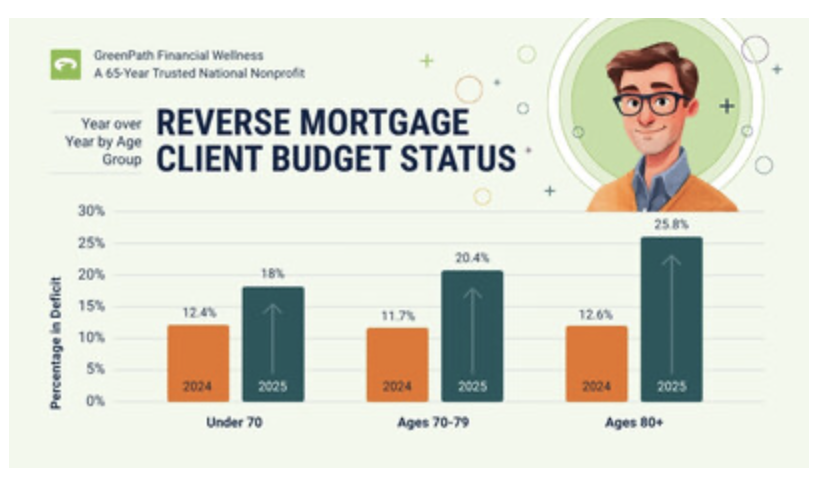
Financial strain also appeared to intensify with age. Among clients 80 and older, the share with budget deficits more than doubled, climbing to 25.8% in 2025 from 12.6% the prior year, according to the analysis.
GreenPath said the trends point to mounting financial challenges for seniors, particularly those living on fixed incomes and facing rising costs.