
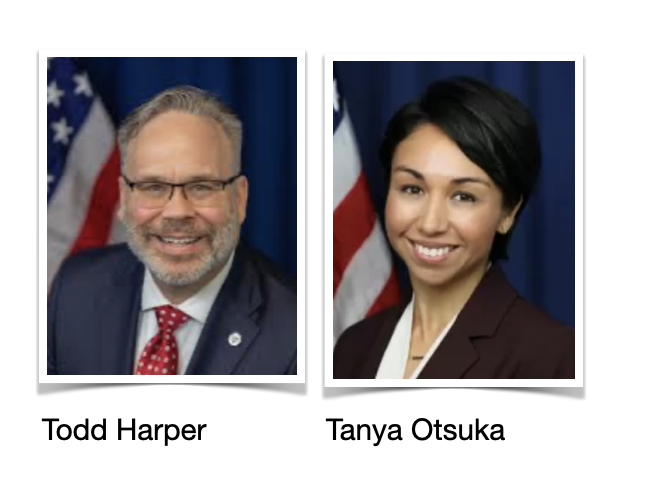
WASHINGTON — Former NCUA Board members Todd Harper and Tanya Otsuka are asking a federal appeals court to quickly resume consideration of their challenge to their removal from office, arguing that two recent U.S. Supreme Court decisions strengthen their case and support their reinstatement.
In a motion filed Thursday with the U.S. Court of Appeals for the District of Columbia Circuit, Harper and Otsuka asked the court to lift its stay of the appeal, restore an expedited briefing schedule and schedule oral argument “at its earliest convenience.”
The appeal has been on hold since September 2025 while the D.C. Circuit awaited the Supreme Court’s decisions in Trump v. Slaughter and Trump v. Cook. As the CU Daily reported here and here, the court ruled President Trump has the authority to fire commissioners at independent agencies such as the FTC. As the CU Daily reported here, the Supreme Court ruled 5-4 that Federal Reserve Gov. Lisa Cook can remain in her position while challenging President Donald Trump’s attempt to remove her, drawing a sharp distinction between the Federal Reserve and other independent agencies whose leaders the court said may be subject to broader presidential removal authority.
The Plaintiffs’ Contention
Harper and Otsuka, Democratic-appointees who were fired from their positions on the NCUA board by Trump in April of 2025, contend the Supreme Court’s decisions reinforce a lower court ruling that found their removals by President Donald Trump were unlawful because federal law protects NCUA Board members from being dismissed without cause during their fixed terms. The district court ordered both officials reinstated after granting summary judgment in their favor, but that ruling was stayed pending appeal.
In their filing, the former board members argue the Supreme Court’s decisions preserved the independence of financial regulatory agencies that have historically played a unique role in overseeing the nation’s financial system, including the Federal Reserve.
The motion argues the NCUA belongs within that same tradition because Congress modeled the agency after the Federal Reserve, giving it similar responsibilities for chartering, supervising and supporting financial institutions while structuring it as an independent regulator.
Additional Arguments
The filing also says Harper and Otsuka intend to argue that the NCUA’s institutional independence can be traced through a long historical tradition of insulating financial regulators from political interference. It further contends that the NCUA Board lacks several executive powers the Supreme Court cited in Slaughter when determining that members of another federal agency could be removed by the president. Among those distinctions, the motion notes, is that the NCUA Board does not possess authority to file civil lawsuits on behalf of the United States.
The former officials also argue that the Supreme Court reaffirmed another principle central to their case: that Congress can implicitly provide “for-cause” removal protections when it establishes fixed terms of office for agency officials.
Congressional Intent Cited
The motion notes NCUA Board members serve fixed terms under federal law and Congress intentionally insulated the board from political influence.
The filing further argues the Supreme Court rejected one of the government’s principal arguments on appeal by holding that courts may order removed federal officials to remain in office while litigation proceeds if they otherwise qualify for preliminary injunctive relief. Harper and Otsuka say that ruling supports the district court’s authority to order their reinstatement.
Harper and Otsuka reminded the appeals court they have now been out of office for more than 14 months while their statutory terms continue to run.
According to the filing, Harper’s six-year term expires April 10, 2027, while Otsuka’s term expires Aug. 2, 2029. The motion argues that prompt resolution of the appeal would allow the NCUA Board to resume its statutory responsibilities with its full membership and restore the two officials to offices from which the district court determined they were unlawfully removed.
Briefing Schedule Proposed
The filing proposes a briefing schedule that would require the government to file any updated opening brief by July 23, Harper and Otsuka to file their response by Aug. 13, and the government’s reply brief by Aug. 27. The former board members also asked the court to hear oral argument as soon as practicable.
The motion notes that government attorneys oppose the request and intend to file their own response. According to the filing, government counsel indicated they are tentatively planning to stand on their previously filed opening brief and submit their own motion governing future proceedings by July 29.