PORTLAND, Ore.–The Toy Story movies aren’t about toys, Finding Nemo isn’t about a fish, Monsters Inc. has nothing to do with what may be hiding in your closet—and credit unions aren’t really about money.
That was among the takeaways from remarks offered by Matthew Luhn, who calls himself a storyteller and “creative visionary” and who worked on many of Pixar’s best-known and classic movies and who was with Disney prior to that.
“I’ve spent 30 years making people feel something. That is the job of a storyteller. To make people feel something,” Luhn told the Northwest Credit Union Association’s MAXX meeting. “And the best way to do that is with a great story.”
Luhn’s comments focused on how credit unions can better tell their story—a topic frequently discussed in the movement, often with little direction on how to do so.
It’s unlikely anyone had a better background for joining Pixar and working on the Toy Story movie franchise. His family had for generations owned seven toy stores, Jeffrey’s Toys, and his father had dreamed of being an illustrator and animator.
He shared that when, at the age of five, he drew a crude drawing of his own father, his father concluded there and then his son would grow up to be an illustrator and often pulled him out of school to see movies (including The Shining, which he admitted wasn’t ideal for children).
Learning the ‘Craft’
He would eventually be accepted to the California institute of the Arts in Los Angeles, created by Walt Disney to train the next generation of artists how to write films, animate characters and tell stories. (Many famous filmmakers and show creators are among the graduates, who include, for some reason, David Hasselhoff.)
At the age of 19 Luhn went to work as an animator on the Simpsons (he’s the youngest person to ever work on the show), where he spent any free time with the writers of the show, where he said he first learned the real “craft” story telling (Conan O’Brien was among the writers at the time).
The Hero With a Thousand Faces
Luhn said he studied everything he could about the principles of storytelling, including the Joseph Campbell book, “The Hero With a Thousand Faces,” which George Lucas read in college and then followed “word for word” when writing Star Wars.
Luhn was eventually contacted by the Steve Jobs-owned Pixar, where he knew some people and they knew he came from a family of toy store owners. Soon, he was working on Toy Story, and he shared a video of how he had screwed his shoes to a plank of wood to mimic how the green army men characters—whose feet were set in a plastic base that allowed them to stand—would walk if they could.
Toy Story—Luhn worked on all four films—“pretty much changed my life,” he said.
“There was going to be this old-fashioned cowboy doll and a futuristic spaceman toy and they hate each other and are completely different, but then they become lost twice and they have to work together to be able to get back to their owner and through that journey they change and they become best friends,” he explained. “It is a classic story that’s been told over and over again.
Story is King
The lesson Luhn said he ultimately learned: “The story is king.”
Luhn said he would do computer animation work during the day and help the story team after work and on weekends. He recalled that when Toy Story was initially released the prediction was it was going to be a bomb. It became the highest grossing movie of the year.
“Thirty years later, when people watch that movie again, it’s still the story that holds it together and that’s the key ingredient,” Luhn said.
Luhn would continue to work on Toy Story, as well as Ratatouille, Cars, Monsters, Inc., The Incredibles, and more.
“Making a film that consistently makes people laugh and cry and feel something–it’s a pretty good job,” he said.
Telling a Great Story
Luhn told credit unions the keys to telling a great story include:
Be Memorable
“If there’s no story people just start to fall asleep. They’ll stop watching the TV show, they’ll walk out of the movie. Or, if it’s a Zoom call and you’re making the presentation and it’s just information, people start to zone out,” he said. “There needs to be something more than just pie graphs and spreadsheets. The truth is when we share just information without a story attached, people will only remember 5% of what was said. You need to include a story. I’m not talking about writing the credit union film screenplay…Stories can be told without just words on a page. We have all the five senses to work with to tell a story, from visuals to what we hear to what we taste to what we touch, what we smell. Sixty-five percent remember the stories they are told.”
He noted, for example, just the shade of blue used by Tiffany’s in its advertising, known as “Tiffany Blue,” paints a picture before anyone ever reads any of the advertising copy.

For that reason, he encouraged credit unions to give attention to the colors and fonts they use in marketing and promotion.
“Tiffany’s isn’t selling jewelry. There’s something more to this story. They’re selling a dream,” Luhn said. “That’s the way we need to think about it.”
Be Impactful
Every credit union wants to be impactful, Luhn noted, but that can only be done by paying attention to the “real science to storytelling.”
“During (script) meetings we say we need a happy moment, we need a sad moment, we need a funny moment. That’s what keeps people watching,” he said, calling the first 10 minutes of the movie “Up,” in which there is no dialogue, some of the most emotional 10 minutes anyone will ever see.
“Whenever there’s something that makes you chuckle or laugh, it releases endorphins, and what endorphins do first is reduce anxiety. It makes us feel more creative and it’s a great tool as a leader in the business world,” Luhn said, sharing examples from Steve Jobs’ presentations as he introduced Apple products, which remain memorable. He said Jobs was the master of creating anticipation and captivating people.
Three Highlights
Luhn advised credit unions when telling a story or making a presentation to provide three top highlights of what is to come first, and then move into specifics.
Be Personal
A particular strength of credit unions, Luhn urged the sharing of experiences and testimonials or, in the case of CU leaders, their own personal stories or career paths.
He said using personal metaphors can be particularly effective when “people are now quite sure about what is a credit union, what does it do?”
“You’re probably the hero of that story and you’re sharing how you had a goal and there was a set of obstacles and how doing this has changed your life and has, in turn, changed other people’s lives,” Luhn said. “You’re putting the member, the listener in the role of being the hero, and that means you got to think about what’s their goal, what are their obstacles and how are you going to transform them? You’re the mentor, you’re Mr. Miyagi. You’re the good witch from the Wizard of Oz. In all of these stories that I’ve worked on at Pixar I’ve always used stories like this.”
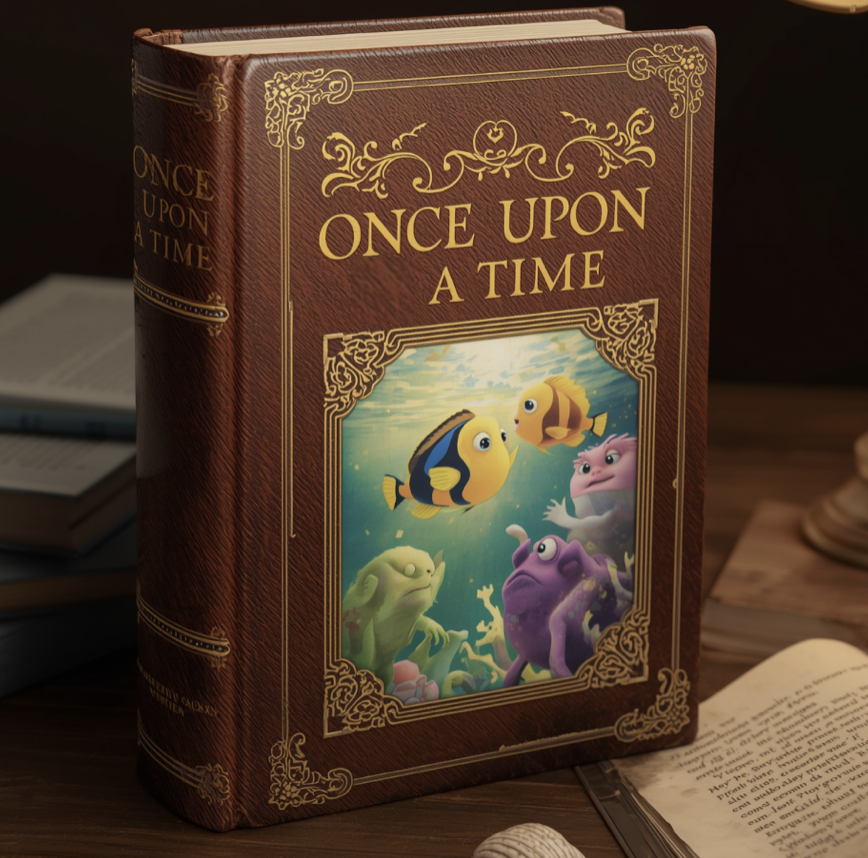
All stories must have a “story spine,” Luhn said, which he shared on the graphic shown here.
- Once Upon A Time. “This is how we learn to tell stories. That’s the beginning of the story until one day there is that moment in the story when a character experiences something that kind of changed their life.”
- Act Two: And Because of That: “That’s the journey that the character goes through or we go through. One of the things we love in stories is the ups and downs. We love to see all the bad stuff and all the good stuff the character goes through and you need to share that as well.
- Until Finally… This is where the character finishes the story. It’s the moral of the story and the theme. “Trust me, every story has a theme even a career path story,” Luhn said.
The Story for Members
“Is the story that you’re telling members the story of what their future stories could be like, would be like?” Luhn asked. “A lot of times we may not even start with ‘once upon a time.’ You may start off with a different intro, but this is the template that you should use. Tell the stories of members and any experiences to be able to let people know other people you’ve helped and how their experience is better now.”
The Hook
Creating an inspiring story for members, like all stories, requires a hook, which can be something unusual, unexpected, action or conflict.
As an example of a hook, Luhn shared, “The first time I saw a dead body I was 12 years old,” which is how Stephen King’s book “Stand by Me” begins. Credit unions may not have dead bodies, but the kinds of work CUs do and the members helped are great hooks, he said, especially when they involve transformation.

The Need to Connect
“If you need to connect to a wide audience, you want to use universal themes, and there are universal themes in storytelling that connect every single person on the planet of every age, every gender, every culture.”
He said those universal themes include:
- Desire for love
- Desire for safety
- Desire for freedom
“All of those are what the various Pixar films are about,” he said. “When you create something that resonates with one of these, you’re guaranteed to capture people.”
There are other universal themes, as well, according to Luhn:
- Fear of failure
- Fear of abandonment
- Fear of not belonging.
“This is why the Toy Story films are so loved,” he said. “They all go back to Woody’s fear of abandonment.”
What People Long For
Luhn touched on a theme that is a strength of credit unions.
“We long for authenticity, to have a relationship that’s personal,” he said. “Don’t be clever; just be vulnerable and honest about why you love what you do and how this will actually help their lives. Every one of those Pixar films would start from a place of authenticity. When we made Monsters Inc., we knew people knew the stories of monsters that hide in the closet.”
An Interesting Aside
Luhn shared an interesting insight about the Pixar movies and how they came to be.
He said that when Toy Story was being developed the writing team were mostly in their 20s, not that far from being kids themselves, and had no children and were workaholics. As they got older and married and had children they didn’t know how to balance their lives between being a workaholic and being a parent, and that’s what Monsters, Inc was about: work/life balance (when a child suddenly comes into the lives of main characters “Sulley” Sullivan and his best friend Mike Wazowski. A
As the writer’s had kids they became protective, leading to the theme of “Finding Nemo,” and as those kids became teenagers and they had no idea what was going on in their heads and how their emotions seemed to be controlling them, Pixar developed “Inside Out.”
And of course, there is “UP,” a story where the main character is nearing the end of his life and reflecting.
What Not to Say
Credit unions should never tell the audience the theme of the story, and should also avoid talking about mission statements and purpose statements.
“People just want to hear your experience, your voice,” he said. “Can you imagine if we would say the theme in our movies?” To illustrate that point, he shared his graphic.
The Structure
All stories—to be effective—must have structure, Luhn said.
“People love to have the whole thing wrapped up in a structure they are familiar with. Set up, build and payoff,” he advised. “Because every day we witness a beginning, a middle and an end and over the course of our lives. It doesn’t make a difference if you’re selling tires or toys or if it’s a credit union you’re setting up the ordinary world in your industry.”
What Ultimately Matters
“Don’t be afraid to explain why you took a different direction,” Luhn advised. “The reason we love heroes in films is not because they succeed nonstop; we actually love heroes who fail. What makes a hero great is they don’t give up. That’s the middle. The end is where you are the success.
“This can be your story,” he continued. “People love us sharing with them what their future story will be. In the end they will not remember the pie graphs and the statistics, but what’s going to move them is how you make them feel. The best way to do that is through the stories we share. In the end, the best story always wins.”