
ADVENTURA, Fla.–Credit unions have every opportunity to compete with–and even have advantages over–the JPMorgans in the marketplace, but the key lies in creating and maintaining an “innovation culture,” according to one CU executive who shared advice and strategies on creating just that and who stressed it’s not about the budget.
Speaking to the Defense Credit Union Council’s (DCUC) Annual Meeting in South Florida, Jonathan Cilley, CIO at Mid-Hudson Valley Credit Union in New York, walked a group of CU leaders through what it takes to build an innovation culture, as well as why such a culture never takes root at a credit union, or fail when it does.

As a preface, Cilley emphasized that developments in AI have become “very instrumental” in enabling an innovation culture and has made it more possible than ever before for a credit union to innovate, and to do so faster than even the JPMorgans in the market. Indeed, throughout his remarks, Cilley said he firmly believes credit unions have advantages the nation’s biggest financial institution does not, regardless of budget.
“With megabanks, it’s like turning the Titanic. It’s the one competitor credit unions can effectively compte against,” Cilley said. “We have an opportunity to be far more nimble than the megabanks. That’s a reality of this new culture, especially with AI.
“Fintechs are very focused on what is the users’ experience: it’s all they are focused on,” he added.
Critical Role of Governance
For credit unions to leverage that advantage, Cilley said board governance is critical to innovation.
“Organizations that fear failure can’t innovate. The board has to set the tone,” Cilley said. “The competition didn’t wait for you. Fintechs and megabanks aren’t trying to beat you on mission, they’re beating you in speed, experience and expectations. And your members are noticing. This is where the threat comes from. Ultimately, you have to meet your members’ expectations, as other companies are meeting your members’ expectation where you aren’t.”
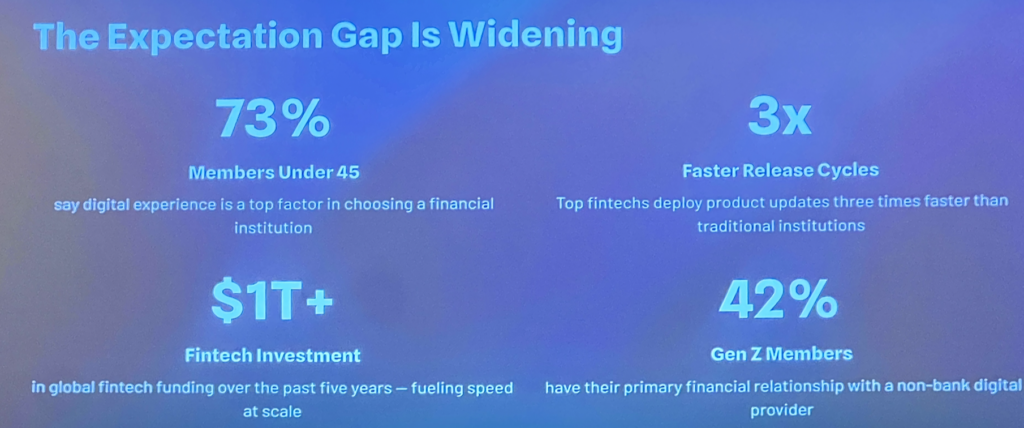
Cilley noted that many of the big-brand tech companies are releasing new features multiple times per month. With credit unions, “you’re lucky to get a new release once or twice a year. It’s just not fast enough anymore,” Cilley said.
As the chart shows, nearly three in four members under age 45 use other digital providers.
Technology Alone Won’t Save You
When it comes to a culture of innovation, Cilley stressed that the most important message is that “technology alone won’t save you.” The old observation that “culture eats strategy for breakfast” is absolutely true when it comes to innovation, Cilley stressed, noting “putting in a new tool doesn’t guarantee success. Success it’s what you do with it. It’s what you allow in terms of experimentation and pushing the organization forward.”
Who is Piloting Projects?
Audience members were polled for how many pilot projects did your credit union launch in the last 12 months?
- 1-2, 25%
- 3-5, 50%
- 6+, 25%
“If you’re doing six plus, that’s awesome, and that’s where you need to sustain the culture,” said Cilley. “One to two, you need to build the culture.”
Cilley said for those credit unions that fall into the bucket of six-plus pilots, “that’s fantastic. You’re in a sustainment place and are looking to keep that going, not just this year but for every year going forward…In all of the cases what you need to keep going is you need a formal governance structure to make organization for on an ongoing basis.”
Cilley asked his audience what was the last thing they tried that didn’t work? One CEO shared that his credit union had spent a “big chunk of resources” attempting to get its arms around big data, and it just failed. “We had maybe a little bit better reporting, but not really,” the CEO said.
Cilley noted it’s hard for organizations to admit something didn’t work. “You just want to move on. Scope and scale don’t matter. But it’s OK that it didn’t work. What did you learn from it and how do you keep the momentum going and don’t stifle innovation,” Cilley asked.
It’s OK to Fail, But…
It’s OK to fail, according to Cilley, but the CU must be able to iterate and fail fast.
“It’s a reputation risk. If you do fail or something doesn’t work, you have to move quickly to address and one of the challenges for us as credit unions is do you have the right partners who will move quickly when something doesn’t work well,” he told the meeting. “There is a vendor management component to innovation. “
For board members, is innovation something that gets talked about in board rooms? Cilley asked. Is there a committee for it? “When board are engaged it tends to push people quick,” he observed.
In the case of Mid-Hudson Valley FCU, Cilley said it has a tech committee on its boards to which he provides a report every month. He said he shares the projects and pilots the credit union has underway.
“You must have this facility between your senior management team and your board. When it comes to innovation, the board has to set the tone for their risk appetite for innovation,” he said. “Are they a move fast board? Or more cautious?”
What it Comes Down To
Cilley said a culture of innovation really comes down to process improvement.
“Some organizations formalize this with things like Lean Six Sigma. Others are more fluid, less formal. The important part is you’re doing the work on what these processes are and what the desired end-state is and coming together on how to get there. Nobody knows your members better than the people speaking to them every day–your front lines. Your teams should be out talking to them. It can be eye-opening.”
Warning Signs Your Culture is Stalling
Cilley said the following are all signs a credit union’s culture is stalling.
- The statement, “We’ve always done it this way.”
- Ideas die in committee. “You’ve got to get ideas out of committee fast. This is about pilots. If within your risk appetite, may not need to go to committee.”
- Failure is punished, not learned from. “When you have a culture of fear, failure is punished. People are taught don’t try anything again ad innovation will never happen.”
- Technology is IT’s job, not leadership’s. “Tech is not IT’s job. IT is there to implement management’s objectives. Tech is an enabler, not the gatekeeper. Tech is there to deliver solutions.”
- Member feedback isn’t closing the loop. “NPS surveys care the classic example. We take it, we respond to members, but it doesn’t feed back into your process improvement pipeline. Instead of thinking about NPS as feedback on how well their experience went, start asking them how hard it was to do what they did. Get a ‘Member Effort Score.’ The fintechs are measuring effort; that’s how they’re winning. They are making it very low effort.’
The Board & Innovation
Cilley told board members their job is to enable the culture of innovation.
“You can’t force it and you can’t implement it yourselves. You are authorizing the innovation your credit union needs to go through. How risk averse are you? What will you allow your organization to do and what do you want to have some approval over?” he asked. “It can be one sentence; it can be more detailed. Give management some guiderails. It’s important to push the envelope a little bit on senior management teams. Ask, ‘Why aren’t we doing this?’ Then you can work on eliminating the blockers and start to move forward. Maybe there are some preconceived notions in place. This is how you get through that uncomfortable session with senior management about moving forward with something. This fosters innovation by breaking down barriers.
Evaluating ‘Learning Velocity’
“Evaluate management other learning velocity, not just quarterly metrics,” continued Cilley. “You can also measure technical training. How is your organization growing staff’s skills. We partner with LinkedIn Learning and others. Measure velocity about how fast your staff—especially those taking courses that aren’t mandated—is learning. Measure how they’re learning, what they’re learning, how fast they’re learning.”
Cilley had these questions for credit unions and boards:
- Have you pushed out learning resources to your staff?
- Are they actively taking those classes and going through learning materials? If they are letting it sit, you are going to fall behind.
Governing For Experimentation
In summation of the above, Cilley offered this overview reminder:
- Set an Innovation Policy
- Add Innovation to the Dashboard
- Dedicate Board Time Annually
- Protect the Experimenter
“You can’t improve unless you are measuring,” CILLEY said.
Boards & Risk Appetites
Cilley polled his audience with this question: Has your board formally defined the CU’s risk appetite for technology experimentation in the last two years?
- Yes, 50%
- Discussed but not documented, 33%
- No, 17%.
One credit union in the audience said it worked with Rochdale to have the company meet with its board and then develop a “risk matrix.”
According to Cilley, “Innovation isn’t a moonshot, it’s a habit. The credit unions that innovate best don’t have bigger budgets or bolder CEOs. They’ve built systemic, repeatable ways to trying things at a low cost, and learn fast when something doesn’t work.
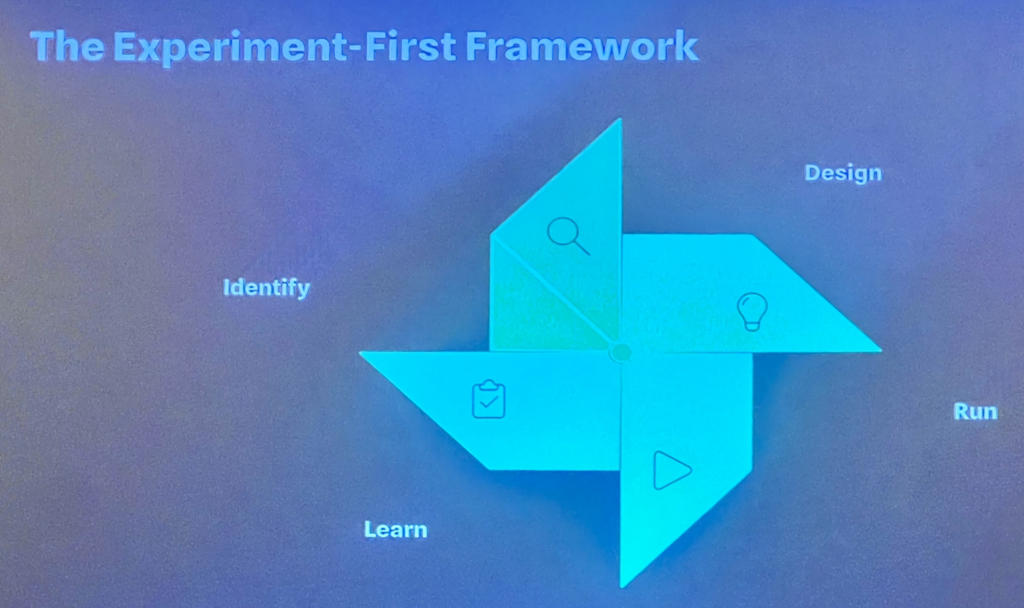
“The learning outcome is the most important part,” said Cilley. “Not only is this very similar to a process improvement framework, but it’s also how an Agile project management works.”
Welcome to Innovation Theater
What does failing small actually looks like?
Cilley called failing small “Innovation Theater.”
He said it involves a big announcement, an innovation committee being formed, a consultant being hired, and an 18-month roadmap being created.
What happens? Energy dissipates, priorities shift, the roadmap collect dust and nothing ships
Real Innovation Practice:
What does real innovation practice look like? Cilley said it involves a small team, a 60-day pilot, a deferred success metrics, a member group of 200, and a $15,000 budget ceiling.
What happens? “You learn something real. You ship, adapt, or stop—and the next test gets smarter. And what do people want to do after this? They want to go do it again.”
Giving Teams Real Permission
Cilley said that giving teams real permission involves:
- Define the Sandbox
- Make Failure Speakable
- Time-Box Everything
- Reward Learning, Not Just Results
The Translation Problem
SEE SLIDE
“Can you take digital first and actually translate that into what that means for someone who is designing for it?” Cilley asked. “If not, it’s going to be completely random. Make sure nothing gets lost in translation.”
Technology Decisions
To guide technology decisions, Cilley offered these four guideposts:
- Start with Member Outcomes
- Evaluate Build vs. Buy vs. Partner. “We are in a very different era now with AI? If you have a team, with AI do you really need to buy or partner or can you do it yourself?” Cilley said MHVFCU has a small development team and used AI to build an alternative to paying for an expensive subscription to Salesforce.
- Pilot Before You Platform. “If you try to build it before you pilot, you will never get it out the door.”
- Measure Member Impact Not Adoption. “Usage metrics tell you how many people logged in. Impact metrics tell you whether the member’s financial life got better. Measure what matters,” Cilley said.
The Ultimate Winners
“The institutions that win won’t be the biggest. The institutions that win will be the ones’ that adapt. And that’s where we win,” said Cilley. “You’ve got to capitalize on that. You’ve got to realize that’s your advantage. You can’t wait two years. You can get out in front of JPMorgan now. You already have the mission, your members; loyalty and you know your members’ needs. This data is priceless. So, capitalize on it. Build the muscle, not just the plan.”