

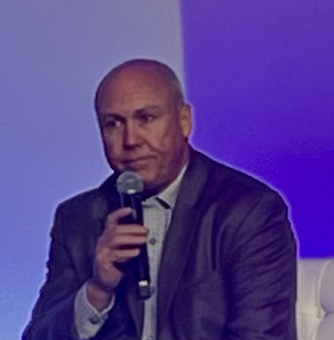
LAKE BUENA VISTA, Fla.—How credit union investments in fintech firms are reshaping relationships, valuations and expectations for both sides was the subject of a panel discussion here.
At NACUSO’s Reimagine conference, the session, “Powering Influence Through Investment,” featured Scott Daukas of One Washington Financial as moderator, with Doug Leighton, formerly of Visa and now consulting with fintechs; David Dean of Evergreen Financial Technology Group; and Nick Evens of Curql Collective.

Here’s a look at some of what was discussed:
Daukas: When a credit union takes an ownership stake, what changes in the relationship and how should both sides design it?
Leighton: Users of that service, or even the intention to use that service, are a really good indicator that the product and service are meeting an important strategic need, and other credit unions will share that same vision. What you get when you make the investment is something like a super user. You have somebody who is providing active feedback, with data, product input and even code development that helps that product improve.
A typical user may not be so generous with their feedback or as candid, so you now have users that are really helping the fintech succeed as much as the product or service is helping the credit union succeed. That benefit should be structured. If you are making the decision to invest, those considerations need to be included in the contract. Are there pricing concessions because you are an investor? What are the expectations around data sharing? Are there governance opportunities, board seats or at a minimum advisory committees that the credit union can sit on?
You don’t want that to be an afterthought. You want it to be considered when you are papering these agreements so that you can gain the collective good of the investment as well as the product co-development and advocacy.
Daukas: How hard is it to get credit unions that are a bit slower to launch products to support the owner-user model?
Evens: It is a huge struggle. You have to have strategic alignment going into the investment. That is what we focus on. Like Doug said, there has to be that strategic fit first and foremost before anything else.
Daukas: Talk to us more about valuations and deal structures.
Dean: Valuation and pricing are what get you in the door. Deal structure is what gets you back out, and whether you get back out the same way. More important than both, and it’s something we talk a lot about, which is the investor mindset. If you are going to invest in businesses on behalf of others, you should not make decisions any differently than if you were investing your own money. At the end of the day, would you still make that investment if it were your own money, or your kids’ money? If the answer is yes, then you go for it.
Then you become a super-user. You do everything you can to make that investment successful by using the product, promoting it and sharing your experience. I think it is very important to go all in. I had a credit union leader tell me it was really more of an R&D play, that if they made some money that would be great, but they were really just trying to learn.
Respectfully, I would push back on that mentality. If you are going to make an investment, go all in, become a super-user of the fintech, promote it, and if not, then don’t make the investment.
Evens: Valuation matters. Sometimes credit unions are doing direct investments at valuations that do not make sense, and you have to realize the downstream effect of doing that. Not caring what the valuation is is the wrong answer. If you invest at an incorrect valuation, you affect future rounds and how people like us look at that company in the future.
Look at the multiples. Multiples matter. Multiples at 20x or 40x are doing everyone a disservice. We saw a company with less than a million dollars in revenue take money at a $95 million valuation. Be cognizant of that.
Leighton: It also gets more complicated when you are in those later rounds as to the different valuations, liquidation preferences and other things you need to think about.
Daukas: How do credit unions actually evaluate whether the investment is working?
Evens: During COVID, liquidity was rampant, and credit unions also knew that big banks were outspending them drastically on technology. A lot of CEOs said this is about relevance, this is about a seat at the table, this is about seeing the best technology that is coming at us and having a say in the product roadmap. Some of them even said they did not care if they saw a return on their investment as long as they got their money back along the way, because this is the experience they were seeking and being at the table with these fintechs and seeing great things.
That has changed a little bit, but the relevance part is still there. We always say when we are raising money and talking to credit union C-suites and boards that strategic fit is the number one priority. We call it 1A and 1B. 1A is the strategic fit for the technology. We have never had a credit union say they are only doing this for return on investment. That is not why you are doing this, and that is not why we are raising money, although eventually you do want to see a return because the credit unions help these companies get to where they want to be in our industry.

Daukas: What do fintechs get wrong about credit unions when seeking investments?
Leighton: While at Visa, I fell in love with credit unions. One reason is the partnership mindset that credit unions have, which is unique compared to many other clients. I never got a hug when I walked into Capital One. I would set a meeting for six people and one would show up. I would set a meeting for six people with a credit union and two more would show up. It is just a better environment for collaboration, and that is the credit union superpower.
That is what I impress on fintechs, what a great community this is and the opportunities for testing and collaboration. A lot of folks think they want to do business with a big bank because of the deep pockets and the large customer base, but they do not recognize the scale and scope that credit unions have collectively and how they operate in a collaborative fashion.
At the same time, credit unions are regulated financial institutions. There are contractual obligations, policies, procedures and certifications. If you are handling payment information, you have to be PCI compliant. If you do not have those things, you are wasting your time because you are not going to proceed to execution or even to a contract. These institutions are looking out for their members’ well-being, and they operate that way. This group treats fintechs as partners, not vendors, and that is an extremely attractive environment.
For credit unions, one final thought is that you are very nice, you are anxious to learn and you will take meetings from fintech founders, but you need to recognize quickly whether this is on your strategic roadmap. If it is, proceed. If it is not, a slow no is a really terrible thing for fintechs because time is their most limited resource. It is better to say not now, maybe later, let’s talk in six months or nine months, because no one on the fintech side will be frustrated by that.



