

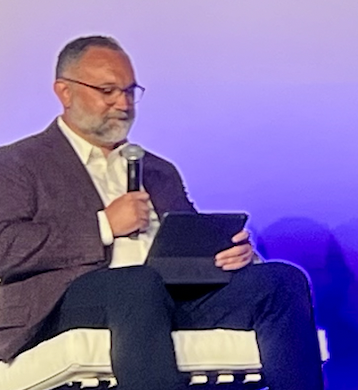
ORLANDO—How can credit unions bring fintech innovations to market more quickly? And what can fintechs do better—and what do they need to understand about credit unions?
Those questions and others were part of a panel discussion at the NACUSO Reimagine 2026 meeting titled, “Fintech Accelerators: How Credit Unions Compete in a Billion-Dollar Innovation Race.”
Participating on the panel were:
- Jim Ryan of Curql, the CU-backed fund that invests in fintech (moderator)
- Dustin Binns of Circuit, an accelerator focused on go-to-market strategies for credit unions
- McKaye Black of Filene Research Institute, which oversees FiLab
- Rowan Hume of Curql Accelerator
- Filip Danielewicz of MSU Federal Credit Union, where its Reseda Group CUSO works with and invests in fintechs

Here’s a look at what was discussed:
Ryan: Q: Banks are spending billions on fintech and innovation. Credit unions can’t match that. How can accelerators change the math?
Black: Banks are spending more individually than credit unions are spending collectively. It’s clear credit unions can’t outspend the big banks. But what we see happening is that big banks are in it for themselves individually. What drives it for credit unions is the idea of collaboration—and I don’t mean that in a vague way.
Credit unions have to do three things. First, we are smaller and closer to members, and we have to leverage what we know. Second, we have to find a way to share our insights and resources with each other. Third, we have to make it easy for fintechs that are really moving the needle to work with us.
Ryan: Walk us through the Curql Accelerate machine. How does it identify and select its cohorts? What does the process look like?
Hume: It’s a robust and thorough process. The strategy is often quantity through quality, which can be hard for some people to buy into. I compare it to a college selection or evaluation process—sometimes seeing something you don’t like is actually valuable, because it gives you a benchmark and helps you understand what to avoid.
From a logistics standpoint, the accelerator typically receives between 250 and 300 fintech applications per cycle. We narrow that down through a scoring process and review every application. Ultimately, we select about 30 to 40 companies for initial conversations.
After conducting diligence—including legal diligence to ensure they are viable companies—we bring in the limited partners from the Curql fund to help make the final selection. That’s a unique part of the process because there is immediate buy-in from those who may ultimately invest.
From there, we select five to 10 finalists. It’s a highly collaborative process.
Ryan: You are in the trenches on the implementation and integration side. What do fintechs get wrong about credit unions when deploying new technology?
Binns: There are two main things. The first is procurement and implementation timelines. Credit unions have a reputation for moving slowly, but that’s by design. What often gets overlooked is the number of internal processes involved.
Many fintechs say they can get a solution live in 30, 60 or 90 days. When I hear that at the beginning of a pitch, it tells me they still have a lot to learn. There are call centers that need to be prepared, back-office teams that need to be trained, and lending staff that need to understand new products.

Fintechs need to become strategic partners by really understanding how a credit union operates—who the decision-makers are, what the onboarding process looks like, and who ultimately signs off on a launch.
The second issue is integration. There are many integration points, whether it’s digital banking providers or core systems. If you’ve seen one credit union, you’ve seen one credit union. Just because you’ve integrated with a platform like DNA, Alkami or Q2 once doesn’t mean it will be the same at another institution.
Building repeatable processes and leveraging relationships with credit unions can help mitigate those challenges. Also, digital banking providers are increasingly offering documentation upfront so fintechs can begin development before formally engaging with a financial institution. Staying on top of those resources is critical.
Ryan: What does working with a credit union look like from a fintech’s perspective?
Danielewicz: Teaching strategic alignment to fintechs starts with helping them understand what’s happening inside a credit union. Many fintechs think they are the one solution that will solve everything.
At a credit union, we want them to meet our head of risk, our call center leadership, our branch leadership, and our marketing team. They need to understand the full scope of what’s going on—the number of projects and initiatives already underway—and how their solution fits into that ecosystem.
It’s not that credit unions can’t move fast. It’s that we already have a lot happening, and fintechs are entering into that environment. They have to understand the pace at which we operate.
The most successful partnerships occur when there is mutual understanding. We move step by step together. Some parts may move quickly, others more slowly. But if we’ve chosen to partner with a fintech and bring it into our ecosystem, we will make it happen—provided there is patience and an understanding of what’s happening behind the scenes.



