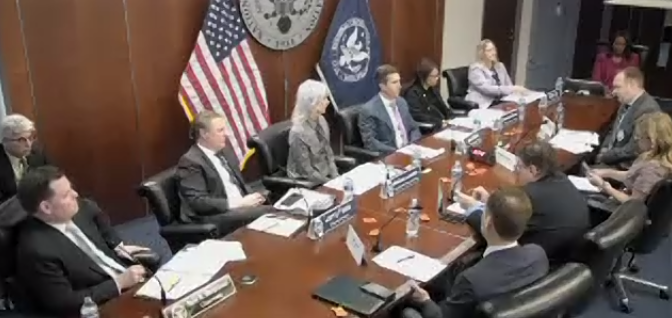
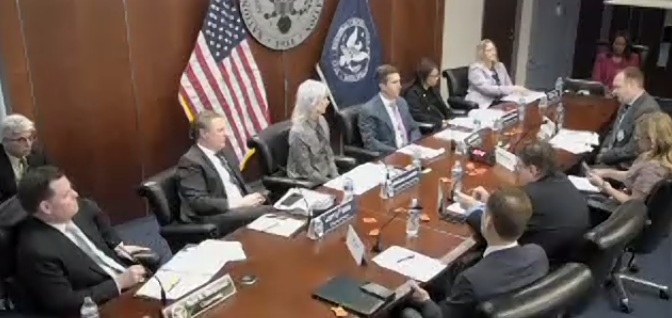
ALEXANDRIA, Va.–NCUA’s public hearing on its 2026-27 draft budget included the opportunity for representatives of four credit union trade groups—after they had made their statements—to ask questions of the agency’s staff on everything from issues related to the biggest and smallest CUs, to extended exams, and more.
Below is a look at the questions asked and responses provided. A full story on the hearing can be found here.
How is the ONES Office Adjusting?
Curt Long, chief economist, America’s Credit Unions: As the agency is evaluating its ONES division, how are you thinking through its right size and how that relates to how you see systemic risks for the industry?
Larry Fazio, executive director, NCUA: We have a supervision and exam model for the largest credit unions. We also have enhanced regulatory standards—capital planning, stress testing, among others–for the largest credit unions. There is math that goes into what does it take to examine that portfolio.
Obviously, we’ve made choices about how to examine them, supervise them, and the time it takes, the level of expertise needed–there’s not a direct algorithmic approach that exactly equates to this risk. But between the regulatory standards, the enhanced examination and supervisory standards, which include enhanced data and analytics for those institutions, we do believe that historically that has been a good approach to managing the risk that those institutions pose to the (share insurance fund).
What About the NCUA Reorganization?
Long: As the agency pursues reorganization, will there be opportunity for stakeholder input?
Fazio: We’re not planning to put out the whole reorg for comment, but as we go through the process there will be opportunities for people to provide input. But, big picture, that’s a board decision.
NCUA Chairman Kyle Hauptman: We have an incentive to get this wrapped up…and communicated internally. You can’t have 23% (of staff leave the agency) and try to do things the same. We don’t try to do more with less, we try to change what we’re doing…I think, board strokes, we’ll probably have (the reorganization) done by December when I think we have to approve the budget.
Where Will the $10 Million Go?
Jason Stverak, Defense Credit Union Council: The draft budget shows $10 million for technology for efficiency gains. How will that $10 million be used?
Fazio: We knew we were going to have a big reorg and we also knew we had various administration priorities to make sure we invested in, one of which is to enhance customer experience.
When you do that there are costs. We didn’t know exactly what those were going to be. We’re already in the process of piloting Microsoft Copilot and I think we’re going to be rolling that out pretty broadly soon. We’re looking at some other capabilities.
There have been requests for NCUA on decisions or actions or approvals to try to better automate that and to also allow the applicant or the requester to see where things are…We’re doing a lot of that because there is the efficiency side and it’s also a better experience for the user. Hopefully, it cuts down on the confusion and the misunderstanding or the calls.
But we don’t currently have an exact road map for the $10 million.
Which Positions Will be Hired?
Jennifer Wagner, EVP, chief advocacy officer, GoWest CU Association: About the 23 FTE placeholders (in the proposed budget): Is that a holding place after the reorg is complete to determine those positions?
Melissa Lowden, deputy CFO, NCUA: We are holding them there in anticipation of hiring up to the level we are allowed to hire to. We can’t go above 967 employees. We don’t have a home for them in place yet because the reorg is (not yet in place).
Hauptman: Seventy or so of the people who (took voluntary separation packages) are still here and working through Dec. 31. That will have no impact on the budget, but we still have some adjustments to make.

What About Tools to Aid Extended Exam Process?
Wagner: The proposed budget relies on extended exam cycles and off-site analytics. Are there any discussions around additional tools or training to help examiners in that new extended process?
Lowden: The extended exam cycle has helped NCUA and credit unions, as well, I think, reduce the burdens on them in terms of the examination and training. There’s a lot of things going on at the agency. You’ve seen our recent proposal on removing reputation risk from the examination. There’s information that’s gone out about changing the way that we do the examination.
As we continue to update examination supervision policies we’re definitely keeping an eye on staff and making sure that that gets communicated, along with training for them, as well, in terms of analytics.
How to Bring More Quality to Quality Control?
Micheal Edwards, counsel, Cooperative Credit Union Association: Over the past few years our members have reported that the time to finalize exams has gotten longer due to a quality control process. Will that take longer with fewer staff? Could that be augmented with machine learning?
Fazio: The analysts in the office or the supervisory examiner (review) the report before it goes to the credit union to make sure we get it right. We’re following policy around quality control, but we are adjusting those parameters to provide more flexibility…
The second piece is, yes, one of the AI things we’re interested in is can run those reports through AI. (Although it may not know substance) it can find other things, like is this clear? Is it well-organized, is it grammatically correct? We’ve been looking into some different things out there.
What About CURE?
Edwards: What about CURE? Howwill reductions affect chartering and FOM expansions, technical assistance to smaller CUs, etc.?
Fazio: Our goal is to really not impact the customer experience. In fact, we want to improve where we can, even with some downsizing. Our commitment is to make sure that that doesn’t happen. We’re human, we might have a few hiccups along the way in the transition, but our goal is for that not to (affect the process) and hopefully even improve it.
We’re finding ways to work smarter to get the same outcome but with less steps.