ALEXANDRIA, Va.–With a proposed budget for 2026 that is more than $100 million smaller than what it was proposing just a year ago, NCUA used a public hearing to share an overview of how it will be allocating dollars in that tighter budget next year, while representatives of four CU trade groups offered praise, shared concerns, asked NCUA to consider recommendations and more.
The CU Daily has separate reporting here on the questions asked by the trade group representatives of NCUA staff and how NCUA responded.
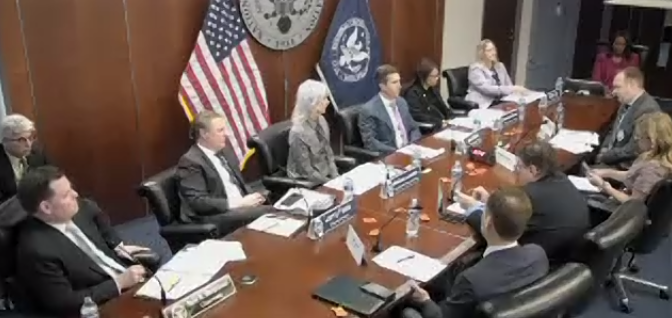
The public hearing on its staff draft budget for 2026-2027 was a departure from prior years when NCUA staff primarily sought to justify budget increases and the trade groups decried the larger expenditures and called for cuts to be made. But that changed with a White House Executive Order earlier this year directing agencies to cut their budgets by 20%, something NCUA was primarily able to do via compensation packages that led to voluntary staff departures, along with other reductions.
‘What Efficient Government Looks Like’
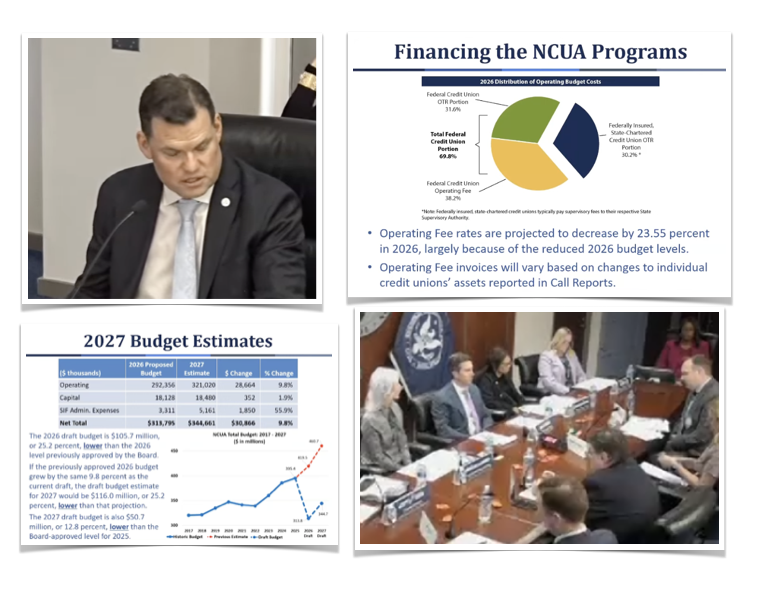
In remarks at the beginning of the hearing, NCUA’s lone board member, Chairman Kyle Hauptman, who noted that moving the budget hearing to a different space than was used for the hearing in 2024 also resulted in a savings of approximately $5,000, said his own staff has been reduced by 20%, while NCUA has also cut contract spending by $16 million and decreased personnel overall by 23% through the voluntary separations.
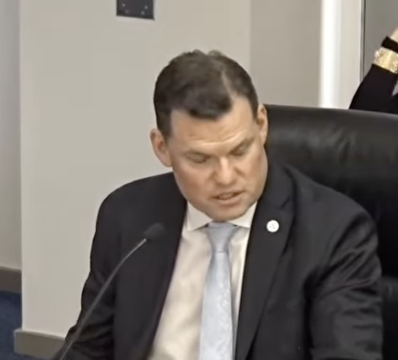
“Yes, we have a smaller workforce but this team represents what efficient government looks like,” said Hauptman. “Our support of credit unions is not stopped or stalled. We’re driving efficiencies to improve technology, streamlining processes and reducing unnecessary burden for both credit unions and ourselves.”
Hauptman said the NCUA staff draft budget is not a final product, but is instead a “starting point for us to build with the feedback we’ve received today.”
Where the Money is Going
Melissa Lowden, deputy chief financial officer with the agency, provided an overview of the budget, noting the 2026 proposed budget is 25.2% lower than what was previously proposed, a decrease of $105.7 million.
The reductions, as the CU Daily has been reporting, reflect 288 fewer full-time employees, a reduction of more than 20% following White House-ordered cuts made earlier this year. A sufficient number of NCUA staff voluntarily took payouts so that the agency was able to hit its target without letting anyone go. Approximately 70 of those individuals are still working at NCUA, but will have departed by year-end.
The draft budget incudes funding for 23 new employees for positions that have not yet been identified. That will bring agency employment to 967 people (positions related to the Central Liquidity Facility (CLF) are separate).
Reduced Exam Frequency
In her overview, Lowden touched on numerous themes, including reduced exam frequency for well-run credit unions, better matching of examiner resources with identified risks, and greater use of off-site analytics to bring down costs. There have also been reductions in travel expenses related to examiners, along with cuts to contractor-related expenses.
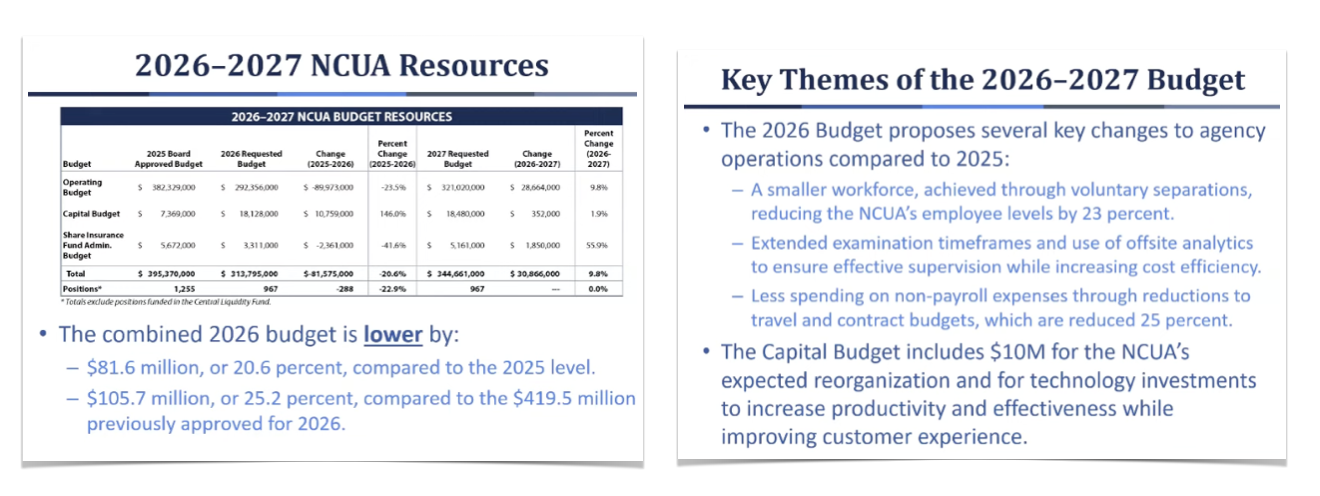
NCUA’s proposed budget can be seen in the graphics below, which were shared during the budget briefing.
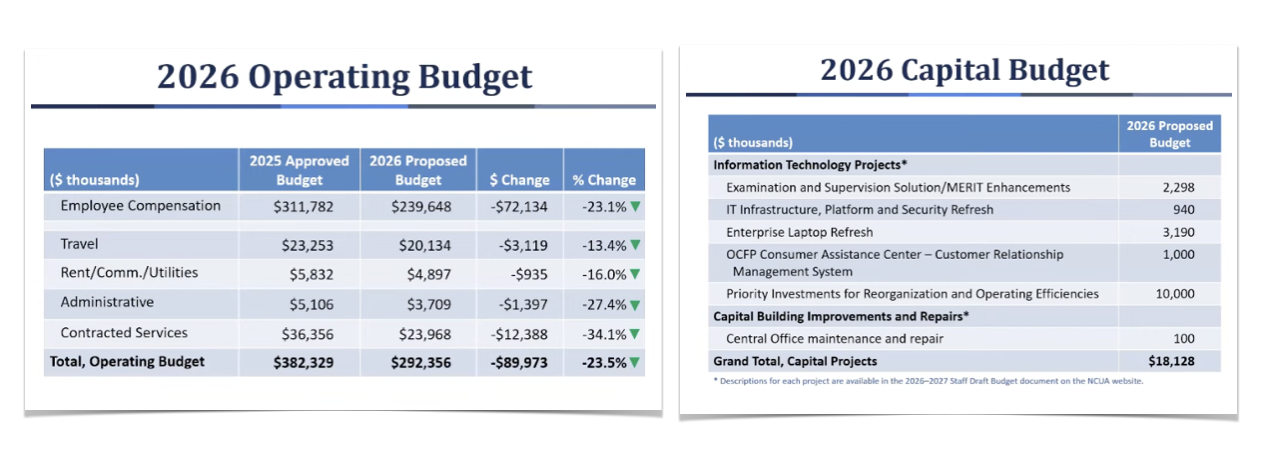
Lowden said employee pay and benefit-related expenses now comprise close to 82% of the operating budget.
She further shared the proposed capital budget, which can also been seen in the graphic. Lowden said the capital budget’s two largest projects involve replacing NCUA laptops and upgrading software, and a next-generation customer relationship management system, as the current system will no longer be supported by the vendor.
Ten-million-dollars of the capital budget is going toward reorganization-related expenses.

Building Sale Provides Offset
As the CU Daily reported here, NCUA sold an asset—fittingly, the Austin, Texas office building that was formerly home to its Asset Management and Assistance Center–earlier this year for $3.4-million, and Lowden said the proceeds have been put toward the 2026 draft budget.
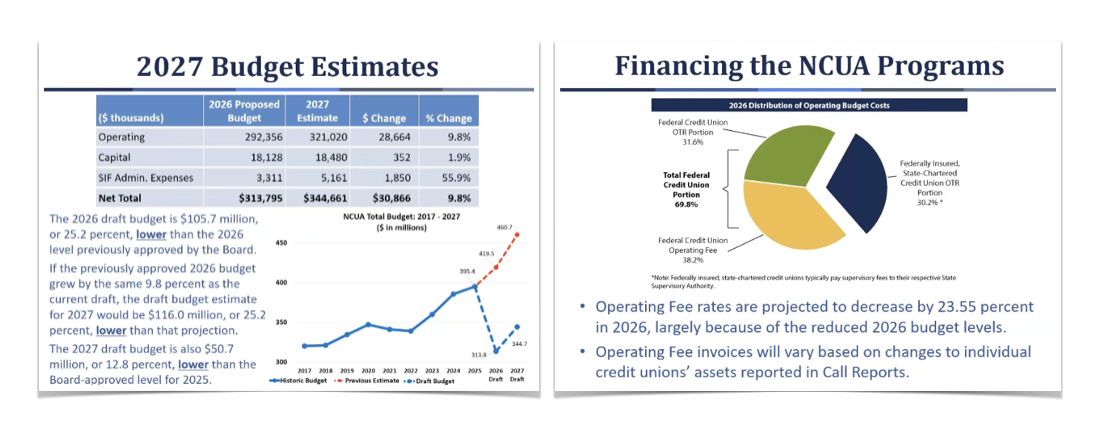
The 2027 draft budget shows an uptick from what NCUA plans to spend in 2026, but Lowden said it is still $50.7 million lower than what had originally been proposed. She said the agency will be able to determine during 2026 whether it can lower its expenditures further in 2027.
In response to a question from Hauptman over why the budget spike in 2027, Lowden said there will be increased compensation and non-payroll costs, NCUA is forecasting a smaller surplus from 2026 will roll into 2027, and it will no longer have the proceeds from the sale of the AMAC building.
Hauptman added that the approximately $345 million budget for 2027 is almost the same as the agency’s budget for 2020, and when factoring in inflation is actually 20% smaller.
“Seven years ago if you had said we’re going to have the same budget in 2027 that we had in 2020, people would have said ‘deal’,” Hauptman said.
Operating Fees for FCUs, SCUs
When it comes to funding NCUA and the overhead transfer from the NCUSIF, Lowden said federal credit unions fees will cover 69.8% of the 2026 budget and fees from state charters will cover the rest.
What Four Trade Groups Told NCUA
Here’s a look at what four people recommended to the NCUA board during the budget hearing:
America’s Credit Unions: List of Recommendations is Shared
Curt Long, chief economist, VP-data and research with America’s Credit Unions, told the meeting that a more modern, risk-based, and innovation-focused supervisory framework “depends on carefully directing spending toward the areas of greatest impact,” and that the budget should not only fund ongoing operations but also drive internal efficiency, improve accountability, and ensure every dollar contributes to mission success.
The White House-ordered budget reductions, said Long present an opportunity “rethink operations and build a leaner, mission-aligned workforce.”

The Recommendations
To that end, America’s Credit Unions is recommending the agency should:
- Consider redirecting hiring funds to modernization that reduces recurring personnel and travel costs
- Prioritize collaboration and technology over duplicative roles through shared-service models for HR, procurement, and IT, and adopting hybrid or virtual field offices.
- Evolve its supervisory strategy by focusing examinations and travel on the highest-risk credit unions, supervising low-risk institutions remotely using data and analytics, and tying staffing and travel budgets to risk tiers and performance history.
Rightsizing Offices
Long urged NCUA to right-size its specialized offices to reflect real risk and avoid duplicating the CFPB.
“Spending must be tied to measurable results, with a focus on efficiency and modernization, he said. “And the agency should invest in innovation—helping credit unions safely adopt new tools and technologies for the future.”
Long praised NCUA’s efforts to reduce its budget and its head-count, especially as the number of credit unions declined. But he added, “…NCUA should avoid understaffing and ensure consistency in examiner experience and staff points of contact.”
IT and Cybersecurity
America’s Credit Unions supports the IT spending reductions as long as they don’t come at a cost of weakening cybersecurity or system reliability, he said, saying the trade group would also like to see greater detail on its capital projects, including any AI use and how those tools will improve productivity.
“Finally, if reorganization affects regional structures or examiner staffing, credit unions deserve transparency to ensure supervision remains responsive and regionally informed,” Long said.
Other Capital Budget Considerations
Long added that America’s Credit Unions also supports modernization of examinations through MERIT, and called on NCUA to keep credit unions updated on the progress it’s making, including posting future RFPs and notices of awards so that credit unions can track contracting budget changes from year to year
Defense Council: Examining the Where, Not the How
In its statement, the Defense Credit Union Council’s chief advocacy officer, Jason Stverak, said that even in times of streamlining, the question should be where reductions will be made, as opposed to how much the reductions will be. We appreciate that the NCUA is providing a more streamlined budget
Stverak said the Defense Council believes there are ways the “budget decreases can be more strategic,” including:
Fewer Credit Unions Automatically Warrant a Proportional Decrease in Supervisory Expenses, Regardless of any Directive to Streamline Expenses
As of June 30, 2025, the NCUA supervised 163 fewer federally insured credit unions compared to the same time last year. “This change alone saves time and money and should be reflected in the budget,” Stverak said.

Lengthen the Time Between Exams
“As examination staff and resources presumably decrease in the next two years, we encourage the NCUA to lengthen its periods between supervisory examinations further, for additional savings,” Stverak said. “Periods can be extended for CAMELS 1 and 2 credit unions, ensuring effective supervision and protection of the Share Insurance Fund while freeing resources for higher-risk credit unions and priorities.”
DCUC believes tech investments should enable that process, he said, adding the organization supports the investment in updating MERIT.
Decrease Travel Expenses
Stverak noted NCUA’s 2026 budget shows a 23% reduction in staffing, a 24% reduction to contracted services budgets, but only a 13% reduction in budgets for employee travel. Given new tech tools, Stverak said DCUC believes NCUA can cut its travel budget even further.
Rethink Reductions in Office of External Affairs & Communications
Noting the 82% proposed cut in the Office of External Affairs and Communications (OEAC), Stverak called the decrease “dramatic” and said “this is the wrong time to diminish a function that ensures open communication with industry stakeholders, Congress, and other regulators.”
Stverak had acknowledged that reduction may be due in part to the agency’s reorganization, something agency staff later confirmed.
“OEAC uniquely reports to the chair of the NCUA, and not the executive director or the entire Board, which ensures the agency’s external communications align with the chair’s priorities and objectives,” Stverak said. “Curtailing its resources could inadvertently reduce the chair’s ability to set the tone of the agency and its outreach strategy.”
Find a Better Cure for CURE
Citing the 30% reduction in budget and 22% reduction in staff within the Office of Credit Union Resources and Expansion (CURE), DCUC called on NCUA to preserve CURE’s capacity to oversee chartering, field of membership expansion, assistance for low-income and minority credit unions, and the Community Development Revolving Loan Fund programs and training opportunities.
To offset reductions for CURE and OEAC, DCUC called for further budget reductions to the Office of Consumer Financial Protection.
Recommendations Offered
DCUC further recommended NCUA reduce the OCFP budget further to:
- Focus its consumer protection resources on higher-risk institutions
- Direct resources to less costly financial education initiatives
- Ensure proportional consumer compliance supervision for credit unions with under $10 billion in assets.
GoWest CU Association: Look Out for the Largest AND the Smallest
Jennifer Wagner, EVP and chief advocacy officer at the GoWest Credit Union Association, which represents CUs in six western states, said the proposed $81.5 million total budget reduction in 2026 is savings that “directly benefit credit union members.”
“..The changes that have been made in the NCUA’s exam program to drive efficiencies are already being felt by credit unions in the GoWest region,” Wagner said. “Credit union leaders have shared recent examples of improvements in their exam experience including fewer examiners on site, all-remote exams, shorter exam times, and improved pre-exam preparations.”

Focus on ONES
Wagner said GoWest want to ensure “resources remain aligned with risk” by prioritizing staffing within the Office of National Examination and Supervision (ONES).
“ONES plays a critical role in supervising both Corporate Credit Unions and the unique needs of the largest natural person credit unions, which together hold a significant share of insured assets,” she said. “While a failure within this group is unlikely, the impact to the Share Insurance Fund would be outsized and, under credit unions shared risk model, could create losses for all federally insured credit unions.”
Wagner also called on NCUA to prioritize staffing of CURE, as it’s vital to smaller credit unions.
While pleased to see a 33% reduction in the examiner training budget, Wagner said GoWest has some concerns, including that a focus on training remain.
“Finally, we strongly encourage the NCUA to maintain its investment in relevant staff travel, which promotes communication and transparency with the industry,” she said.
Cooperative CU Association: Avoiding a ‘Double-Whammy’
Michael Edwards, counsel for the Cooperative Credit Union Association, which represents four states in the northeastern U.S., told the budget hearing that the savings NCUA is now seeing should be allocated toward the reserves of the National Credit Union Share Insurance Fund (NCUSIF) to reduce any potential “double-whammy” from a premium being assessed at the same time many are increasing their loan-loss reserves and also recording larger loan-loss expenses due to CECL.
Edwards said there are also opportunities to reduce the overhead transfer rate because the SIF’s equity ratio is at 1.28% (five points below the normal operating level of 1.33%) largely due to increases in insured shares, and not due to any losses.
The Risk From ‘Procyclicality’
“This can result in so-called procyclicality, which bank supervisors define as a causal feedback loop by which the financial system amplifies the business cycle, possibly leading to increased financial instability,” Edwards said. “In other words when financial conditions deteriorate like they did during the global financial crisis 15 plus years ago, federally insured credit unions got hit with multiple high costs at once…There is potential for this type of procyclicality feedback loop, because CECL focuses on expected credit losses instead of incurred losses, and it also factors in macroeconomic conditions. This means that a negative macroeconomic forecast could result in increased loan-loss expenses for a federally insured credit union, even if that institution does not experience increased loan delinquency let alone defaults.”

Adding to the NCUSIF’s reserves could help address that potential issue, he said, adding that when the NOL exceeds 1.33% NCUA could then authorize a dividend be paid to credit unions.
Amid staff reductions, Edwards said the CCUA also wants NCUA to retain knowledgeable staff with experience across a number of areas.
“Credit unions need examiners who understand how credit unions typically operate,” he said, said it’s especially true for smaller credit unions, which is why the CURE office is important.
Little Ships, Big Ship
Noting those same smaller CUs pose a much smaller risk to the NCUSIF, Edwards called on NCUA to give more regulatory focus to larger credit unions that are more complex.
Credit unions with assets below $100 million, he pointed out, collectively have assets of $77 billion, “significantly less than the total assets of Navy Federal Credit Union alone, which had approximately $192 billion in total assets.”