

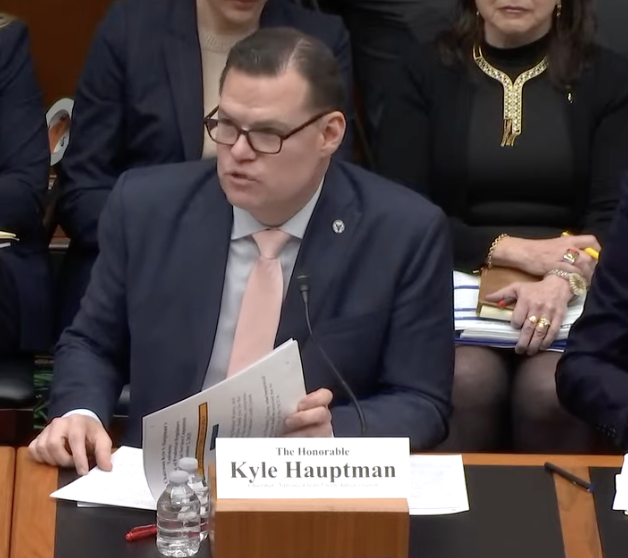
WASHINGTON–In testimony to a congressional hearing, NCUA Chairman Kyle Hauptman outlined how the agency has reduced over-regulation, eliminated regulation by enforcement, and worked to “foster innovation.”
In addition to Hauptman, others testifying before the House Committee on Financial Services’ semi-annual hearing featuring prudential regulations, included:
- Michelle Bowman, vice chair for supervision with the Federal Reserve
- Jonathan Gould, Comptroller of the Currency
- Travis Hill, acting chair of the FDIC
After offering an update on the size and scope of credit unions in the U.S., Hauptman said in his prepared statement that CUs continue to do the work they were founded to do as a “grassroots effort to expand financial services and provide low-cost credit to groups and communities that were otherwise excluded from the financial system.”
He pointed to the federal credit union interest rate cap of 18% as being “quite a bit lower than what banks are allowed to charge” and said what makes the agency unique is that given its role and responsibilities, “NCUA is the OCC, FDIC and the Fed all rolled into one, because in addition to being a regulator and insurer we’re also the source of emergency liquidity through the Central Liquidity Facility.”
‘Fair & Transparent’
Hauptman told the committee NCUA is meeting its statutory obligations while also remaining aware that over-regulation can “stifle innovation and growth in a way that could threaten the viability of the credit union system.”
“Our regulatory activities must be fair and transparent,” he said. “We must avoid the perception and the reality of regulation through enforcement.”
Hauptman said he the agency now works to ensure the right rule is in place before enforcing it.
“It’s worth noting that as an insurer NCUA’s incentives are aligned with the success of the credit unions we regulate,” Hauptman said, adding that avoiding regulation through enforcement is official public policy. “It is on our website and it flows through to the Examiner Manual. It merely extends the same protections that our civil servants have under civil service law through to the institutions that we regulate to right size our approach to safety and soundness.”
Fostering Innovation
Hauptman further said NCUA is working to capitalize on the opportunities created by the Trump administration to “foster innovation as a first priority.”
He said the agency is reviewing its regulations to remove any that are “obsolete, overly prescriptive or unduly burdensome.”
“We have a new strategic plan that guides our priorities through 2030 and a couple of months ago we invited credit unions to share their ideas on how to strengthen the system, highlight future issues and tell us what they would change about our strategic plan,” Hauptman said. “We’re using that feedback to ground our planning for Main Street priorities. We will focus on safety and soundness, protecting the fund and creating space for credit unions that innovate responsibility, especially in leveraging artificial intelligence and digital assets.”






2 Responses
Giant *kudos* to Chairman Kyle Hauptman and his team, they are already taking steps to help reduce the regulatory burden on small credit unions. Small credit unions have very limited resources, and despite their simple operations, they have been saddled with an compliance burden that is increasing every year, often from regulations which are often designed for large institutions. Small credit unions are disappearing at an alarming rate – and they are the heart and soul of this not-for-profit cooperative movement. What is suffocating small community credit unions, while offering benefit to members, or safety and soundness? NMLS, CECL, HMDA, inane DOR threats (for non urgent and non impactful findings), pressure to over-comply and hire 3rd parties at considerable expense, examinations that are lengthy fishing trips for items of low consequence… Shall I go on?
Doug Wadsworth
President of Tri-CU Credit Union
President of the Endangered Small CU Defense
What is suffocating small community credit unions, while *NOT* offering benefit to members, or safety and soundness?