

By Adam Stewart

Credit unions have always prided themselves on serving members, not shareholders. The distinction shapes everything from how we price products to how we measure success. It’s why credit unions consistently rank high in member satisfaction surveys and why many members stay with their credit union for decades.
But in a financial services environment where every institution claims to put customers first, that advantage only matters if members can see and feel the difference in practice. Trust and transparency used to be assumed, and now the stakes for getting them right have never been higher.
Qualtrics’ 2026 Consumer Trends Report found that while consumer trust has improved to 76%, the relationship between trust and loyalty has never been stronger. Satisfied consumers are four times more likely to recommend a business, almost four times more likely to trust it, and almost two and a half times more likely to purchase additional services. What credit unions were built to provide is now what the market values most.
The question is how other institutions are responding to this shift, and whether credit unions are doing enough to leverage our natural advantage.
Where Trust Breaks Down
Credit unions earn trust and member confidence because their structure keeps them closely aligned with the people they serve. As member-owned cooperatives, decisions are guided by long-term value for the membership rather than shareholder returns. That structure naturally keeps members’ interests at the center of conversations about products, pricing, and service.
Banks, by comparison, operate under a different set of expectations. As shareholder-driven organizations, they balance customer needs with performance targets and investor expectations. This model isn’t inherently negative, but it can create competing priorities that pull focus toward financial performance over customer value.
The Motivation Behind Fintechs
Fintechs offer yet another model. Their innovation-driven approach has introduced speed and simplicity across the industry. At the same time, fintechs are often backed by venture capital or growth investors, which means they must demonstrate rapid expansion and a clear path to profitability. This differs from the credit union model of people over profits and reinvesting into the cooperative for the benefit of members.
The FinXTech 2025 Credit Union Survey shows that 73% of credit union leaders identify fintechs as their primary competitive threat, with neo/challenger banks close behind at 54% and big banks at 48%. Yet research from the American Bankers Association found consumers trust traditional banks over fintech payment providers by a 6-to-1 margin when it comes to fraud protection.
What Transparency Actually Looks Like
Regulatory disclosures don’t build trust. Simply put, consumers don’t read 47 pages of legalese and feel good about it. Real transparency offers clarity about how an institution operates, what things cost, and why. Publishing straightforward pricing in plain language and explaining why fees exist rather than burying them in boilerplate are critical ingredients to creating loyal relationships with members.
Loan decisions work the same way. When applications are declined, many institutions stop at the decision itself. Credit unions can offer more transparency by explaining why and what a member can do to improve their position. This takes more time, but it builds relationships that transcend individual transactions.
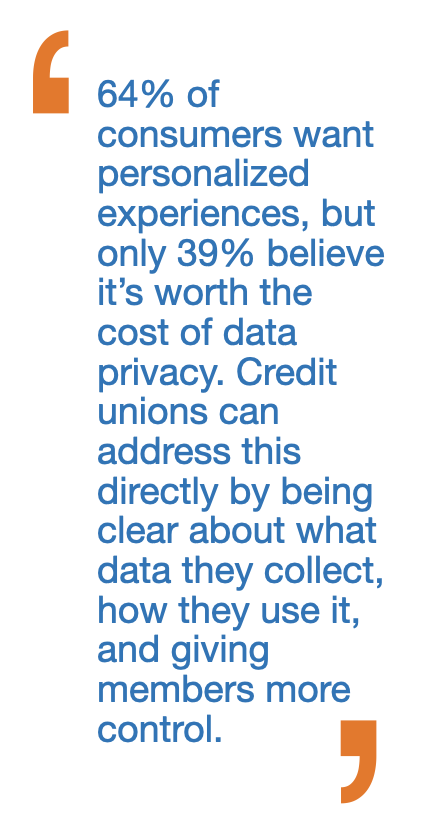
What’s more, Qualtrics showed how data usage has become a defining concern: 64% of consumers want personalized experiences, but only 39% believe it’s worth the cost of data privacy. Credit unions can address this directly by being clear about what data they collect, how they use it, and giving members more control.
Education that Builds Relationships
Financial institutions talk constantly about financial literacy, but the execution often undermines the message. While sponsored seminars and gamified interfaces are oftentimes meant to encourage more trading and spending, true financial education goes beyond slapping a logo on a slide deck or re-creating a user interface that doesn’t help solidify financial health.
Credit unions can offer something different: education that builds understanding first, with the expectation that informed members will make better decisions. Under the cooperative model, member financial health directly benefits the institution.
Consumers resonate with financial education when it’s made accessible on the platforms they’re familiar with, like social video apps, and is intuitive through vehicles like interactive calculators. A consistent cadence of material across multiple channels helps reinforce trust and transparency with the audience.
A Significant Generational Opportunity
The generational opportunity here is significant. Younger members want financial guidance but distrust institutions. They’ve watched economic volatility affect their families and communities. They’re skeptical of advice that comes with strings attached.
Credit unions can meet that skepticism with genuine education tied to life stages. A college graduate needs help understanding how different financing choices affect their trajectory, whether they’re ready to borrow from us today or not. A member preparing to buy a home needs clarity on how mortgage qualification works and what steps improve their position, regardless of timeline.
Digital tools can scale this approach. Interactive calculators that show how different choices play out over time. Plain-language explanations that acknowledge tradeoffs rather than presenting everything as upside. One-on-one financial counseling builds loyalty that transcends rate shopping.
Three Shifts to Demonstrate Structural Advantage
Three shifts can help credit unions more clearly demonstrate our structural advantage.
First, audit member communications for jargon and unnecessary complexity. Members should be able to immediately understand what a decision, cost, or term means for them. If they can’t, we need to make it clearer.
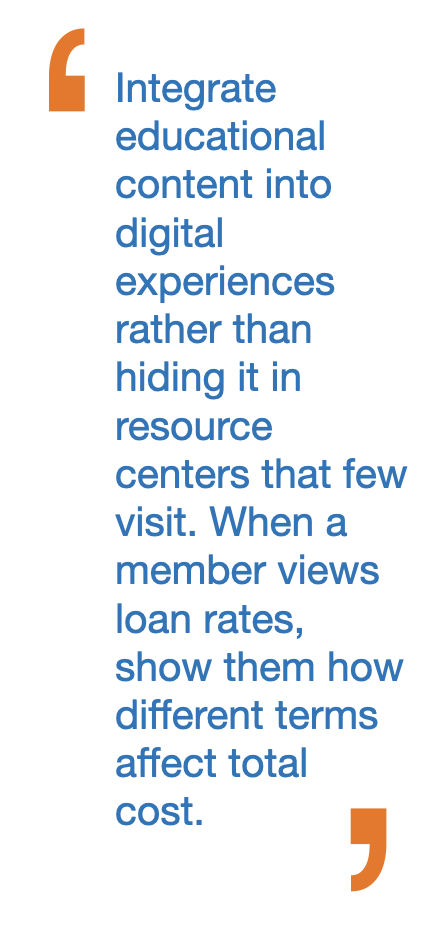
Second, integrate educational content into digital experiences rather than hiding it in resource centers that few visit. When a member views loan rates, show them how different terms affect total cost.
Third, train staff to prioritize explanation over transaction speed. Members who feel rushed don’t feel heard. Staff who have time to explain build the relationships that matter.
This requires accepting that some members will make choices that don’t maximize short-term revenue and trusting that transparency and education build loyalty that more than compensates.
The market now rewards exactly what credit unions were built to provide. Trust drives loyalty more than any other factor, and we’re structured to deliver it better than anyone else. But structure alone won’t capture that opportunity. Every fee schedule, every loan decision, every member interaction either reinforces our difference or makes it invisible.
The work ahead doesn’t require inventing a new competitive strategy. Genuinely building trust through transparency and education ensures members can see in practice what’s already true by design.
Adam Stewart is vice president-retail delivery and sales at PSECU in Harrisburg, Penn.



