
WASHINGTON — Americans’ concerns about affordability are being driven disproportionately by rising housing costs rather than a broad decline in purchasing power or living standards, according to a new report from the American Consumer Institute for Citizen Research.
The August report, “The Role of Housing in the Affordability ‘Crisis,’” argues that inflation-adjusted incomes and purchasing power have generally improved over time, but those gains can be obscured by rising costs in large, essential portions of household budgets — particularly housing.
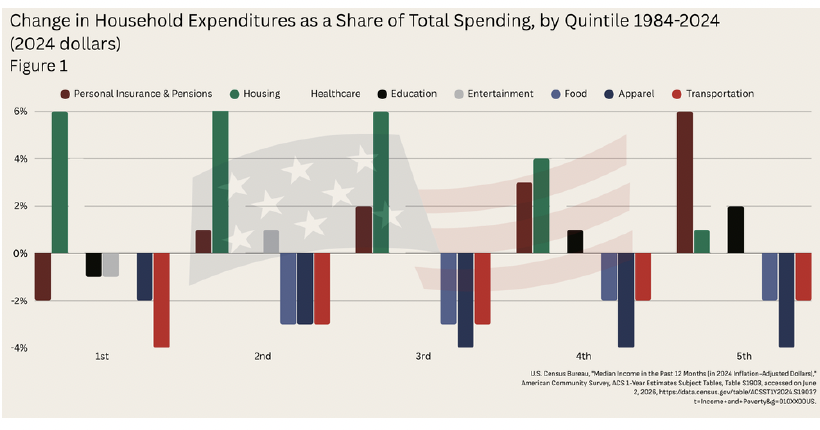
ACI said its analysis of consumer spending from 1984 to 2024 found inflation-adjusted average expenditures increased 18%. Housing accounted for 50% of that growth, while healthcare accounted for another 25%. Housing also consumed a larger share of spending across all income groups in 2024 than it did four decades earlier.
A Financial Juxtaposition
The findings help explain why consumers may feel financially squeezed even as broader economic measures show improvement, ACI said.
Housing is particularly important because it is both a major household expense and relatively difficult for consumers to reduce or substitute. As housing consumes more household resources, it can have an outsized effect on perceptions of financial well-being even when income and consumption are rising, according to the report.
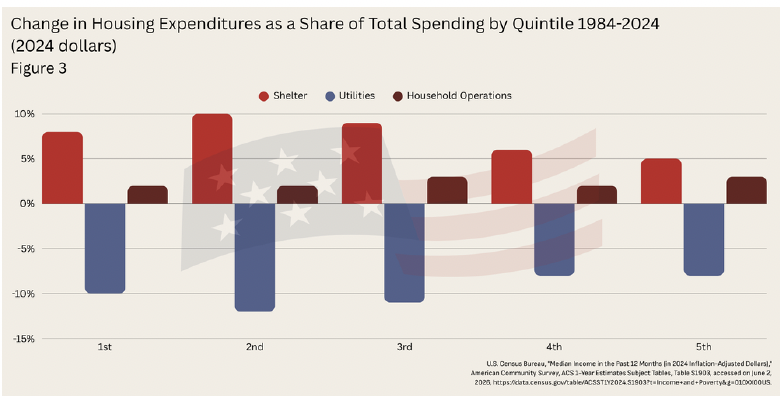
ACI found shelter — which includes owned and rented dwellings — accounts for roughly 70% of housing spending across income groups. Rental expenses drove the largest increase for households in the lowest income quintile, while expenses associated with homeownership were the primary driver beginning with middle-income households.
The Underlying Problem
The Institute argues the underlying problem is insufficient housing supply, pointing to research identifying restrictive zoning, density limits and permitting requirements as factors that constrain construction and increase prices.
ACI said organizations across the political spectrum have reached similar conclusions about the importance of increasing housing supply. Among the approaches cited in the report are allowing accessory dwelling units, micro apartments and manufactured housing, legalizing additional types of housing, making public land available for development and improving access to development capital and housing finance.
The report is more skeptical of policies such as rental assistance and vouchers as solutions to the broader affordability problem. ACI said such programs can reduce costs for individual households but do not reduce the underlying market price of housing unless accompanied by increased supply.
Caution Against Rent Control
ACI also cautioned against rent control, citing research showing that while such policies can benefit existing tenants, they can reduce rental housing supply and increase rents elsewhere in the market.
The institute similarly questioned efforts aimed at restricting institutional investors from buying single-family homes. ACI acknowledged research showing institutional ownership can raise home prices and reduce homeownership in some markets, but said studies have also found institutional investment can expand rental supply and moderate rents.
ACI concluded that policies intended to lower housing prices should focus primarily on increasing construction and reducing regulatory and financial barriers.
‘Often Misdiagnosed’
“The broader affordability narrative is not without basis, but it is often misdiagnosed,” the report said.
ACI said the data instead point to a concentrated affordability problem in a small number of high-cost necessities, led by housing. Restrictive zoning, regulatory delays and development limits constrain supply and push prices higher for renters and prospective homeowners alike, according to the institute.