

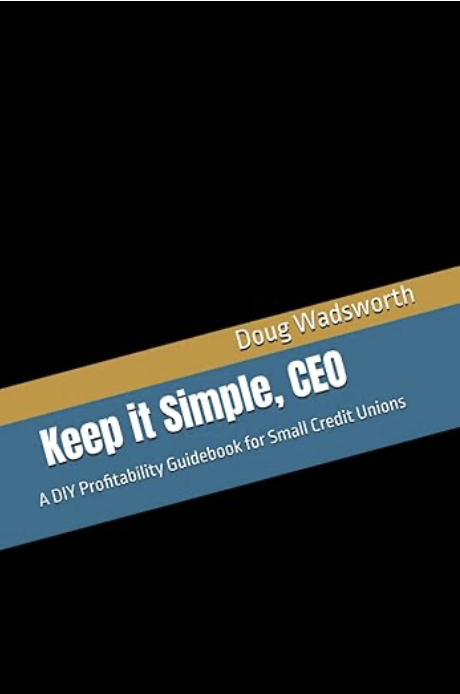
Editor’s Note: The following is excerpted from the book, “Keep it Simple, CEO,” by Doug Wadsworth, CEO of the $73.8-million Tri-Cities Community Credit Union in Kennewick, Wash.
By Doug Wadsworth

After nearly 20 years of managing a small credit union, I have learned that (barring a few rare exceptions), the NCUA cannot help you. By nature, it is a bureaucracy of nitpicky regulators with little real-world business experience, and following their advice will probably hurt your profitability.
It isn’t that they want you to fail, but rather a case of misaligned incentives and priorities. When the NCUA sends examiners that lack common-sense-flexibility, they end up disproportionately hurting the smallest and most vulnerable credit unions. When facing rigid or inexperienced examiners who seem to be on a power trip (armed with the firepower of the federal government), what can you do?
Here are some general tips from my own experience:
Be An Open Book
Don’t be secretive or protective of your credit union records, policies, procedures, or anything: be a completely open book. Otherwise, it looks like you are trying to hide something and their antennas will go up (get ready for disaster). Be as friendly and transparent as possible, answer all their questions and admit when you have made mistakes. Let them look over your shoulder, let them go chat with any of your employees whenever they want, and make it very clear you have nothing to hide. Your exam will go so much smoother because your examiners won’t be suspicious, and you will likely have a better outcome.
Understand Their Motivation
What do examiners want? Simple: They want to be done as quickly and easily as possible, with several clear findings they can write up in their report. They want to run through their simple “checklist,” without tons of reading or complex analysis. They want to make sure the insurance fund (NCUSIF) is not at risk, without worrying that something they missed in their exam that might come back to “bite” them later (making them look incompetent).
Remember, examiners are paid to be fixated on regulatory compliance and risk prevention, that is all. In fact, they likely view all regulatory non-compliance areas as serious risks, even when the regulation has zero bearing on safety or soundness. Crazy, I know.
Outsourcing Pressure
There are thousands of regulations you are required to follow, and if you are creative in simplifying your compliance and doing things in-house, you can save time and money, allowing you to be more profitable, and thus better give back to your members. Hooray!
However, the examiners will not congratulate you. Rather, it will probably irritate them because it makes their exams longer and more difficult. Doing it yourself the cheapest or easiest way possible (despite their complex “best practice” recommendations) introduces “gray areas” into your compliance. This causes your examiners more work and increases the risks to their reputation. They don’t care about how much money you saved, that isn’t their job.
Overcompliance Pressure
Examiners have at their fingertips thousands of excessively lengthy, complicated and time consuming “best practices” that far exceed the simple regulations. If your examiners suggests something like that: nod and smile. Then, politely ask for the reference of the actual wording of the exact regulation.
After they are gone, find the simplest way to only comply with that. You don’t have to comply with the 50-page interpretation of some bureaucrat with zero real-world business experience.
A significant portion of your job should be fighting to keep your policies as short, vague and simple as possible, because you will be forced to comply with them. There is quite a bit of latitude in what your policy says, so keep your life simple, with as few requirements as possible (at least for the dumb stuff that doesn’t impact your safety, soundness or profitability).
NCUA Suggests You “Seek Legal Advice?”
Your job as the CEO is to assess risks and decide which are acceptable (with board input). You really think it will help to get a lawyer involved? Usually not, and the NCUA isn’t actually requiring you to do so (it’s just examiner CYA).
Avoid involving attorneys, especially if the risk of the worst outcome happening is low and the cost of the worst happening is also low.
Examiners Carry Guns
Yeah, we are scared of examiners. If you push back too hard they might get punitive with your examinations and come down harder. They might imply to your board of directors that you are a bad CEO, impacting your pay or even costing you your job. So how do you strike the right balance?
If you got the job as CEO, you have some degree of emotional intelligence (people skills). Those skills need to be fully engaged during examinations. Examiners are people, too. They want to feel their work is important, and their contributions are helpful, so make friends, use tact and give them some wins.
Give the Examiner some Wins
Preferably on “low cost” concessions, so, choose the small battles you are willing to lose (so you can win the war). During the exam they will be giving you constant advice: Some is required, some is debatable (gray area) and some is inane (childishly idiotic). If you refuse to do everything they suggest, it will get ugly fast, so you need to come across as earnest and willing–in 80% of the interactions.
If they start aggressively pushing you to comply with something that you know exceeds the regulation (and is idiotic, costly and labor intensive), now you push back, firmly, but politely. How? “Mr./Ms. Examiner, thank you for the suggestion. To my understanding that is actually a bit beyond what is required, and I struggle to see how the extra cost and work are justified for our small credit union. Although I am not sure right now whether I am willing to do quite what you suggest, I will certainly at least do ‘this’ immediately while I research further into the rest. Thank you.”
Keep in mind that many of their “best practice” suggestions will not end up in the exam report, they are just trying to be “helpful” (shudder). Therefore, nod and smile, say you appreciate the suggestion. They will likely have forgotten, when they come back next year!
When You Risk Losing the War
Your job is to keep your credit union alive, to serve your members and community. If your examiner is hurting more than helping, or simply punitively unreasonable (and the temperature is rising because communication has broken down), that is when you should perhaps go over their head to their NCUA district supervisor.
At the very least, they may assign a different examiner to work with you. As the very last resort, you can go right to the NCUA board and keep your identity confidential by contacting the NCUA Ombudsman. They are an independent third party for “emergencies.” I wasn’t even aware of this role until last year–after 20 years!
The Summary
In Summary: Don’t expect NCUA examiners to care about your profitability or offer useful advice to improve it. Sometimes examiners may tell you what other small credit unions are doing, but that isn’t necessarily helpful if those other small credit unions are also struggling financially (also brow-beaten into over-compliance and outsourcing without taking worthy risks).
If you want to be more profitable, go directly to healthy and successful credit unions peers or business consultants, not to the examiners! Businesses simply cannot be “regulated” into greater profitability.
If you are interested in hearing more of my ideas and experience, check out my new book on Amazon: Keep it Simple, CEO, a DIY Profitability Guidebook for Small Credit Unions.
Doug Wadsworth is CEO of Tri-Cities Community Credit Union in Kennewick, Wash. He can be reached at [email protected] or on LinkedIn here.





One Response
As the author, I have received quite a bit of positive feedback about this article from other CEOs and industry professionals on Linkedin and via email, but it’s always extra intimidating to speak up in public forums, I get it (target on your back)! If you are a small credit union who is desperate for regulatory relief, feel free to follow what we are doing on our Linkedin group for ECUD: The Endangered Credit Union Defense: https://www.linkedin.com/groups/14776042/
-Doug Wadsworth