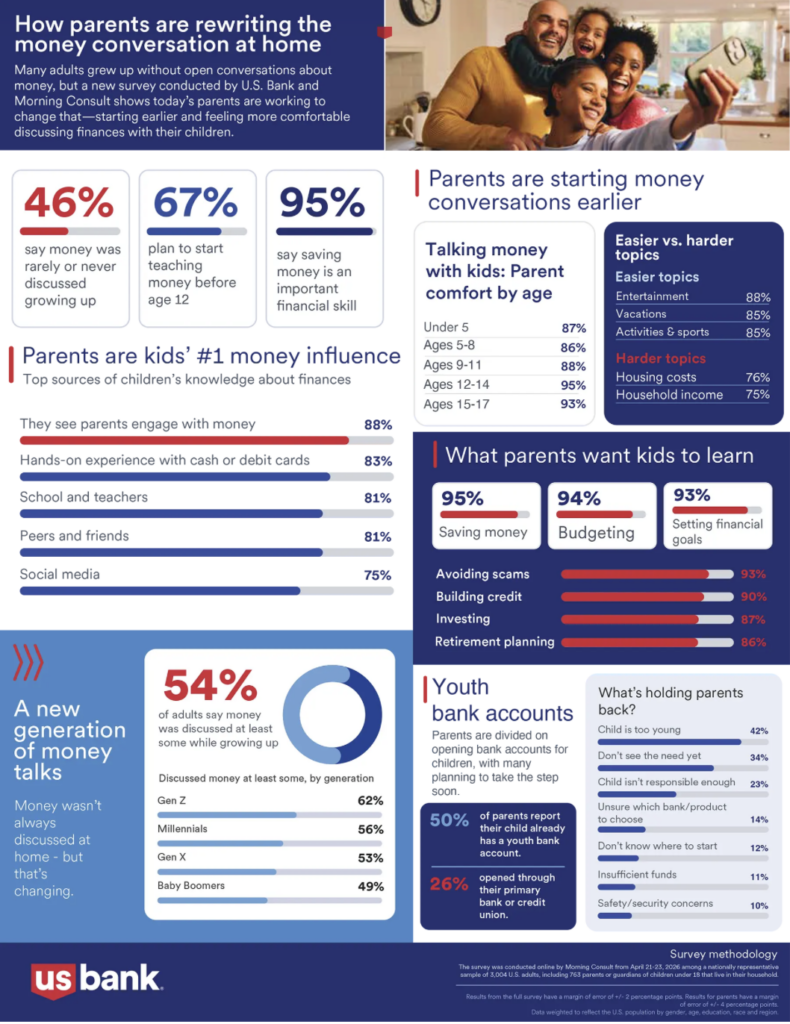
MINNEAPOLIS — Parents are becoming more open about discussing money with their children than previous generations, reflecting a shift in how families approach financial education, according to a new survey released by U.S. Bank.
The study, conducted by Morning Consult on behalf of U.S. Bank, surveyed more than 3,000 U.S. adults and found that while many Americans grew up in households where finances were seldom discussed, today’s parents are more likely to begin money conversations early and emphasize financial literacy.
According to the survey, about half of respondents said money was rarely or never discussed while they were growing up. Older generations were less likely to have had those conversations than younger Americans.
Today’s parents are the first generation where a majority are choosing to have open conversations with their kids about money — and at an early age,” Arijit Roy, head of consumer and business banking products at U.S. Bank, said in a statement. “These findings underscore our continued focus on empowering families with tools to start money conversations and offer real-world experience with money, so the next generation can make smarter financial decisions sooner.”
The Findings
Among the survey’s findings:
- 49% of Baby Boomers said money was discussed while they were growing up, compared with 62% of Generation Z respondents.
- Nearly 90% of parents said they are comfortable talking with their children about money.
- About two-thirds of parents said they have begun, or plan to begin, teaching basic money management concepts before their children reach age 12.
- More than 90% said it is important for children to learn how to save, budget and set financial goals.
- Nearly 90% said the spending and saving habits they model have a greater influence on their children’s financial understanding than schools, peers or social media.
Many Have Taken No Steps
Despite those attitudes, the survey found many families have not taken practical steps to introduce children to financial services.
According to U.S. Bank, only about half of parents have opened a youth bank account for their child. Among those who have not, the most common reason was uncertainty rather than cost. Nearly one-quarter said their child was not yet ready, while more than 10% said they did not know where to begin or which type of account to choose.
U.S. Bank said it is working with family financial technology company Greenlight to provide families with tools designed to help children and teenagers learn money management skills. Eligible U.S. Bank checking account customers receive complimentary access to the service through the bank’s mobile app, which the company said has an annual value of $69.