

ORLANDO–The challenges facing smaller CUs (and the trade associations serving them), new risks from interchange legislation, the data privacy debate and other pressing issues were addressed by the president of America’s Credit Unions during a meeting here.
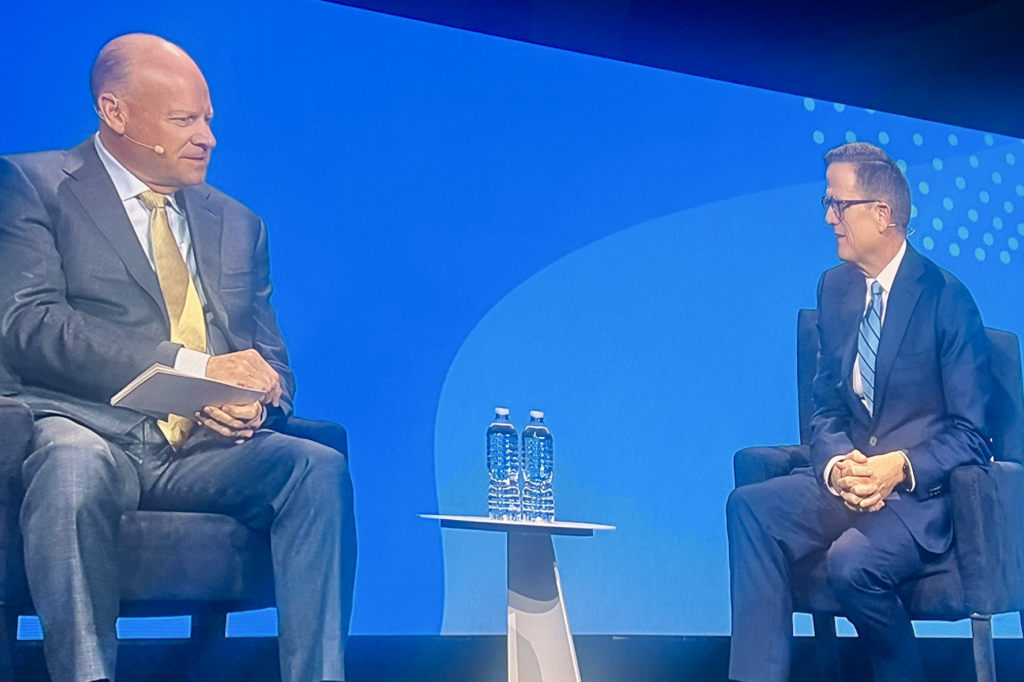
During the VeleraLIVE meeting, ACU President and CEO Scott Simpson joined Velera President and CEO Chuck Fagan for a Q&A. Here are some of the questions posed and how Simpson responded.
Fagan: One of your earliest and most important moves has been the hiring a chief advocacy officer. Tell us more about her.
Simpson: Kathleen Coulombe starts Monday. She is machine tooled for this job. I’m excited to bring her aboard. We have a very capable senior executive team, but we only have one who has been with one of the legacy organizations (NAFCU and CUNA) for less than 20 years, and to have an outside lens coming in, to have unbelievable D.C. capability, someone who can come in from the outside and have an understanding from that perspective is really important.
Fagan: What about the GENIUS Act and stablecoins. Can you share how the process has gone and what mean for credit unions.
Simpson: It remains incredibly complex. Our number-one objective at ACU was to ensure equivalency for credit unions. There were many opportunities where credit unions may not have been contemplated. All of that stuff had to be worked on and was worked on. Credit unions have been really great in leaning in and using the listening machinery we have to emphasize our role. Congress listened and credit unions are included in the ecosystem, wherever it may be going.
The challenge now is we now have proposed rules out for comment. We now need your view of that. The question is to build the rules in a way that ensures we continue to have equivalent opportunity in the future.
Fagan: Interchange is a favorite topic in this room. It’s not just attacks at the federal level but in 25 states where there are 30 bills on interchange that are active. Walmart is a pretty powerful engine. What is your take and what can we do?
Simpson: The good news is at the federal level policymakers have already paid the price for the position they are in. Any lawmaker who would change the position they are in now would pay a new political price. The status quo is what we are hoping for, and Walmart is doing their best to create chaos in as many state capitals as they can and then use that chaos to induce Congress to act.
It is ongoing, it will not be settled, the thing we have in our favor is the incumbent position in Washington. The financial services industry is spending a lot of money and energy to try to stop that in those 25 capitals. When your state leagues call on you, please respond.
Fagan: Banker attacks on the tax status are nonstop. What can you share about that ongoing battle?
Simpson: I spent 22 years in Utah which is one of the most anti-credit unions states. Zions Bank is very active there. I am steeped in attacks on taxation. I was gratified last year to see credit unions’ grassroots energy. It was sufficient enough to stem that little bump in 2025. (Proposals to tax credit unions were) tied to a policymaking stunt called budget reconciliation, which needs 50% plus one vote in the Senate. And that was a huge risk last year because tax policy that was reconciliation.
This is different this year. It’s still a threat. Congress can be crazy, but we don’t have expiring tax cuts, and we are much closer to the election. The worry I have for credit unions is you really have to sort through what really should be DEFCON 5 and what should be vigilance. If we speak of every potential threat as DEFCON 5 and in a hyperbolic way, you won’t be able to sort through what is a real threat. We need to be able sometimes to just deprive an issue of oxygen, and that’s what this season of Congress is about.
There are two issues right now and that is CBP and ICE funding, and that’s it. That doesn’t require and offset or a pay-for. But any ornament hung on that will likely kill it.
Fagan: The president months ago mentioned a credit card rate cap that created a collective gap. What is happening now?
Simpson: There is a fight for the middle of America. There was the talk around junk fees. That was just purely a play to try to convince American voters elected officials felt the pain). It’s the same thing with credit cards and affordability. There are genuine affordability pressures in the marketplace.
The president, I think without socializing it with his team, pulled the trigger and then the team. including the Secretary of the Treasury, started to say, ‘Hey, wait a second, this is not what you think it is. We need to back up this truck.’ Then interchange was sort of brought up. I think with the administration if the rate cap were to become a thing, Congress would have to do it and this Congress at this stage in this election cycle is very unlikely to take that on.

We’ve got plenty of folks both sides of the aisle that understand the dismantling that the rate cap would do and end up harming the very people that they want to protect. It’s always possible and I don’t know how much energy the president is willing to lay down on this issue, but I think we got a hint of it when he made the declaration and boldly declared that date upon which the (rate cap) enactment would be made, and all of those things sort of faded as we pivoted to a different moment/
Fagan: What about data privacy legislation?
Simpson: It continues to be a constant drumbeat. There continue to be attempts at legislation around privacy. There is an intent to hold folks responsible for protection and you have others who want to enable a new way of thinking around privacy, such as blockchain. We are in the challenging position of having to watch all of it, both the impact it has on our systems, our processes and the extension of credit, but also the adjacent things, like shifts in labilities around sensitive data and who is responsible for that.
Then there are the new playgrounds around the availability and optimization of data and making sure these sandboxes don’t put us at a disadvantage. We want to make sure these frameworks ensure equivalency for the industry. We also want to induce innovation wherever we can.
Fagan: What about mergers and consolidation. We’re seeing fewer CUs and perhaps some smaller CUs are being left behind without scale. The smaller CUs play such an important role in what you do in DC.
Simpson: I’ve been in credit unions for 23 years and have watched the trajectory. In Utah, half of the credit unions exist today than existed when I started. It is a challenging reality. I don’t think that compression is unique in credit unions. You see almost an equivalent trajectory in banks.
Here is the concern, and I don’t know how to talk about this. I love small credit unions. There’s nothing like the proximity of a community financial institution. whatever that community may be. It may be a factory or a small town, and I want to do all I can to enable that.
But this isn’t just regulatory pressure, it’s the economy of America. There are so many pressures at work here. A trade association cannot stem some of those pressures. What we can do, we should do, (is address) the regulatory framework for leaders who already wear 12 hats. We are also trying to have the right listening machinery in the family, so we are getting the right communications to our team from smaller credit unions, so that the power dynamic doesn’t silence voices.
There are two concerns that worry me. There is a false notion that growth equals a departure from the underpinnings of being a cooperatives financial institution. When you achieve scale, in a cooperative that value generation goes to the consumer. That falsehood is the lie upon which every banker argument is based, and we have to go directly at that. I think that is a challenge we have inside the family. It is not getting easier to run a small credit union
I think we’ve also reached an inflection point where smaller credit unions see even larger credit unions making scale decisions, and we are feeling some of that tension in the family.
We can’t allow democracy to become a fiction. CUs are controlled by their members. We can’t stop that. Credit unions choose who they are and continue to choose who they are. It is the challenge we have as a trade association. You have asked one of the most difficult questions. There are things we can fix and there are things we will never have our hands around.
I’ve seen mighty powers in the smaller credit unions, in innovation, in resilience. We need to dump fuel into that ecosystem.



