
CARY, N.C. — Companies with stronger governance, data quality and accountability measures for artificial intelligence are significantly more likely to report higher returns on their AI investments, according to a new SAS report based on research by IDC that also found banks are seeing a 6.6x difference in returns.
Organizations investing in what SAS describes as “trustworthy AI” practices were 15 times more likely to report strong or high returns on AI projects than organizations lagging in those practices, according to the second annual Data and AI Impact Report: The New Economics of Trust.

Specifically, as outlined below, the research found banks are seeing 6.6X difference in returns on AI vs. other organizations.
The global study surveyed 2,699 decision-makers with knowledge of or influence over their organizations’ data and AI initiatives. Respondents were from 28 countries and included the banking, insurance, life sciences and public sectors.
SAS said organizations with the strongest governance, data quality, explainability and auditability practices reported at least twice the return on investment from AI deployments as their peers. Fewer than 1 in 20 organizations classified as trustworthy AI “laggards” reported similar results.
“When AI works, it’s incredibly impactful,” SAS Chief Technology Officer Bryan Harris said in a statement.
Harris said organizations seeking greater accuracy and consistency need to incorporate domain expertise into agentic AI workflows while maintaining human governance and oversight.
Explainability Emerges as Key Issue
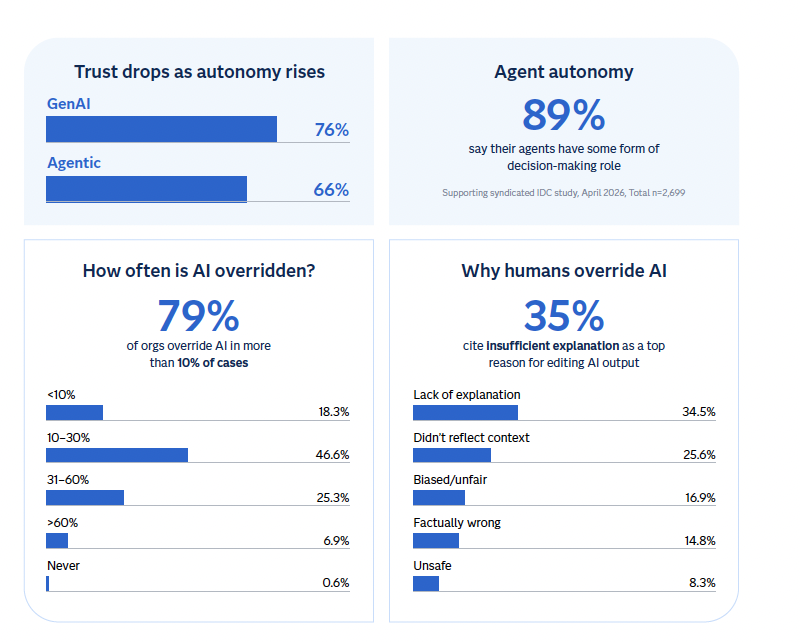
SAS said the research found employees are increasingly reluctant to rely on AI systems when they cannot understand how those systems reached their conclusions.
The issue could become more significant as organizations deploy agentic AI systems capable of performing tasks and making decisions with greater autonomy.
Among the findings:
- 97.2% of users override AI-generated recommendations in at least some cases.
- The leading reason employees override an AI recommendation, even when the output is considered correct, is the system’s inability to explain its decision.
- Trust falls from 76% for generative AI to 66% for agentic AI.
“As AI becomes more autonomous, organizations face a new challenge: maintaining confidence in systems people don’t fully understand,” Chris Marshall, vice president at IDC, said in a statement.
Marshall said stronger oversight, explainability, accountability and data foundations are becoming prerequisites for organizations seeking to scale AI.
Trustworthy AI Linked to Higher Returns
The research found a significant performance gap between organizations SAS classified as trustworthy AI leaders and those that have not implemented similar governance practices.
Among the findings:
- 62% of organizations investing in trustworthy AI measures reported strong or high ROI from their AI projects, compared with 4% of lagging organizations.
- Organizations with the strongest trustworthy AI practices reported 1.85 times greater gains across 13 business outcomes, including revenue growth, cost savings and customer experience.
- 85% of trustworthy AI leaders are increasing their investment in those practices by more than 10% this year.
SAS said the findings suggest organizations achieving the greatest returns from AI are not necessarily using different technology but are managing and governing it differently.
Data Infrastructure Remains a Weak Point
Many companies are attempting to deploy increasingly sophisticated AI systems using data infrastructure that has not kept pace with the technology, according to SAS.
Only 17.5% of enterprises surveyed reported having fully optimized data infrastructure considered mature enough to support the demands of agentic AI.
Organizations with optimized data foundations were four times more likely to expect strong returns from AI projects and six times more likely to require data-quality and explainability controls, SAS said.
Banks See 6.6X Difference in AI Returns
When it comes to financial institutions specifically, the SAS and IDC research found banks that have built stronger governance, validation and accountability around artificial intelligence are reporting sharply better expected returns and are more willing to allow AI systems to operate autonomously, according to new research from SAS and IDC.

SAS found that 66% of banks classified as “trustworthy AI leaders” expect strong or high returns on their AI investments, a rate 6.6 times higher than banks identified as laggards.
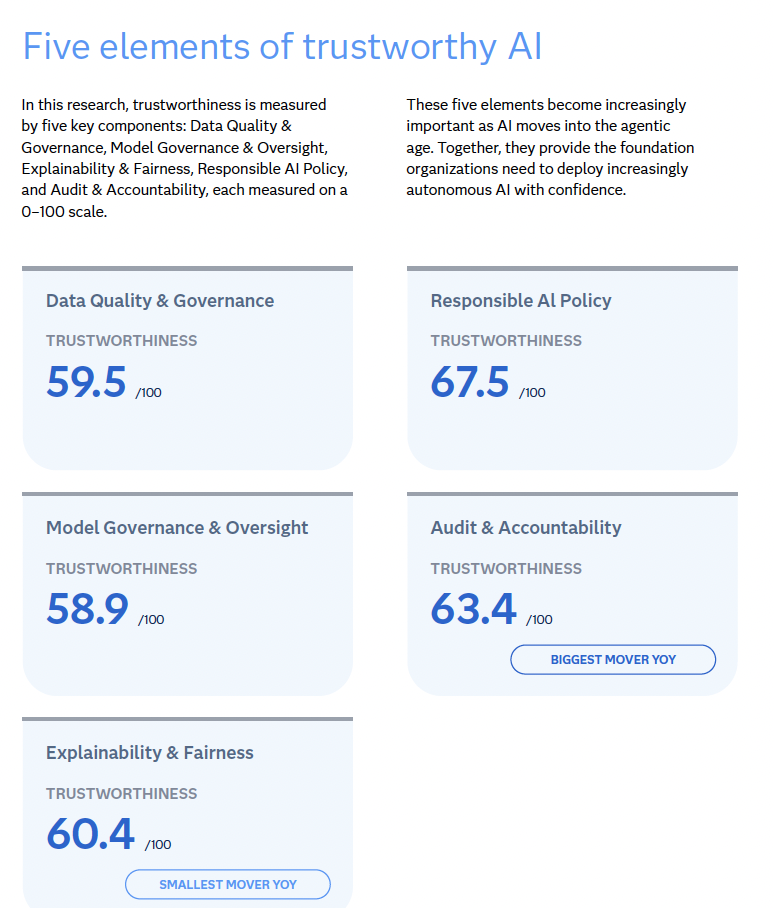
The report defines AI trustworthiness using five measures: data quality and governance, model governance and oversight, explainability and fairness, responsible AI policy, and audit and accountability.
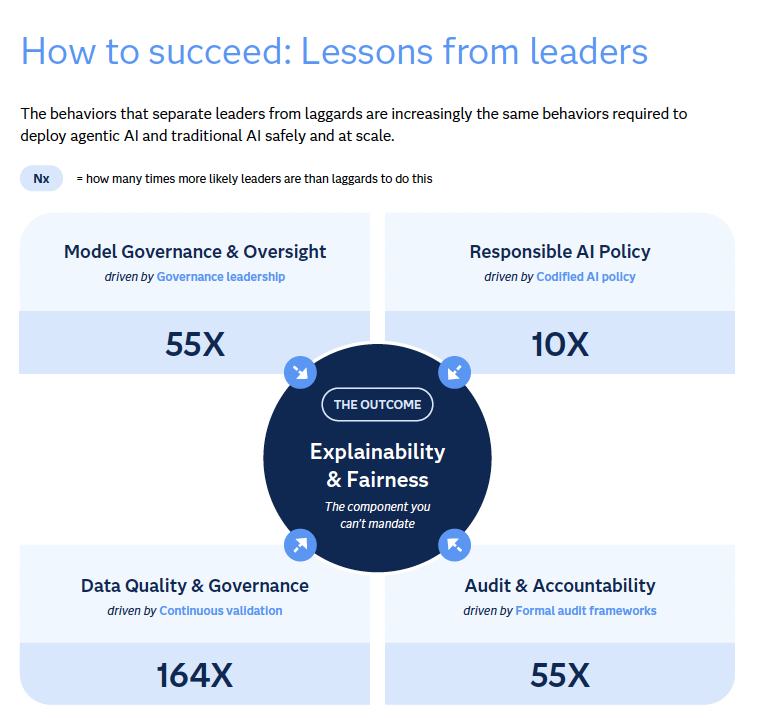
Among banks identified as leaders, 85% have implemented responsible AI policies covering all employees, compared with 29% of laggard banks. More than two-thirds of leading banks also use automated, continuous AI validation, compared with effectively none of the laggard group.
The findings suggest the difference between AI leaders and laggards is less about what banks want AI to do than how much autonomy they are prepared to give it.
Both groups identified credit, risk, eligibility and financial crime detection among AI’s most important applications. But 41% of leading banks consider automated investigations and case management mission-critical, compared with 7% of laggard banks — the largest gap among the banking use cases examined.
“The advantage does not come from choosing different use cases,” the report said. “It comes from building enough trust, governance and accountability to allow AI to operate at speed and scale.”
More AI Maturity Brings Different Concerns
The research also found that banks with more mature AI programs are confronting different risks.
Among AI leaders, 64% cited data privacy and security as a primary concern, compared with 46% of laggards. Meanwhile, laggard banks were more likely to be hindered by reliability concerns and uncertainty over who owns responsibility for AI.
Managing AI autonomy and human oversight was cited as a concern by 38% of leading banks, compared with just 12% of laggards. SAS said that difference reflects the fact that leading institutions are already deploying AI in situations where autonomous decision-making has become a practical issue.
One community bank chief information security officer interviewed for the report said tracing and explaining an AI agent’s decisions remains a major hurdle.
“The biggest challenge with the agent is: If the agent makes a decision, how do we go back and trace it and explain why the agent took certain actions?” the executive said. “That’s one of the reasons why we haven’t really embraced autonomous AI completely yet.”
Banking Outpaces Other Industries on AI Trustworthiness
Banking’s overall trustworthiness score increased to 63.5 from 50.7 a year earlier, according to SAS.
The industry scored above the global average in all five measures of trustworthy AI, with year-over-year improvements ranging from roughly eight to 14 points.
Responsible AI policy received banking’s highest score at 69 out of 100, followed by audit and accountability at 64.6, explainability and fairness at 62.6, data quality and governance at 61.3, and model governance and oversight at 59.4.
SAS said banks appear to be benefiting from their experience with model risk management, extending practices developed over the past two decades to AI more quickly than industries that have had to develop governance structures from scratch.
The Largest Weakness
Model governance and oversight remains banking’s largest weakness, however, with a 10-point gap between perceived trust and actual capability.
The report said closing that gap should be a priority as banks adopt more agentic AI because committees, reporting structures, documentation and approval processes become more difficult to add after autonomous systems are already operating.
SAS said the broader lesson for financial institutions is to adapt controls they already use successfully rather than treating AI governance as an entirely new framework.
“Find the control disciplines you already run well and translate them to AI,” the report advised, “rather than treating governance as a fresh build that slows you down.”
SAS defines trustworthy AI as artificial intelligence designed to be reliable, fair, secure, compliant with applicable regulations and capable of explaining how it reaches decisions.
About the Study
For the study, organizations were scored on a 100-point scale across five areas: data quality and governance; model governance and oversight; explainability and fairness; responsible AI policy; and audit and accountability. Organizations with average scores of 80 or higher were classified as trustworthy AI leaders.