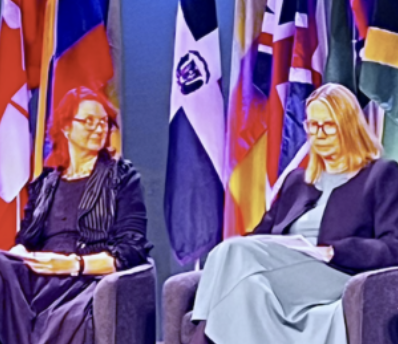
SYDNEY, Australia–The issue of housing affordability and the role credit unions can play along with other organizations was the topic of a panel discussion here.
Participating in the panel during the World Credit Union Conference were:
- Louise Crabtree-Hayes, professorial research fellow in the Institute for Culture and Society at Western Sydney University
- Jocelyn Martin, managing director, Housing Industry Association
- Rolf Stomsoe, chief customer officer, Great Southern Bank (which is a credit union). It has approximately 420,000 customers/members. Like most mutual banks in Australia, about 90% of its lending is in home lending. Great Southern specializes in loans to first-time home buyers, who represented about 35% of its borrowers in 2025.
- The session was moderated by Luke Hannan.

Here’s a look at what was discussed:
Hannan: What are the core issues affecting affordability?
Crabtree-Hayes: Effective deregulation and the financialization of housing, which have been critical in inflating house prices and the cost of homeownership and renting and the increasing ability to move from one to the other. So, we’ve been looking a lot at how we can actually bridge that gap, because in the Australian context at least, there are very limited other options when you’ve been financialized housing system for a few decades. It has really made for minimal choices in terms of what you can move into.
So, a lot of the work we’re doing is looking at that in perpetuity. We really need now to see innovation and strategic intervention.
Martin: The problem is supply, supply, supply. The federal government has set a goal of building 1.2 million homes by 2029. At the moment we’re falling short. The reality is it has been worthwhile to set a target. This is a real number. It is the number of homes we need to build to just meet the need for housing, before we discuss affordability.
We have advocated hard around what is now a significant document, the National Construction Code., which is not national. We do build high-quality homes in Australia, but we only build about 200,000 homes per year. There doesn’t have to be a trade-off between quality and affordability. One reason we’re falling short is we’re not building enough apartments. They require a level of affordability before they even break ground.
Stromsoe: Supply, supply, supply. Australia doesn’t build enough houses, especially in the areas where people want to live and need to live. That is an acute issue for essential service workers.
Hannan: With this gap between renting and buying? Why is this transition of closing the gap so difficult?
Crabtree-Hayes: Supply alone is not enough. The issue is that the market will respond to the return, the price it can get. People will landbank land and wait until they see the return they want. That is not going to deliver affordability. We need targeted intervention that sits between the renting and owning models. We need a structural intervention for affordable housing. There is a renewed role here for the state. It’s also where mission-aligned lenders can play a role. We need a new sector that is purpose-built, so it isn’t so hard for first-time buyers
Hannan: Has anyone nailed this globally”
Crabtree-Hayes: Yes. There are cooperatives in the Nordic states, community land trusts. There are multiple jurisdictions that have done it. But we haven’t done it in Australia.
Martin: If you had spoken to our association 10-15 years ago, we would have said the only housing is a three bedroom, owner-occupied home in the suburbs. We have substantially changed our views on housing. It’s not always about homeownership, although we should not lose sight of that aspiration. Affordability varies in the market. I believe there is definitely an opportunity for us to look at better models. There is a government funding for social housing construction. More recently, they are putting the onus back on the owners. It is shifting the cost on to those people. So, I don’t think the model that’s evolving to support affordable housing is actually working.
Hannan: What are you doing in the first-time buyers’ space, and what structures have you looked at to make it more accessible?
Stromsoe: The work we do tends to be a little more incidental. What we’ve been quite focused on is listening very carefully to our customers about the challenges they experience in terms of access to their first homes and then making a difference where we can. We have capital we can bring to bear, we have credit assessment skills, and we consistently review those.
In the last year we introduced an extended term mortgage. We will now lend out to 40 years and that has helped a number of customers. In Australia it takes 11 years on average to save up the 20% needed for a downpayment.
For us, it’s always about multiple different pathways to homeownership. We emphasize the savings journey so they can afford a more traditional 20% down home mortgage. We have some interesting products there. We are a participant in the federal government’s deposit scheme, with homeowners putting up 5% of the downpayment and the federal government making up the rests. Having the government onboard eliminates the need for LMI.