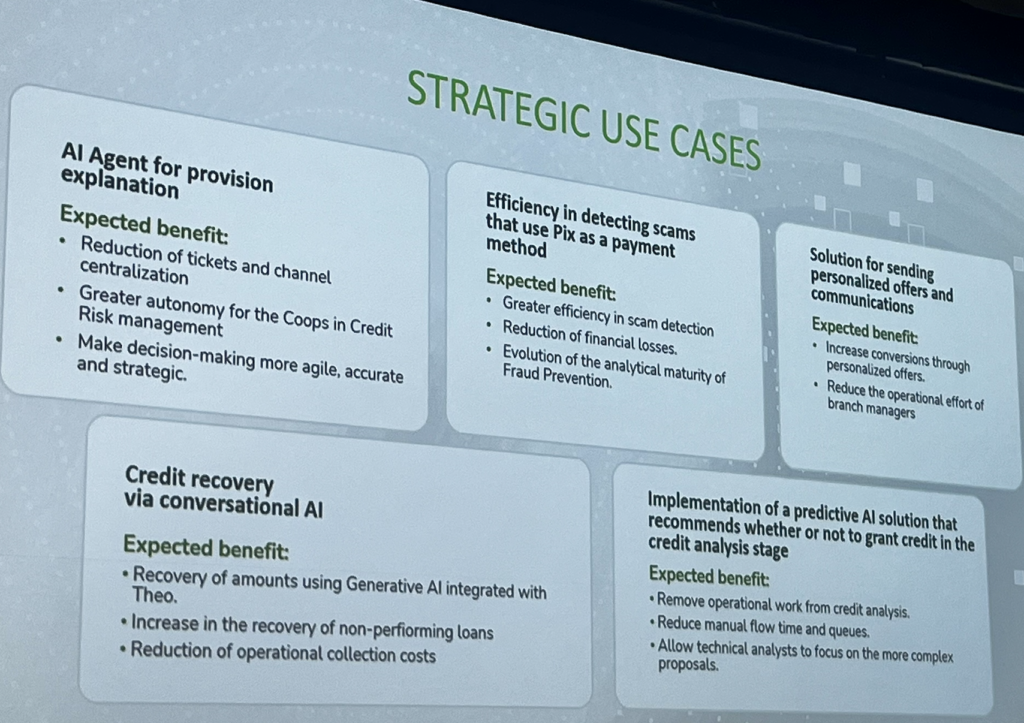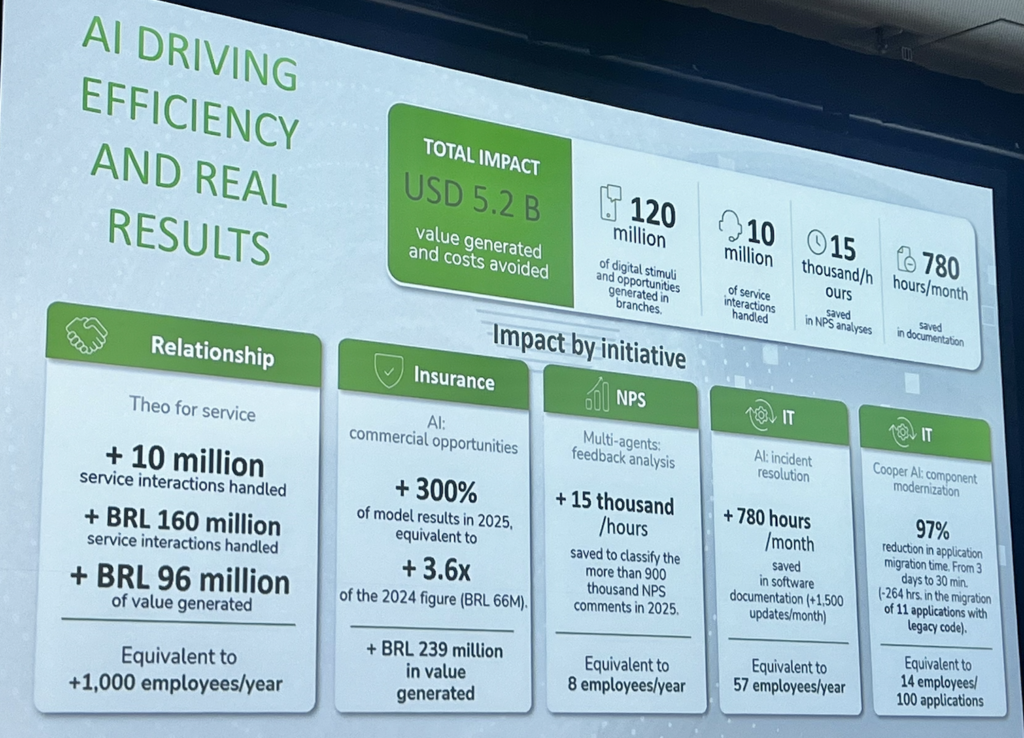
SYDNEY, Australia —The approach being taken by one large credit union movement in using artificial intelligence—including as a tool to be “more human” to members and advice on where to begin and where to focus, was shared by one person here.
Overall, credit unions were encouraged to embrace generative artificial intelligence as a way to deepen relationships with members rather than diminish them, according to Alexandre Barbosa, chief financial officer and economist with Brazil’s Sicredi, who told the World Credit Union Conference that AI’s greatest value lies in freeing employees to spend more time serving people.

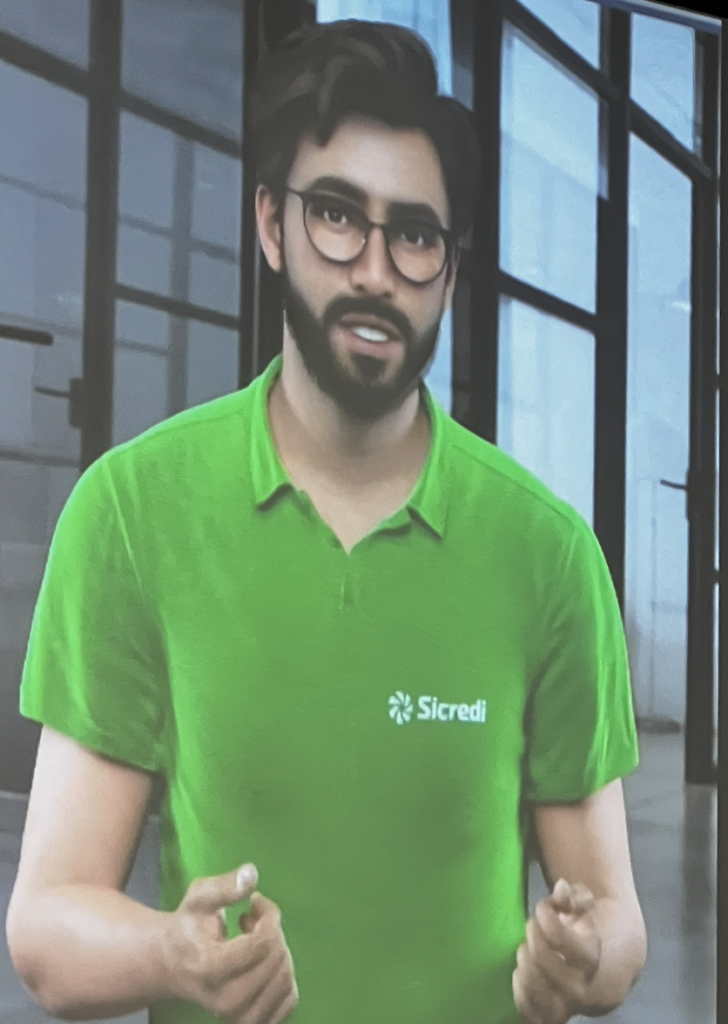
During his remarks, Barbosa was assisted several times by “Theo,” who is Sicredi’s virtual assistant and who addressed the audience.
Speaking to conference attendees, Barbosa said AI should be viewed as a tool that enhances efficiency while preserving the cooperative model’s human-centered mission.
“The key idea is that we should not make this less human,” Barbosa said. “Instead, we need to be more present and closer to our members.”
While AI can organize tasks, improve efficiency and accelerate decision-making, Barbosa said trust and meaning remain uniquely human.
“AI is always going to be on our side, but it will almost never substitute for us if our members want to talk to us,” he said.
Barbosa described AI as a collection of technologies that recognize patterns, learn from data and support — and sometimes even make — decisions. For credit unions, he said, AI should be used to improve decision-making and efficiency while allowing employees more time to better understand members’ needs.
Three Levels of AI
He outlined three levels of AI:
- Machine learning, which analyzes historical data and improves decision-making.
- Generative AI, which helps explain the outcomes of machine learning, allowing financial institutions to better understand and communicate why lending or other decisions were made.
- Agentic AI, in which AI agents perform specific tasks, coordinate work and, when deployed at scale, require governance and management through a common platform.
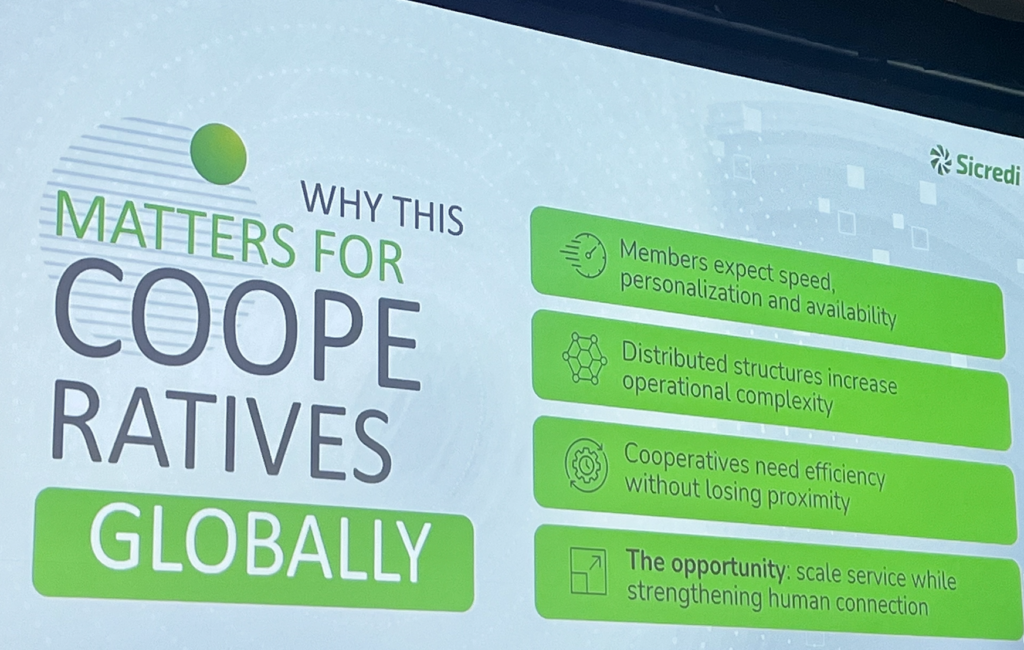
According to Barbosa, AI offers cooperatives an opportunity to grow without sacrificing the personalized service that distinguishes them.
“As we grow, how can we not lose hyper-personalization?” he asked. “AI can help us.”
‘Deeper Understanding’
He said AI can gather and organize scattered information to give credit unions a deeper understanding of members while helping meet growing expectations for speed, personalization and around-the-clock availability.
For Sicredi, which operates through 90 cooperative credit unions across Brazil, maintaining local relationships while expanding nationally is a constant challenge.
“Our cooperatives need efficiency without losing proximity to members,” Barbosa said. “The opportunity is to scale service while strengthening human connection. They are not competing with one another.”
Barbosa acknowledged what he called an “AI paradox.” While surveys show many people say AI is what scares them most, only about 26% of organizations successfully scale AI and capture meaningful value.
Where the Bottleneck Lies
“The bottleneck is not technology,” he said. “It is integration and process.”
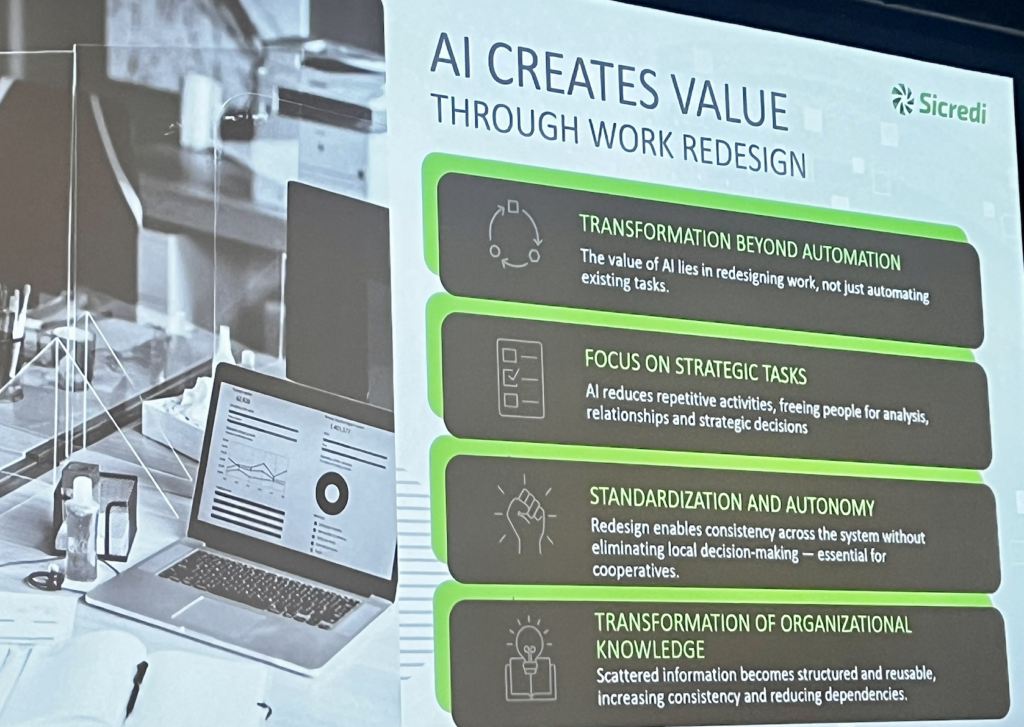
Rather than simply inserting AI into existing workflows, organizations should rethink whether those processes should continue to exist in their current form, he said.
“What usually happens is we take AI and think about it from the outside in,” Barbosa said. “Instead, we have to change our mindset. We should ask, ‘Why is this process still needed?'”
He said organizations should redesign workflows from the beginning and continually adapt them as employees gain experience using AI.
Governance is equally important, Barbosa said, recalling an internal exercise at Sicredi in which staff asked an AI system how to build an atomic bomb.
“It answered us,” he said. “This is why there must be boundaries.”
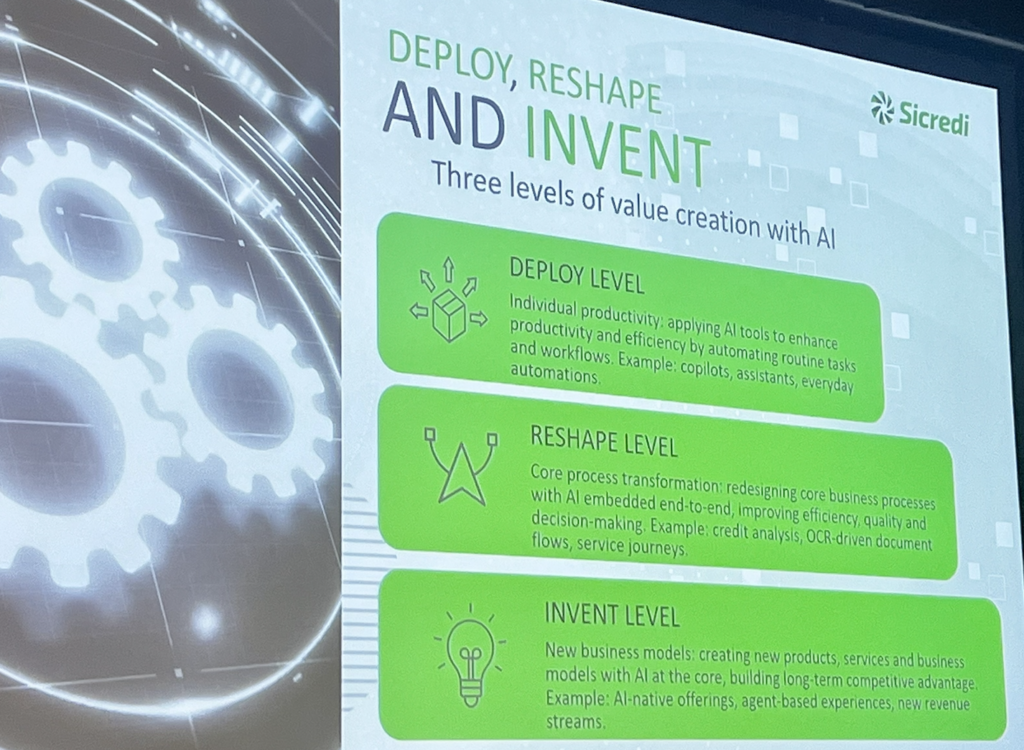
Barbosa stressed that AI creates value through redesign rather than simple automation and encouraged organizations to begin with lower-risk tasks before moving AI into core business processes.
A ‘Brilliant Intern’
He characterized AI’s evolution as follows:
- Predictive AI predicts, classifies and optimizes. “It is a very good calculator.”
- Generative AI creates, writes and reasons. “It’s a brilliant intern.”
- Agentic AI acts, coordinates and executes under supervision. “It is a scalable coworker.”
Barbosa said Sicredi’s scale demonstrates both the opportunities and challenges facing large cooperative systems.
The organization now serves:
- More than 10 million members
- 52,000 employees
- 90 cooperatives
- Approximately 3,000 branches
Sicredi operates under a distributed cooperative model that gives local credit unions autonomy in decision-making while sharing infrastructure and governance across the system.
“We are working with AI to ensure we are as close to our members as when we had two or three million members,” Barbosa said. “At Sicredi, we have the same challenge many cooperatives face — scaling without centralizing everything.”
Barbosa concluded with three key takeaways for credit union leaders.
From Concept to Reality
AI delivers value only when embedded into core business processes, he said. Credit unions should begin with high-volume, repetitive work where time savings can be measured, but the greatest impact comes from redesigning how work is performed.
How to Do It
Successful AI adoption depends on governance, shared infrastructure and a unified strategy, Barbosa said. Fragmented AI experiments create unnecessary risks, while common platforms improve consistency, safety and reuse.
Rather than creating a separate AI strategy, organizations should consider embedding AI into their broader business strategy, he said.
“I believe AI is there to support the business strategy,” Barbosa said.
He also emphasized the importance of continuous feedback from members and credit unions, along with common AI platforms, AI gateways, large language models and reusable AI agents operating within a unified environment.
“When it is all together, it is much safer to scale it,” he said.
AI Enhances, Doesn’t Replace Human Value
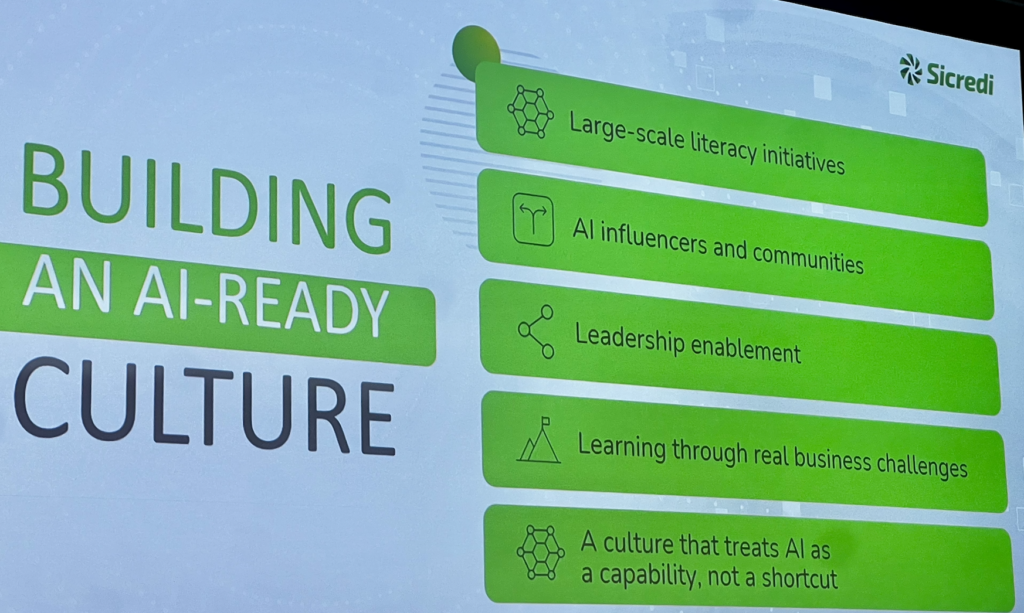
Barbosa said AI should reduce operational burdens so employees can focus on higher-value work.
Examples include:
- Branch managers spending less time on operational tasks and more time serving members in consultative roles.
- Credit analysts using automation for standard cases while applying human judgment to complex decisions.
- Software developers reducing repetitive documentation work and spending more time on architecture and innovation.
“The future of credit unions won’t be determined by who uses AI first,” Barbosa said. “It will be determined by who uses AI best to serve their communities.”