


SYDNEY, Australia —A diverse panel here showed they agree on one point: credit unions and customer-owned banks can’t afford to wait to act when it comes to the tokenization of deposits and payments, and they had some advice on where credit unions should start and what they should be doing.
The observations were shared during the World Council of Credit Unions’ World CU Conference in Sydney during a session titled, “How to Compete in a Tokenized World: From Bank Strategy to Customer Outcomes.”
Panelists included:
- Freya Smith, chief client officer, Cuscal Ltd. (moderator)
- Stu Burns, CEO, Imperium Markets
- Andrea Zanier, CEO and co-founder, ICON Future Technologies
- Camilla Bullock, CEO, Emerging Payments Association Asia
- Nathan Churchwood, head of product solutions and innovation, Cuscal Ltd.
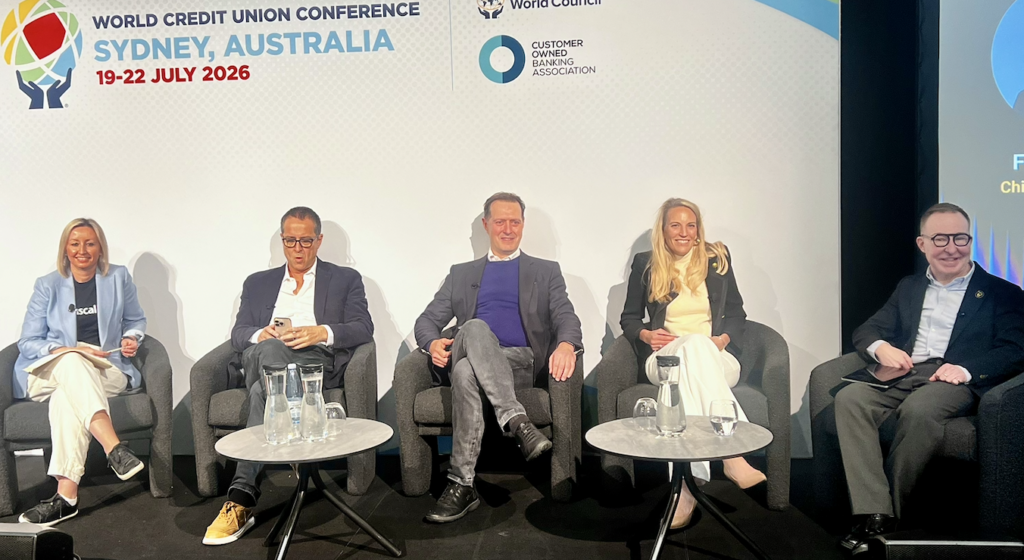
Here’s a look at some of what was discussed and shared.
Smith: When we talk about tokenization, it’s not new. But when we talk about tokenized money, what do we mean? And what part of the value chain will be impacted first?
Churchwood: The transaction itself is what matters because settlement, ownership, data and conditions can all come together within the same environment.
Instead of payment being the final step after a process, money becomes part of the workflow. It is released when specific conditions are met, tied to an asset or obligation, and settled with much less manual coordination.
You’ll hear the term “programmability” a lot today and after this conference because it’s central to what’s coming. If I had to pick the first part of banking that will change, it won’t be retail customer experience. It will begin with wholesale funding, liquidity and settlement. That’s where delays, reconciliation, trapped liquidity and operational friction have the greatest impact today.
My opening view is simple: It shows up first in the plumbing, not in the shopfront. Customer impact comes later, but infrastructure choices begin much earlier.
Smith: What has Project Acacia done in Australia?
Zanier: It has demonstrated that this is no longer theory.
We’re going to see the convergence of industries and sectors working together and leveraging technology. The technology itself isn’t the challenge. It has been around for some time, it’s secure, and it’s proven. The challenge is bringing the system together to use it effectively.
Project Acacia has highlighted the willingness of many different participants to work together using technology in the best possible way.
The next phase is creating certainty around the system. We’re talking about moving hundreds of millions of dollars in milliseconds. The technology is incredibly fast, but people have spent centuries learning to trust banks and payment schemes.
For tokenization to succeed, we need governance, rules and certainty that create an efficient marketplace.
Smith: Can you give us a global perspective? What are you seeing? What works well, and what should we do differently?
Bullock: There are many projects underway globally. Out of roughly 290 financial institutions around the world, only about 3.5% currently have tokenized money offerings in the market. However, approximately 20% expect to launch offerings within the next 12 months.
To capture value, interoperability is essential. That’s the biggest gap today.
Interoperability isn’t one thing. One project we’re involved in has seven different layers. If any one of those layers fails, the entire system won’t work.
Smith: What is to be gained from the Australian model?
Churchwood: Optionality. Institutions don’t have to go it alone. That comes from programmability, but it won’t fully play out until interoperability is solved. Once it is, institutions gain access to liquidity, certainty, lower friction and greater operational efficiency.
Strategically, this is much bigger than any one organization. These models will reshape lending, funding and customer relationships. By engaging early through shared infrastructure and interoperability initiatives, organizations can help shape the wholesale financial system while protecting trust, preserving competition and staying close to their members.
Trapped liquidity carries a real cost. It’s capital that can’t be lent. Once that layer disappears, capital goes back to work. That’s where shared infrastructure becomes so valuable.

Smith: What does tokenization mean from a wholesale funding perspective?
Burns: We work directly with 20 to 30 mutual banks in our marketplace today. It’s important to understand what the broader marketplace looks like. Frankly, it’s a mess. Much of the market still operates through phone calls, emails, spreadsheets and legacy systems.
Take Australia’s $400-billion term-deposit market. Outside our marketplace, there really isn’t a centralized venue or meaningful data. Banks raising money often don’t know where the market actually is.
Mutual banks also face challenges because they typically have lower credit ratings, or at least a perception of greater risk. That means they pay higher rates. Many institutional investors won’t invest below a certain credit rating, limiting the available investor base.
Unlike major banks, mutual institutions generally don’t operate wholesale funding desks, so they rely on intermediaries, adding cost. At the same time, investors have difficulty even identifying which mutual banks are looking for funding.
One of the oddities in Australia is that major banks often pay higher rates than mutuals because of poor market transparency. Then there are manual settlement processes, failed settlements, delays and reconciliation. Tokenization changes that.
Shared market infrastructure allows transactions and settlement to occur simultaneously. Ownership can be maintained on ledger. This is ultimately about democratization.
Smith: What do the Project Acacia use cases reveal?
Zanier: They demonstrate the value of a level playing field. Only under those conditions do you achieve shared liquidity. Markets must be interconnected. Interoperability is essential to creating open markets. Technology succeeds when it solves real problems.
One example involves stablecoins. Traditionally, when a stablecoin is issued by a bank, deposits leave the bank. In the United States, the Hazel Network has demonstrated another approach, where tokenized deposits can move, perform their function and then return to the originating bank. The deposit isn’t permanently lost. That’s an example of technology helping banks rather than replacing them.
Smith: Should institutions view this as a strategic opportunity or a defensive strategy?
Burns: When new technology rolls over you, you can either become part of the steamroller or part of the road. Tokenization is coming. Regulators have made that very clear. It’s not a question of if, but when.
I expect it to begin in money markets and bond markets. Governments are already discussing tokenized government bonds. There is a first-mover advantage. Mutual banks have an opportunity to move ahead of larger competitors by providing simpler, better services to customers.
Bullock: Now is the time to lean in. Don’t fall behind. You don’t have to do this alone. Identify the right partners. Start with contained projects inside your organization and learn as you go.
Churchwood: This is about operational efficiency and strategic participation. Mutual institutions already possess strong trust and deep community relationships. Those strengths will become competitive advantages in a tokenized environment. Shared infrastructure provides the pathway while allowing institutions to help shape future standards. Find partners who already have seats at the table.
Smith: Where does tokenization go from here?
Churchwood: For me, it’s the difference between payments and workflows. Real-time payments answered the question, “How fast can money move?” The next question is much richer: What can the money actually do? Can it automatically release when property settles? Can it trigger when goods are delivered? That’s the power of programmability.
Banking moves from isolated, manually triggered transactions to fully orchestrated end-to-end workflows. Competition shifts away from who owns the fastest payment rails and toward who designs the best customer workflows. Organizations that understand their members’ real-world processes will have the advantage.
Bullock: I see enormous potential in cross-border payments. Nearly all of the global projects underway involve moving money or value across borders. Infrastructure comes first. Applications for customers come second. We still need agreement around frameworks to achieve interoperability. The industry has a long way to go.
Zanier: Regulation also deserves attention. It’s evolving rapidly across Europe, the United Kingdom, the United States and Australia. Australia has become a leader because regulators are working collaboratively with industry.
One particularly important concept is “compliance by design.” Payments can be programmed so transactions only occur within approved parameters. If conditions aren’t met, transactions simply stop. That provides regulators with significant confidence because compliance becomes embedded directly into the transaction itself.
Smith: What changes for the actual customer or business?
Burns: Imagine you’re investing $5 million or $10 million today. Right now, you might negotiate separately with 30 different banks using emails and static rate sheets. That’s hardly an efficient experience.
Under a tokenized marketplace, customers gain access to multiple institutions through shared infrastructure. Pricing becomes available within minutes. Customers choose the best offer. Money moves instantly. Fraud and operational errors are dramatically reduced. Most importantly, customers receive a modern digital experience from their financial institution.
Smith: Audience question: I’m scared. Is this about fraud, or am I simply afraid of change?
Zanier: Technology actually gives us more tools than we’ve ever had before. It’s more powerful. It’s automated.
It can do exactly what we ask it to do. The key is programming it correctly. Markets require rules, and those rules create trust.
If organizations implement technology poorly, reputations can be destroyed very quickly. But if we configure these systems wisely, technology becomes one of our strongest defenses against increasingly sophisticated fraud.
Collaboration is essential. Working together helps us manage risks while capturing new opportunities. Ultimately, every institution should ask itself one question: “How can technology add value to our business?”
Bullock: This is new for everyone. Now is not the time to remain silent. Now is the time to speak up. If you don’t have a voice at the table today, you’ll regret it later.
Smith: Who will be the losers?
Burns: Organizations that fail to reduce costs won’t remain competitive.
Zanier: I prefer to look at it differently. The opportunity is serving members better. Moving faster. Especially helping small and medium-sized businesses and improving cross-border payments. The focus should always be on how technology can better serve members.
Bullock: Watch proportionality carefully. Everyone wants to participate in these new markets. The question is whether smaller institutions will be allowed to compete alongside larger organizations. That’s another reason to speak up.
Churchwood: The losers will be those who dismiss this as simply a discussion about stablecoins. This is much broader than that. It’s about deposit tokens, stablecoins and the future financial infrastructure. We cannot afford to cede control to third parties.



