
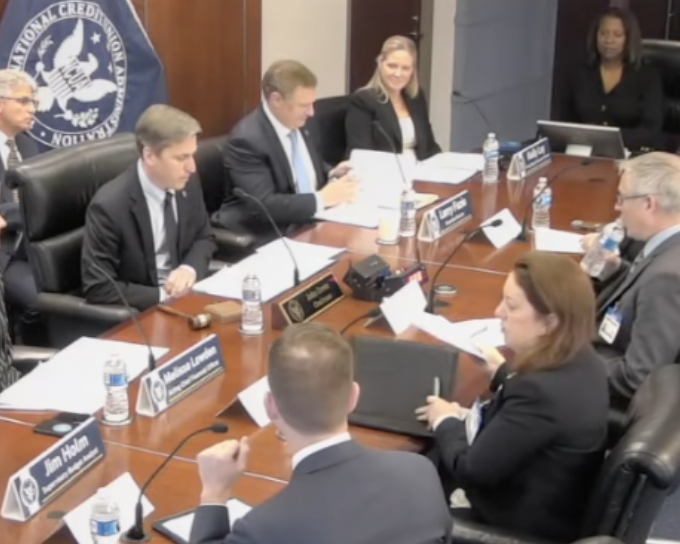
ALEXANDRIA, Va.–Following a presentation by NCUA on its budget, and after they offered feedback and recommendations to NCUA as part of the agency’s budget hearing, four people had the opportunity to NCUA senior staff a number of questions about how the regulator is spending its money, what it prioritizes, what it has planned for examinations, and more.
Participating as witnesses and asking questions were:
- Curt Long, chief economist with America’s Credit Unions
- Elizabeth A. Eurgubian, partner with Atlas Advocacy LLC, who represented the Defense Credit Union Council
- John Trull, SVP-regulatory advocacy with the GoWest CU Association
- Joshua Urbick, president of the National Small Credit Union Association
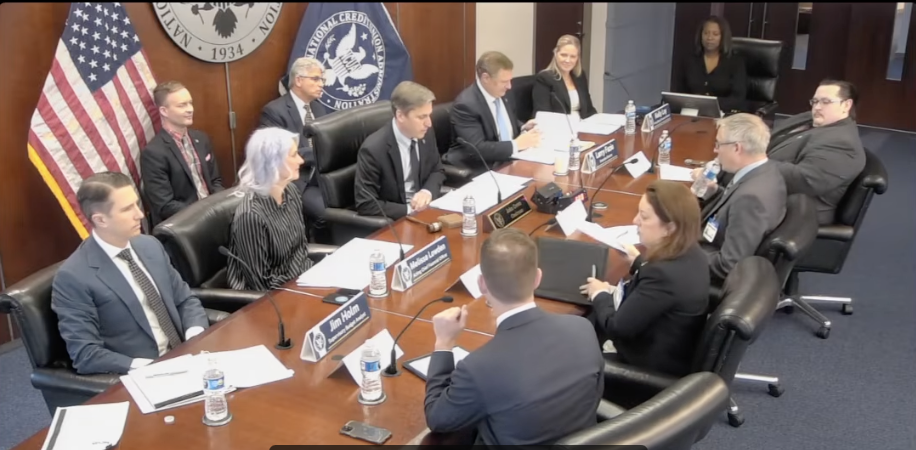
Representing NCUA were:
- Executive Director Larry Fazio
- Acting Deputy Executive Director Kelly Lay
- Acting CFO Melissa Lowden
- Supervisory Budget Analyst Jim Holm
Here is a look at some of the questions posed and how NCUA responded:
Long: During the (agency) presentation there was discussion of reallocating supervisory resources on a risk-based fashion. How does the agency think about risk?

Fazio: We’ve done a lot of work on that in the last year and a half, really focused on material risks. The main drivers tend to be actual problems we’re seeing in credit unions. Size does matter. If you have a large institution, a complex institution, that may drive the resources needed. In addition to identified problems, you have indicators of problems that require resources. Those are the main variables. We have sort of a matrixed approach from the examiner level to their supervisor to regional management looking at those decisions. And then we have some top-down things, such as advanced analytics. It’s a robust process we do annually.
Long: Any process changes credit unions should be prepared for?
Fazio: You can find on our website how the exam cycles work. For very healthy, certain size credit unions you can go all the way up to 24 months. For others it’s 18 or 16 months. Some are still on an annual exam. We’ve retooled a lot as it relates to the exam process itself.
We’ve updated the exam notification letter; I think that’s helpful. We’ve updated the document request list to try to streamline and improve that. I know that’s been a source of frustration from credit unions; it’s time-consuming for them and for us. We’ve retooled the way our tool our exam tool, MERIT, works to have it more focused on material risk and have refined the training that goes with that for examiners.
In particular, there has been some streamlining on the small credit union procedures to tailor those down even more, to rightsize those. We’ve streamlined how we do the exam report in terms of the overview and other aspects of it, including no longer using risk ratings. We focus on the CAMELS ratings. We have prohibited use of reputation risk, so that keeps us out of those areas.

Lay: I would add that because of some of the advanced analytical tools we are developing, that will help us to identify material risk and how often we go on site.
Long: The proposed budget shows $5 million for cybersecurity in 2028, but none in 2028. Why? :
Holm: It’s so rapidly evolving that we re-baseline every year. We can’t accurately project what the cyberthreats will look like a year from now. I would suspect we will be in the same range for 2028 (as 2027).
Eurgubian: Do you expect to see more data collection and electronic collections and submissions based on changes in how material risk is looked at?
Lay: I think our focus would be on revising the call report to get the most important information to identify those risks.
Eurgubian: With regards to consumer protection examinations, can we expect those to increase/decrease? Are there specialists who just do these examinations? How many such exams done this year?
Fazio: We look at consumer protection regs and laws as part of the regular examination. We don’t typically do separate exams. We do some that are risk-based, that are based on red flags. But our goal is to have those become part of the regular exam. We employ specialists in certain cases. We have a cadre of fair lending examiners. We are looking to continue the process but to make it as efficient as possible.
Lay: We have six regional consumer compliance specialists. We have eight or nine fair lending examiners. As part of the reorganization, we have shifted the fair lending examiners to be supervised by the regions and they will support exams in the regions. We anticipate that will help us to streamline the examinations, and ultimately reduce the number of duplicate document requests.
Fazio: That’s not the only area where we have this model. We have that model in capital markets, for example.
Trull: What was the total cost of the voluntary separation program incentives? The anticipation was that when those payments were made in 2025 and 2026, we would have reductions in future budgets, and instead it rose.
Lowden: Nearly all of the voluntary participation participants departed in 2026. Approximately $4.6 million was spent on the separations and $8 million for payouts for accrued leave. These one-time costs were fully funded through the 2025 contract services budget. The employee compensation budget was lowered by more than $70 million in 2026.
Trull: Given the significant investment in analytical tools for the ONES credit unions, why are these tools primarily limited to the largest credit unions, and has agency considered expansion across smaller credit unions?
Hulm: The ONES models used for the largest credit unions are risk-based and are based on a substantial dataset. Smaller CUs are not required to generate these complete data sets for our analysis. Any kind of cost benefit from that change would have to consider the cost to the credit union of complying with those complex data submissions.
Urbick: What efforts is NCUA making to prioritize the needs of small credit unions in this 2027-28 budget? That is, credit unions under $250 million in assets, which is the majority of CUs?
Lowden: NCUA considers the needs of small CUs in most everything we do. The small credit union exam program provides limited scope, and we have worked to streamline exam procedures. In addition, the Deregulation Project will continue to impact all credit unions by removing burdensome rules. The budget includes capital investments to automate the new charter system and to automate the grant program.
Urbick: How many employees are dedicated to the CURE Office presently, and how many in 2027-28?
Hulm: We do not assign staffing levels to individual offices. We do think about small credit unions in everything we do in terms of our planning.

Lay: As far as CURE is concerned, we are still going through the reorganization.
Urbick: What are your plans to increase training on cybersecurity, AI, risk management, for smaller credit unions?
Hulm: We do offer quite a bit of online cybersecurity coursework. That’s available with a simple registration. The link is on our website. We also encourage CUs to download our ACET tool, the cybersecurity tool. We have a special AI website itself that gives links to and discussion of risks around AI, as well as best practices around AI decision-making. There is a lot of information there.
Lay: We also have the revolving loan program and the grant program that can be used to help improve cybersecurity.