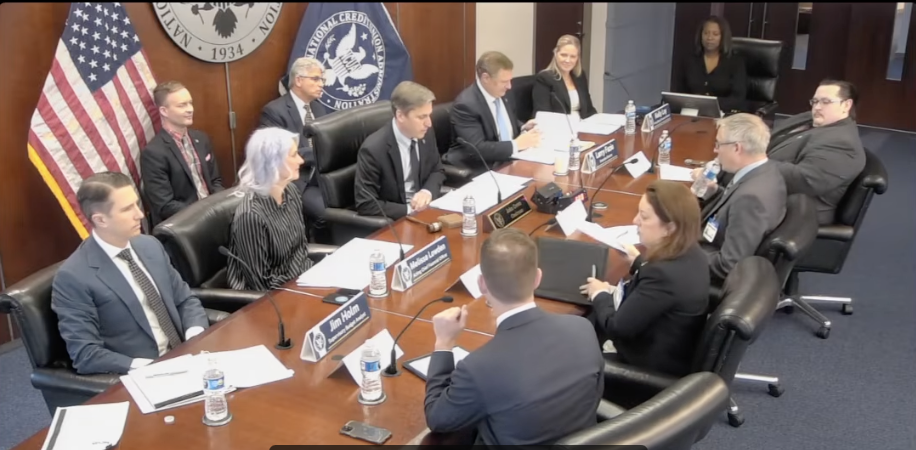
ALEXANDRIA, Va. — During its annual budget hearing here, NCUA offered an update on what it is proposing to spend in 2027 and 2028, while representatives of four different credit union organizations offered feedback and recommendations, and also posed questions to four NCUA officials, as separately reported here.
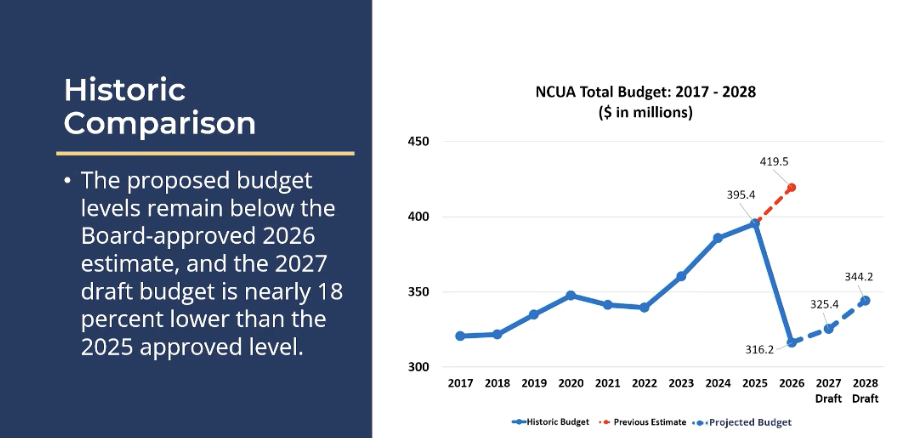
NCUA, alone among financial regulators in holding the budget briefing each year, has a proposed 2027 budget of $325.4 million, a 2.9% increase over what it is spending this year (the Operating Budget is up 8.2%).
The overall amount is 18% below what it budgeted in 2025 and reflects a White House-ordered budget cut that left the agency with approximately 23% fewer staff.
In opening comments, NCUA Chairman John Crews, presiding over his first budget hearing, said he wanted to remind everyone that the NCUA staff draft budget is the starting point for the discussion and is “not final.”
“We want your input to inform what we ultimately finalize,” said Crews. “While we can’t promise that all feedback will make the final budget, we can promise to listen and consider input from our stakeholders.”
Budget Specifics
NCUA’s acting CFO, Melissa Lowden, followed with a presentation offering specifics around the budget, explaining the budget authorizes 972 positions in 2027, with a projected increase of $18.8 million (5.8%) for the 2028 budget of $344.2 million. Staffing levels are projected to remain relatively unchanged.
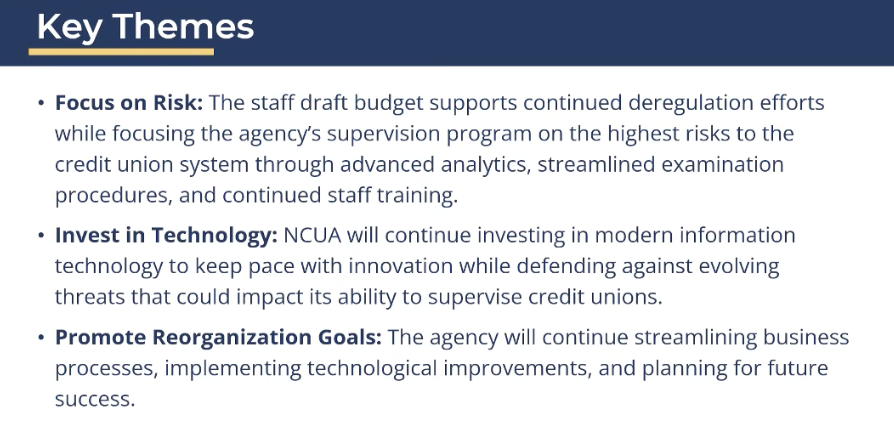
In reviewing where money is being budgeted and spent, Lowden said there is a focus on risk even as ongoing deregulation is taking place as the agency invests in advanced analytics, streamlined examination procedures and ongoing staff training.
Lowden pointed out the proposed 2027 budget remains below every board-approved budget from 2019 to 2025. Had the spending increases that occurred over that time period remained on the same trajectory into 2026, Lowden said the budget would have been $419.5 million, or $103 million higher than the current budget.
Lowden shared additional details in the slides below.
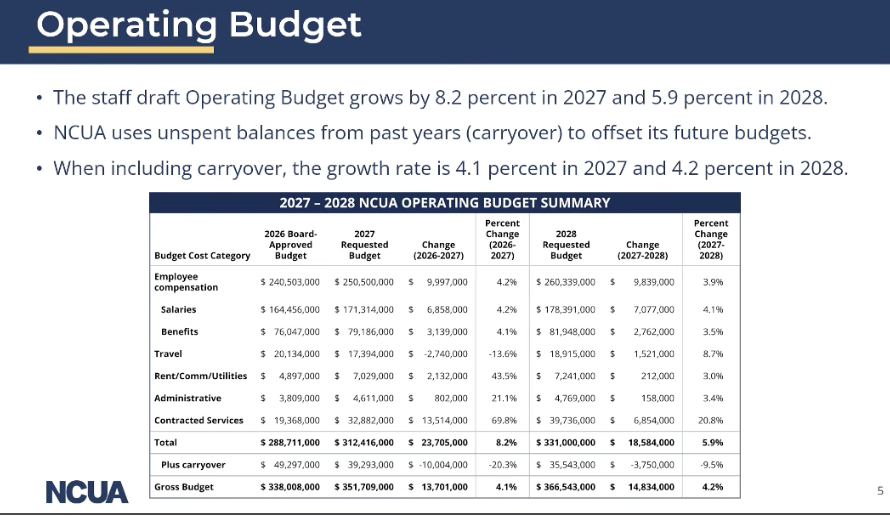
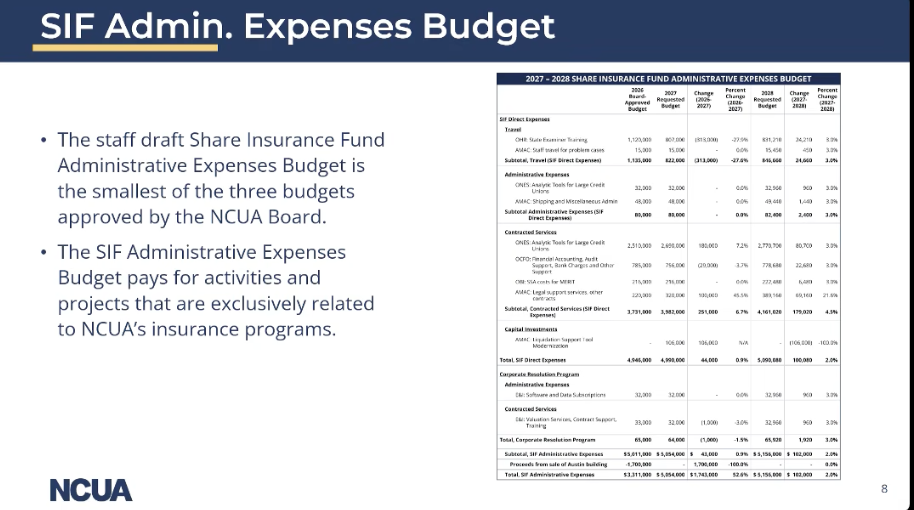
In his follow-up comments, Crews said much of the 2027-28 budget increases are for rising employee compensation costs, as well as for five proposed additional positions. The budget also reflects increases in contracted services, for cybersecurity, and for an increase in the Share Insurance Fund’s administrative expenses.
Unspent funds from 2026 are also being carried forward into 2027.
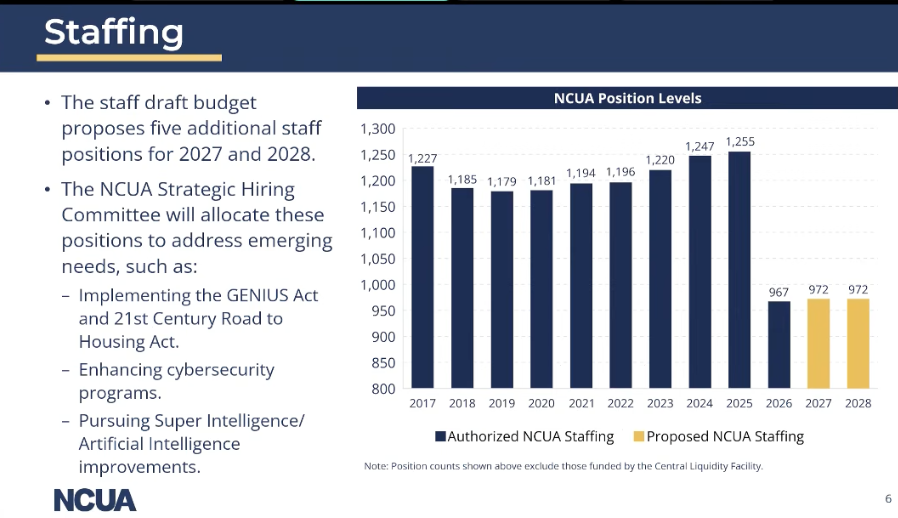
While NCUA is leaner, Lowden said it is “committed to investing in information technology to keep pace with innovation. The draft budget provides funding to deploy a superintelligence, or artificial intelligence, strategy and advanced analytics tools across the agency. This effort aims to optimize business operations and harden agency systems against evolving digital threats and foster a secure environment that supports responsible innovation across the credit union landscape.
She added NCUA has sought to craft 2027-28 budgets that include resources to reduce regulatory burden and to focus the exam program on material risk.
What the Witnesses Had to Say
Here are some of the comments that were made to the board:
America’s Credit Unions Outlines Numerous Proposals
Curt Long, Chief Economist, Vice President of Data and Research
America’s Credit Unions
Noting NCUA’s 2027 proposed budget of $325.4 million is a 2.9% increase over the 2026 budget, and the proposed 2027 Operating Budget reflects an increase of 8.2% over the approved 2026 budget, Long called on NCUA to ensure any increases are necessary and that the benefits of its reorganization and technology investments are reflected in future budgets.

Long offered several proposals America’s Credit Unions wants NCUA to consider, including:
- Before the board approves the final 2027 budget, publish a description of the organizational structure the agency intends to have in place by December 2027 and a schedule showing when it plans to consolidate or eliminate offices.
- Include more detailed information by office, such as number of positions and spending breakouts by type, which were included in prior budgets.
- Carefully evaluate staffing needs as the reorganization moves forward, rather than automatically filling vacancies or replacing positions that may no longer be necessary.
- Publish the aggregate results of the workload analysis by asset size and composite CAMELS rating, along with the change from the prior-year.
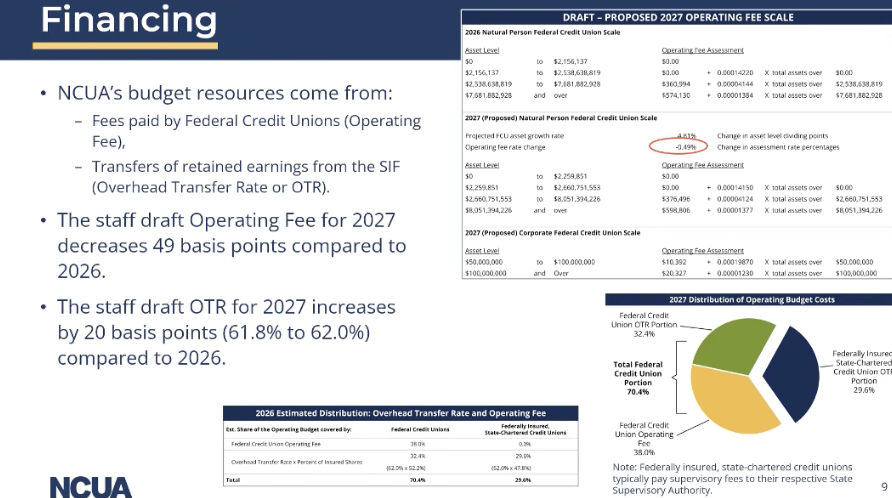
- Explain which variables caused the 20-basis-point increase in the overhead transfer rate. “We encourage the board to review the methodology again once the agency reorganization is complete, and to seek public comment on any proposed changes,” he said.
- Recognizing that on-site examinations remain important but that travel costs represent a significant share of the agency’s operating budget, the NCUA should continue evaluating when an in-person examination is necessary and when off-site review can accomplish the same objectives.
- Provide greater transparency around how IT resources are being deployed. “For each superintelligence/artificial intelligence (SI/AI) and analytic tool the agency deploys, we encourage the NCUA to identify the tasks the tool would perform and the staff hours or contractor costs the tool is expected to replace,” Long stated.
Support Sought for Statements
Long noted the draft budget states that the NCUA’s reorganization is underway and is targeted for completion by December 2027 and that the agency has stated it increased its operational efficiency and improved service delivery during 2025 and 2026. He encouraged NCUA to support that statement with measures that it reports each year alongside the budget, and said such measures could include:
- The average length of examinations, by credit union asset size and composite CAMELS rating
- The average time between the close of an examination and delivery of the final examination report
- The average number of documents requested from credit unions before and during an examination
- Processing times for field of membership applications, charter applications, waiver requests, and other requests from credit unions
- The share of total agency staff assigned to examination and supervision.
Six Recommendations for NCUA to Consider
Elizabeth A. Eurgubian, Partner, Atlas Advocacy LLC
Testifying on Behalf of the Defense Credit Union Council
Eurgubian said DCUC generally supports the NCUA’s supervisory direction as reflected in its 2027-28 draft budget, but believes improvements can better accomplish its mission of enabling access to financial services through safe, sound, and resilient credit unions.
One: Transition to Tech
“First, because the NCUA’s authorized positions have declined by 23% since 2025, the agency is well-positioned to transition from an examination-intensive regulatory structure to a technology-enabled, risk-based supervisory agency,” Eurgubian stated. “However, the agency is proposing a 2.9% budget increase for 2027 and an additional 5.8% increase for 2028. While some expenses may be necessary regardless of staffing levels, we ask the agency to demonstrate how it is achieving efficiencies and controlling costs in a smaller agency.”
Eurgubian also noted that in addition to fewer employees, the NCUA supervises fewer credit unions than in prior-years (now 4,214), and the budget should reflect this change.

“We encourage the NCUA to lengthen the intervals between supervisory examinations for CAMELS 1 and 2 credit unions to achieve additional savings while maintaining effective supervision, protecting the Share Insurance Fund, and accurately assessing risk,” Eurgubian said.
Two: Streamline Examiner Travel
DCUC further believes examiner travel expenses can be further streamlined as the number of examiners and credit unions decreases.
“While the proposed travel budget will decrease by $2.7 million to $17.4 million, or 13.6%, compared to 2026, the proposed 2028 travel budget is estimated at $18.9 million, an 8.7% increase from the proposed 2027 level, attributed to inflation and an agency-wide training event,” Eurgubian said. “The NCUA should reassess its travel requirements in light of its reduced workforce, organizational restructuring, electronic processes, and risk-based examination model.”
DCUC is recommending requiring cost-benefit justifications for non-examination-related travel, consolidating meetings and training when possible, increasing virtual training, and prioritizing on-site examinations based on risk.
“As restructuring continues, the NCUA should determine whether existing travel practices are cost-effective and necessary or simply reflect unnecessary legacy practices,” Eurgubian said.
Three: More Transparency
A third request made by DCUC is for the agency to provide greater transparency into how much of the budget is allocated to consumer protection examinations.
“While we recognize the Office of Consumer Financial Protection’s 10% reduction in the 2027 proposed budget from 2026, it is unclear how much of this budget is applied to examinations,” Eurgubian said. “DCUC requests a breakdown of resources devoted to consumer protection examinations compared with other supervisory responsibilities. Credit unions must be on a level playing field with larger banks and fintechs supervised by other agencies.”
Four: More Info on Individual Office Expenses
Fourth, DCUC is requesting NCUA provide greater transparency into the increased expenses for various offices, including the Office of the Executive Director (a 66.3% increase), the Office of Ethics Counsel (a 22% increase), the Office of Human Resources (a 20.6% increase), and the Office of the Inspector General (a 16.4% increase).
“We encourage the NCUA to demonstrate these offices’ additional operational needs and how the additional funds will support efficiency, risk-based supervision, and reorganization,” Eurgubian said. “Nevertheless, DCUC supports maintaining adequate resources for the Office of External Affairs and Communications, given the significant funding cuts to this office last year. OEAC uniquely reports to the Chair of the NCUA, ensuring that the agency’s external communications align with the Chair’s priorities and objectives. DCUC strongly encourages the NCUA to preserve and prioritize OEAC as it finalizes its budget, reorganizes, and fills vacancies.”
Five: Setting Priorities
Eurgubian testified that setting a budget requires strategic choices given limited funds, and that DCUC supports the agency’s prioritization of technology modernization, cybersecurity, and artificial intelligence.
“These investments should improve internal operations and the credit unions’ examination experience, not merely create additional data transfers and reporting requirements,” Eurgubian said. “We encourage the NCUA to prioritize technology that streamlines examination procedures, eliminates duplicative reporting, and improves the consistency of supervisory practices.”
Six: A Challenge for NCUA
While noting NCUA has significantly reduced its internal staff, Eurgubian pointed out its proposed contracted services budget will increase substantially from 2026 to 2028.
“We understand that the substantial percentage increase in the contracted services budget is largely attributable to a reduction in the amount of prior-year unspent budget surpluses used to offset the 2027 budget; however, we challenge the NCUA to find other ways to use these funds,” Eurgubian said. “If contracted services are the most viable and cost-effective way to acquire specialized expertise, then we support the investment. However, if internal staff responsibilities are redirected to contractors, undermining past streamlining efforts, then we ask the NCUA to evaluate which services can be performed internally, eliminate duplicative services, and explain how contracting will improve efficiency following the workforce reduction.”
Questions Around Specific Budget Expenditures
John Trull, senior vice president of regulatory advocacy
GoWest CU Association
Trull praised NCUA for being the only financial regulator that publishes a detailed draft budget and invites public comment, and said the agency has been responsive in the past to that comment.
Trull further recognized the “significant” changes the industry has gone through as a result of its Voluntary Separation Program, and said credit unions in the region served by GoWest (Washington, Oregon, Colorado, Arizona, Wyoming and Idaho) are seeing the efficiencies the agency has implemented, including extended examination cycles, fewer examiners on site, remote examinations, shorter examination timelines, and improved pre-examination preparation.

“GoWest supports the 2027 capital plan, particularly the $605,000 investment to modernize the Community Development Revolving Loan Fund grant and loan management system,” said Trull. “These funds reach underserved communities, and a modern system benefits both agency staff and applicants. We also recognize the improvements made to CAPRIS, which credit unions have noticed and which have resulted in greater efficiency in processing field of membership expansion requests.”
‘Surprising’ Problems on NCUA’s Website
Trull said the association was “surprised,” however, to see the capital plan doesn’t address the agency’s website, where “broken links and outdated pages create confusion, and this concern is growing in importance. Credit unions and their teams increasingly rely on artificial intelligence tools that treat the agency’s digital content as an authoritative source. Accurate, current agency content has become an essential part of effective supervision.”
Trull said the draft presents a $325.4 million budget, while the Operating Budget reflects $351.7 million in gross resources once $39.3 million in carryover is included, and he asked NCUA to provide greater transparency in the final budget regarding the source, accumulation, and intended use of the carryover balance. He reminded that when NCUA did the midyear 2026 budget review, most of the carryover was applied to contracted services, and total contracted services reached $67.7 million in 2026.
In addition, Trull said NCUA’s December 2025 Board Action Memorandum identifies $27.685 million derived from overhead transfers from the Share Insurance Fund to remain available for expenditure in the 2026 Operating Budget.
“The magnitude of this balance raises an important question as to whether prior-year overhead transfers exceeded the actual insurance-related expenses incurred by the agency and whether those funds should be credited against future transfers,” he told the meeting.
Additional Points Raised
Other points made by Trull included:
- The budget reflects restructuring-related staffing reductions but does not separately disclose the cost of voluntary separation incentives or other separation payments paid through the 2026 operating budget. “Credit unions were told these payments would conclude and produce savings, so a clear accounting in the final budget is warranted, along with an explanation on why the one-time payments are not resulting in future cost savings.”
- The Office of Ethics Counsel and the Office of External Affairs and Communication grew by 22% and 22.8%, respectively, compared with overall Operating Budget growth of 8.2%. “These increases warrant a detailed explanation, particularly as neither of these expenses were reflected in the previous two-year budget,” he said.
How NCUA Can Provide More Support for Smaller CUs
Joshua C. Urbick, president and CEO
National Small Credit Union Association
President and CEO, IBEW 26 Federal Credit Union
Urbick said NSCUA generally supports the NCUA’s 2027 and 2028 draft budget but offered some recommendations on ways the NCUA’s budget can “better prioritize the development and sustainability of smaller credit unions.”
“The NCUA’s budget should reflect not only the resources needed to regulate and examine credit unions, but also a commitment to supporting their development, sustainability, and ability to serve their members and communities,” Urbick said, pointing to three areas where it believes additional attention and investment would benefit smaller credit unions.
Strengthen the Office of Credit Union Resources and Expansion (CURE), Both in its 2027 and 2028 Budgets and in its Upcoming Reorganization
“The CURE Office should be treated as an important strategic investment. CURE plays a significant role in supporting credit union development, especially for low-income and minority credit unions and institutions seeking help with chartering, field-of-membership changes, and other operational challenges,” Urbick said. “While the proposed 2027 budget indicates a 5.9% increase from 2026, it is still far below the nearly $12 million reflected in the 2025 budget.”

Additional Recommendations
Urbick also recommended:
- NCUA increase the resources devoted to technical assistance for small credit unions
- Provide more individualized assistance to credit unions seeking to expand their fields of membership
- Improve support for credit unions considering charter conversions
- Expand education and training opportunities for credit union leadership and board members.
- Allocate additional resources to modernizing agency systems and transforming workflows in NCUA’s capital budget.
“As the NCUA noted in its Budget Justification, these projects use data-driven practices to expand access to financial services, support new credit unions, and strengthen the financial system,” Urbick said. “To support smaller and newer credit unions, we support increased funding for the Community Development Revolving Loan Fund Grant & Loan Management System to enable faster, more efficient grant management, and for new charter system improvements to increase efficiency and reduce the burden on credit union applicants.”
NCUA Should Invest More in Helping Credit Unions Strengthen Their Cybersecurity Programs
Urbick said that while NCUA’s proposed budget reflects investments in the agency’s own cybersecurity capabilities, which the NSCUA supports, “Smaller credit unions often lack cybersecurity personnel, which is especially dangerous in today’s complex financial system, where threats are increasing exponentially and services are increasingly outsourced,” he said. “The NCUA could fill the void by providing additional assistance through educational programs, shared resources, training, and updated incident response guidance. These investments would strengthen the resilience of individual credit unions and the broader credit union industry.”
How to Fund Recommendations
To fund its recommendations, Urbick said the NSCUA believes NCUA has room to trim its budget.
“For example, the NCUA’s examiner travel budget is proposed to decrease by 13.6% in 2027 but then increase again by 8.7% in 2028,” he stated. “Given the decrease in both examination staff and the number of credit unions, along with the NCUA’s more risk-focused examination procedures, we believe this portion of the budget can be reduced further. The Budget Justification stated that the proposed 2028 level reflects presumed travel-related cost inflation and an agency-wide training event. We strongly encourage the NCUA to hold this training event in a more centrally located area that requires less staff travel, so this cost can be reallocated to other, more pressing areas.”
Additional Recommendations
Urbick also noted:
- NCUA is proposing a 21.1% increase in administrative expenses for 2027 due to recurring costs for employee relocation, recruitment, and employee supplies, a cost he said can be reduced because the budget expects only five additional employees in 2027.
- NCUA’s proposed operating budget for contracted services is another area where the organization believes further savings are possible.
“The proposed budget shows an increase of $13.5 million in 2027, or 69.8%, compared to 2026, and an additional increase of $6.8 million, or 20.8%, for 2028,” Urbick said. “We recognize the percentage increase is partly attributable to changes in the application of prior-year budget surpluses; however, projected contracted-services expenditures continue to increase. The NCUA should provide further justification and transparency for these amounts and demonstrate why it must retain expertise from contract providers rather than internally.”