
NEW YORK — Artificial intelligence assistants could eventually move household cash from low-interest checking accounts into higher-yielding accounts automatically, putting pressure on a source of funding financial institutions of all kinds rely on to make loans, Apollo Global Management’s chief economist is warning.
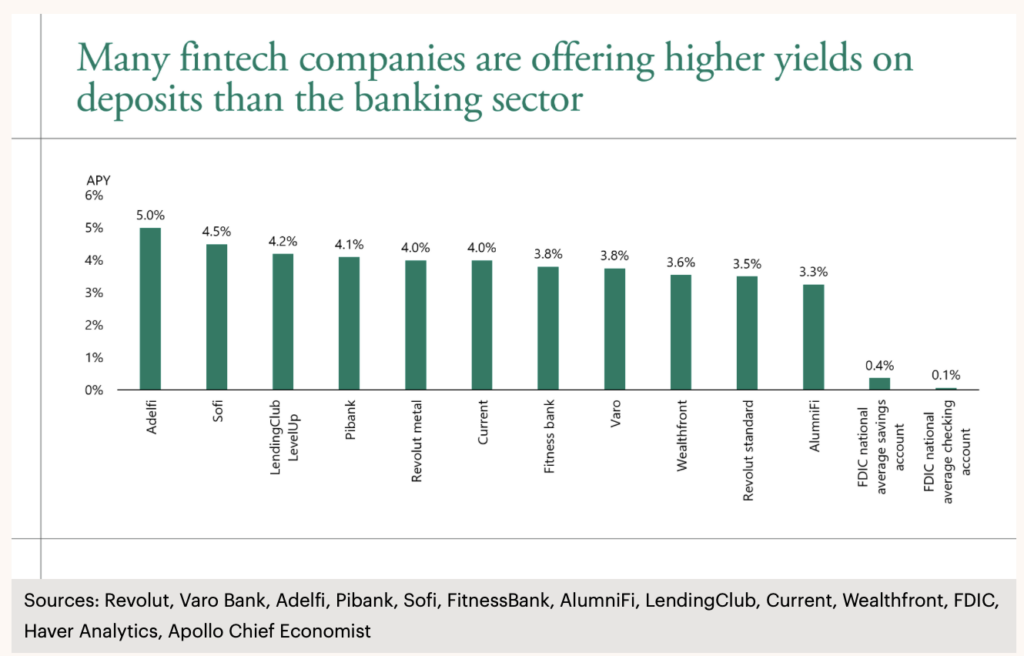
In a Sept. 27 analysis titled “Is an Agentic Bank Run Coming?,” Torsten Slok said assistants such as Meta’s Muse could sweep cash into accounts paying 3.3% to 5.0%, compared with what he described as a 0.1% national average on checking accounts. Apollo’s accompanying chart draws on rates from several financial technology companies and banks, along with Federal Deposit Insurance Corp. data.
“If every household used AI agents to optimize the return on their cash balances, banks could lose a large share of the cheap deposits they rely on to make loans, which would be a problem for the entire financial system,” Slok wrote. His analysis describes a potential outcome; it does not report that Muse is already moving deposits at scale or estimate how much money might leave checking accounts.
The Incentive for Consumers
The rate gap illustrates the incentive for consumers. At the rates Slok cited, $10,000 would earn about $10 a year at 0.1%, compared with $330 to $500 at 3.3% to 5.0%, before taxes and assuming the rates stayed constant. For banks, widespread moves out of low-cost checking accounts could raise funding costs or reduce the deposits available to support lending. That systemwide effect remains Slok’s hypothetical scenario.
Meta introduced Muse on Sept. 8 as an assistant that can work across connected apps, open a browser, fill out forms and take actions for a user. Meta says people choose which services it can access and that Muse seeks approval for sensitive actions, including purchases. Its announcement describes payment and shopping features but does not say Muse currently offers automatic transfers among deposit accounts to seek higher interest rates.
The CU Daily has additional reporting around what Muse might mean for credit unions here.
Question Raised
Slok’s warning raises a question for banks and credit unions alike: If consumers can routinely direct software to find a better return and move idle cash, how much will financial institutions have to pay to retain those balances? Apollo’s analysis does not separately assess the effect on credit unions.