

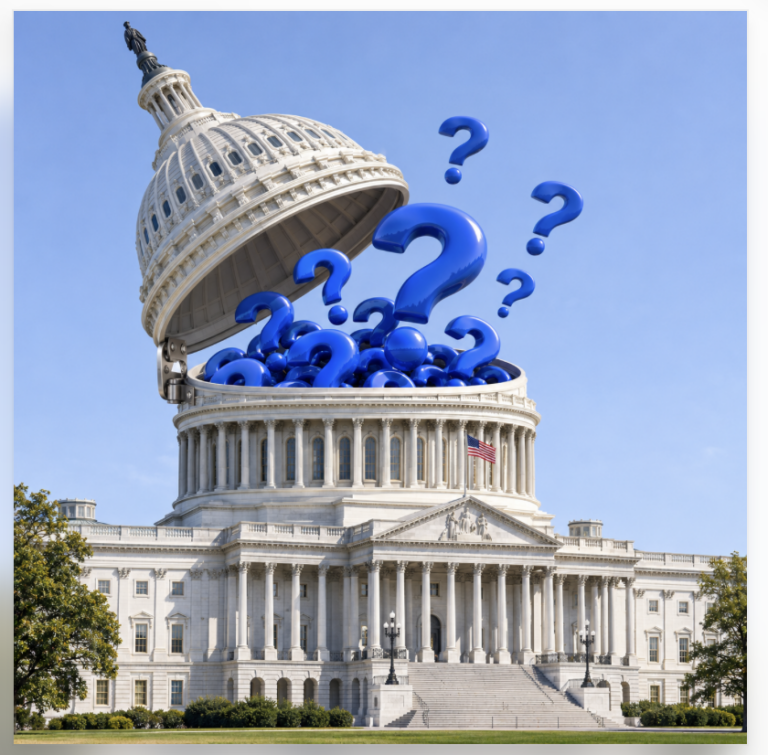
WASHINGTON–The “blue tsunami” in the midterm elections has led to a flood of questions for credit unions when it comes to Congress and financial supervision and regulation, including the potential for a renewed focus on OD/NSF fees, CRA and third party vendor authority; fresh life for the CFPB, new subcommittee chairs, more uncertainty for the NCUA board, and a lame duck session in which outgoing members of Congress look to leave legacies—or line up new jobs for 2027—and push through bills thought to have been dead.
Oh, and then there is the angling that has already begun for the 2028 elections.
As the CU Daily reported here, Democrats have been swept into majorities in both the House and Senate, and they are bringing a focus that in many ways is 180-degrees away from the priorities of Republicans, who have been laissez faire about government oversight and have championed a deregulatory agenda.
“Obviously, the election changes a lot in terms of advocacy for DCUC and the entire credit union industry, with the Democrats retaking sizable majorities in both the U.S. House and Senate,” said Jason Stverak, chief advocacy officer with the Defense Credit Union Council. “It will mean a lot of changes in terms of priorities as we look forward to the 120th Congress. With the likelihood that Maxine Waters (D-CA) will return as chair of the House Financial Services committee, and the likelihood that Elizabeth Warren (D-MA) will be the incoming chair of the Senate Banking, Housing and Urban Affairs Committee, they will be most likely advocating for a more consumer protection-related agenda. We have seen from Sen. Warren in her position as ranking member (a call for) increased oversight of credit unions, particularly in terms of overdraft and NSF fees. We expect that that will be a priority for her as she assumes leadership of this position.”
Similarly, Stverak said he is anticipating increased oversight through the appropriations process and the nominations process related to both NCUA and the CFPB, the latter of which the Trump administration has largely sought to eliminate.
The Outreach Begins
One day after the election, Stverak said DCUC had already begun to reach out to returning members of Congress, congratulating them on their victory and asking for meetings to sit down to talk about the trade group’s 2027 agenda, and to the representatives-elect and senators-elect with a similar goal.
Stverak is expecting a Democratic Congress will put the spotlight back on issues it has spotlighted in the past, such as the Community Reinvestment Act, overdraft/NSF fees and third-party vendor authority, which NCUA has sought but credit unions have opposed.
“We will aggressively defend credit unions on those topics,” said Stverak. “But there are going to be many opportunities for cooperation on priorities for both the credit union industry and the new leadership in Congress. Current ranking member Waters has been a strong proponent of field of membership expansion in the past to the point where she has introduced and pushed legislation through the House to expand field of membership. We look forward to working with her office as much as possible on that important issue going into the next Congress.”
Credit Union 101
In addition to all the new subcommittee chairs, Stverak pointed out there will also be a “lot of new staff members around the Hill and we are going to be aggressively pushing forward a Credit Union 101–as we’ve dubbed it at DCUC,–education program so that the member and their team are up to speed on basic questions of what is the credit union, how do we interact in their community, how are we different, how are we serving the community, how is the defense credit union serving the base that’s in their district, so that they know and understand the full buffet of financial options and support that we can provide them and their voters.”

As the CU Daily reported here, DCUC had earlier sent a letter to congressional leadership outlining three priorities it wants the 199th Congress to act on and include in either the National Defense Authorization Act (NDAA) or as part other must-pass pieces of legislation: the Veterans MBL legislation, CLF reform, loan maturity reform.
“These are common sense reforms that would benefit credit unions and the tens of millions of members that they represent,” Stverak said. “We will be up on Capitol Hill every day that Congress is back until this Congress is officially over pushing for the priorities now as we look to the next Congress.”
If the Veterans MBL bill doesn’t move in this Congress, credit unions will need to find a new champion, noted Stverak, as Rep. Brian Fitzpatrick (R-PA), the Republican lead on the bill, lost his re-election bid.
Potential Flight in the Lame Duck
Looking to the next two months of the lame duck session of Congress, Stverak noted Sen. Roger Marshall (R-KS) lost his Senate seat, while Sen. Dick Durbin (D-IL) is retiring. Both have strongly supported the Credit Card Competition Act, which would affect card interchange.
“I think that over the next two months there’s going to be a sprint to try to include their interchange legislation as part of some must-pass bill,” said Stverak. “I think Sen. Marshall may want to go out having a win, and Sen. Durbin, as his career is ending, is also looking for kind of a signature legislative victory. That is kind of giving me a little bit of concern moving forward, because National Restaurant Association has come out with its list of priorities for next Congress, and #2 on that is the interchange legislation, which indicates to me that there will be a full court press…from the entire retail industry to try and get that done this Congress.”
There is another factor at work with so much turnover taking place in Congress, pointed out Stverak.
“I think that there is more of a jump ball situation, as you have many members of Congress looking for employment, looking for their next opportunity and they may or may not have the same loyalty to make the same vote that they would have made a month ago,” he observed. “We’ve already been in touch with our industry partners on this to ensure that even if a member is leaving, they still have until Jan. 3rd in their current position as a member of Congress to understand the long-term harm that they would do to credit unions. It is not worth the quick yes vote, just because they lost the election.”
The Need to Work with GOP Administration
While Democrats may have swept to power in Congress, the administration remains Republican, and moving any legislation is going to require some compromises. Stverak reminded that the Democrats do not have the 60 votes needed to invoke cloture or the same number of votes needed to overturn a veto in the Senate, “so it’s going to force the need for everyone to come around the table and at least try to negotiate in good faith. The president is also a lame duck, so everyone is going to have to come around the table.
“2028 started this morning, so there’s going to be a lot of presidential politics being played,” he added.
President Trump said on Fox News that he can do “deals” with the Democrats. Stverak said he’s hopeful that among any such deals is passage of the NDAA to assure members of the military get paid, and that separately the federal government receives funding.
The Fate of the NCUA Board
Amidst all of that flux, there remain a lot of questions around the NCUA Board. President Trump fired board members Todd Harper and Tanya Otsuka in April of 2025, and with the exception of a brief period when a court returned the two Democrats to the board for one board meeting, the NCUA board has had just one board member, currently Chairman John Crews. Harper and Otsuka continue to challenge the president’s authority to remove them, and the District Court has scheduled a hearing in the case for Nov. 17. A ruling would come sometime later and, depending on that ruling, it could be appealed to the Supreme Court, which would push any ruling into 2028. All of that means it could be a one-person NCUA board for the foreseeable future. But there’s a caveat.
Stverak said the lame duck Congress could attempt to move as many nominees as possible in the next 60 days, although they are likely to prioritize the appointment of judges. But even if two NCUA board nominees are put forward, the court’s ruling could affect their fates.
“It will be incredibly difficult for nominees to move in the next Senate, just based upon the numbers,” Stverak forecast. “I’m concerned there may be some unwillingness to do bipartisan work…”

Stverak noted, for instance, that California Democrat Robert Garcia, who is set to become the next chair of the oversight committee of the House of Representatives, had two words for Republicans on Tuesday evening: “Lawyer up.”
That does not bode well for bipartisan cooperation,” said Stverak, noting that when it comes to the next two years, for now, “It’s as clear as mud.”
America’s Credit Unions Says ‘CU Champions’ Elected
As reported earlier by the CU Daily, America’s Credit unions said the elections show “hundreds of credit union champions” have been elected to the 120th Congress, based on 320 of the 342 reported races and 49 open-seat candidates.
The trade group called the election results a culmination of its PAC’s record $10 million in spending on the midterm races.
“The 2026 midterm elections underscored the enduring strength of the credit union movement and the value of bipartisan advocacy,” President and CEO Scott Simpson said in a statement. “Across the country, voters made their voices heard, and we congratulate the newly elected and returning members of Congress who will help shape our nation’s economic future. I am extremely proud of our team at America’s Credit Unions, league partners, and the countless credit union professionals who dedicated an incredible amount of resources and volunteer hours to this election cycle Backed by a historic $10 million investment from our movement to support champions who step up for credit unions, our collective grassroots effort ensured that the priorities of 146 million American consumers remained front and center.
“Regardless of which party holds the gavel, our mission transcends partisan lines. Credit unions are essential to promoting consumer choice, lowering household costs, and expanding access to affordable credit on Main Street,” Simpson continued. “We look forward to partnering with the new Congress to advance policies that preserve the cooperative model and not-for-profit tax status, modernize outdated regulations, and protect local communities.”
Highlighted Wins
America’s Credit Unions said that “called wins for priority credit union races” as of Wednesday morning include:
- Rep. Chris Pappas (D-NH), who won election to the state’s open Senate seat
- Rep. Vicente Gonzalez (D-TX)
- Rep. Brad Sherman (D-CA)
- Rep. Celeste Maloy (R-UT)
- Rep. Mike Kennedy (R-UT)
- Rep. Susie Lee (D-NV)
- Rep. Steven Horsford (D-NV)
- Rep. Dina Titus (D-NV)
- Rep. Tom Suozzi (D-NY)
- Rep. Don Davis (D-NC)
- Ben McAdams (D), elected to Utah’s 1st Congressional District
- Luke Bronin (D), elected to Connecticut’s 1st Congressional District.




