
PHILADELPHIA — How did everyday working Americans handle their personal finances in 1776, when there was no neighborhood credit union or bank, no checking or savings accounts, and certainly no credit cards? It was personal.
As the American colonies declared independence from Britain 250 years ago, daily financial life depended on a patchwork of foreign coins, paper currency of varying value, barter, handwritten credit arrangements and personal trust. Farmers, merchants, artisans and laborers managed their finances through family networks, local merchants and wealthy lenders rather than financial institutions.
Economic historians say the colonial economy functioned less like today’s banking system and more like an interconnected web of personal relationships.

“Credit was the lifeblood of the colonial economy,” according to the Economic History Association, which notes that most commercial transactions occurred on credit rather than with cash.
There were no commercial banks operating in what became the United States in 1776. The nation’s first bank, the Bank of North America, would not be established until 1781, followed by the First Bank of the United States a decade later. As the CU Daily reported here, the First Bank of the United States in Philadelphia has just completed a $43-million renovation in time for the 250th birthday of the Declaration of Independence.
The absence of banks forced Americans to develop other ways to save, borrow and conduct business.
Short on Cash
One of the greatest challenges facing colonists was the chronic shortage of money, according to historians.
Britain discouraged the export of gold and silver coins to the colonies, preferring to keep hard currency within the empire. As a result, specie — gold and silver coins — was always in short supply.
Instead, Americans relied on an extraordinary mix of currencies.
Coins circulating in 1776 included:
- Spanish silver dollars, often called “pieces of eight.”
- British pounds, shillings and pence.
- Portuguese and French coins.
- Dutch coinage.
- Various colonial paper currencies issued before the Revolution.
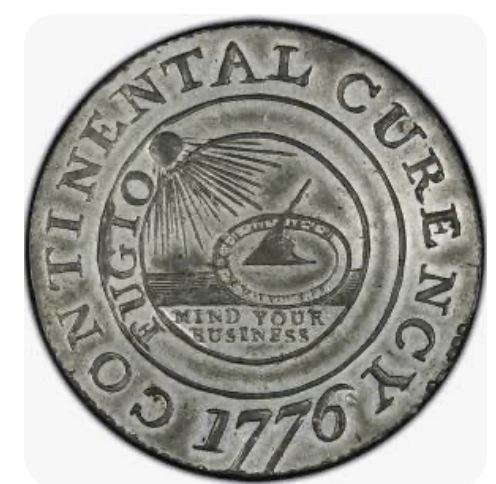
- Beginning in 1775, Continental currency issued by the Continental Congress.
The Unofficial National Currency
The Spanish dollar became especially important because of its reliable silver content and widespread acceptance throughout North America.
“The Spanish Dollar served as the unofficial national currency of the colonies for much of the 17th and 18th centuries,” according to the Federal Reserve Bank of Philadelphia.
Even pricing was confusing by modern standards.
Most colonies continued to quote prices in pounds, shillings and pence inherited from the British system, although the actual coins exchanged might be Spanish, Portuguese or French. The value of those units often differed from colony to colony.
Paying With Crops
For ordinary Americans, cash was frequently unnecessary.
Farmers commonly paid debts using agricultural products such as wheat, corn, tobacco, rice or livestock. Local economies depended heavily on barter, particularly in rural communities where coinage rarely circulated.
A farmer needing a blacksmith might pay after harvest. A merchant might accept tobacco in place of cash. Neighbors traded labor during planting and harvesting seasons.
Economic historians describe the colonial economy as operating simultaneously through three systems:
- Cash transactions when coin was available.
- Barter involving goods and services.
- Credit based on promises of future payment.
Storekeepers Became Bankers
Without banks, country merchants filled many of the same roles financial institutions perform today, according to numerous historical references.
General store owners extended credit to customers, maintained handwritten ledgers tracking purchases and payments, accepted produce instead of money, and occasionally provided cash advances until crops could be sold.
A family’s financial standing depended heavily on its reputation.
If a farmer had consistently repaid debts over many years, merchants generally continued extending credit. If not, obtaining goods became increasingly difficult.
Store ledgers often functioned as the community’s financial records, historians say.
Where People Kept Their Savings
Without insured financial institutions—deposit insurance would not arrive until the 1930s–Americans stored wealth themselves.
Many families hid coins inside their homes — beneath floorboards, inside walls, buried in gardens or concealed in furniture. Wealthier households often owned lockboxes or strong chests designed to hold valuables and important documents.
Savings also took forms other than money.
Land represented perhaps the most important store of wealth. Livestock, tools, silver tableware, jewelry and durable household goods all served as assets that could be sold or pledged if needed, historians said.
Farmers often viewed a healthy herd of cattle or productive acreage as a more dependable investment than scarce currency.
Because cash supplies fluctuated constantly, tangible property frequently provided greater long-term financial security than coins.
Borrowing Depended on Relationships
Getting a loan in 1776 required knowing someone with money.
Unlike modern borrowers who apply to banks using standardized underwriting, colonists relied on personal relationships. It’s similar to the loan criteria used by most credit unions in the days prior to credit bureaus, when loans were often made based on “character.”
In the colonial days, loans commonly came from:
- Wealthy merchants.
- Large landowners.
- Relatives.
- Friends.
- Business partners.
- Estate executors managing inherited wealth.
Loan agreements generally were documented through handwritten promissory notes specifying repayment dates and interest.
In many communities, local attorneys also arranged lending transactions among clients.
According to the Economic History Association, extensive credit networks stretched from Britain through colonial port cities and into inland farming communities, allowing commerce to function despite limited supplies of money.
Wealthy Colonists Had More Options
In parallel to today, not surprisingly, affluent Americans possessed financial advantages unavailable to most colonists.
Large merchants in cities such as Boston, New York, Philadelphia and Charleston maintained business relationships with British merchant houses, which extended commercial credit across the Atlantic.
Rather than depositing funds into banks, wealthy families typically held diversified forms of wealth.
Their assets often included:
- Large landholdings.
- Rental properties.
- Ships.
- Warehouses.
- Business inventories.
- Slaves, whose labor and market value formed a significant portion of wealth in slaveholding colonies.
- Gold and silver coin.
- Investments in government securities or private business ventures.
Merchants frequently reinvested profits directly into additional inventory or overseas trade rather than maintaining idle cash reserves.
The Risks of Paper Money
Paper currency presented its own problems.
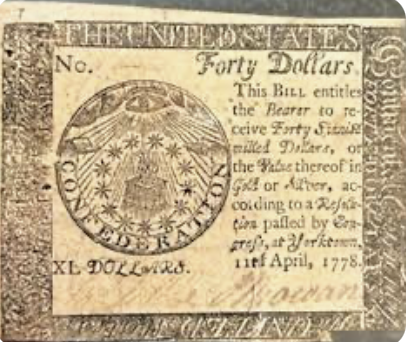
Before independence, several colonies issued their own paper money to compensate for shortages of coin. Those notes often fluctuated sharply in value depending on public confidence and the colony’s financial condition.
The Continental Congress began issuing Continental dollars in 1775 to finance the Revolutionary War.
Initially accepted throughout the colonies, the notes eventually depreciated dramatically as Congress printed increasing quantities without sufficient revenue to redeem them.
The collapse produced the famous expression “not worth a Continental.”
Financial Security
Financial security depended almost entirely on family support, community reputation, productive land and diversified assets.
If crops failed or illness struck, families often relied on relatives, churches or neighbors. Communities functioned as informal financial safety nets.
Trust Was the Real Currency
Historians say the colonial financial system ultimately depended less on money than on trust. In another parallel to today, many say it is trust that is the greatest differentiator for credit unions.
A person’s reputation determined whether merchants would extend credit, neighbors would lend money or business partners would invest.
For working Americans in 1776, wealth was measured not only in coins but in fertile farmland, productive livestock, reliable harvests and good standing within the community.
Within five years, the financial landscape would begin changing. The creation of the Bank of North America in 1781 marked the nation’s first true commercial bank, laying the foundation for the American banking system that would eventually evolve into today’s network of thousands of financial institutions.
The first credit union in the U.S., St. Mary’s Bank in Manchester, N.H., was chartered in 1909 in response to a banking industry that would not serve small, working class savers.