


LAS VEGAS–Asking audience members for their votes, a “Presidential Debate” took place here, and this time it was around which financial business model is ultimately the best and most relevant going forward—credit union, community banking or fintech—with the “candidates” arguing their positions and occasionally taking digs at their rivals.
Editor’s Note: The debate took place on two occasions, first during Mitchell Stankovic’s Underground Reckoning meeting held ahead of the Money 20/20 conference, and then on the Main Stage during the Money 20/20 event itself. This report is a hybrid of the discussion at both.
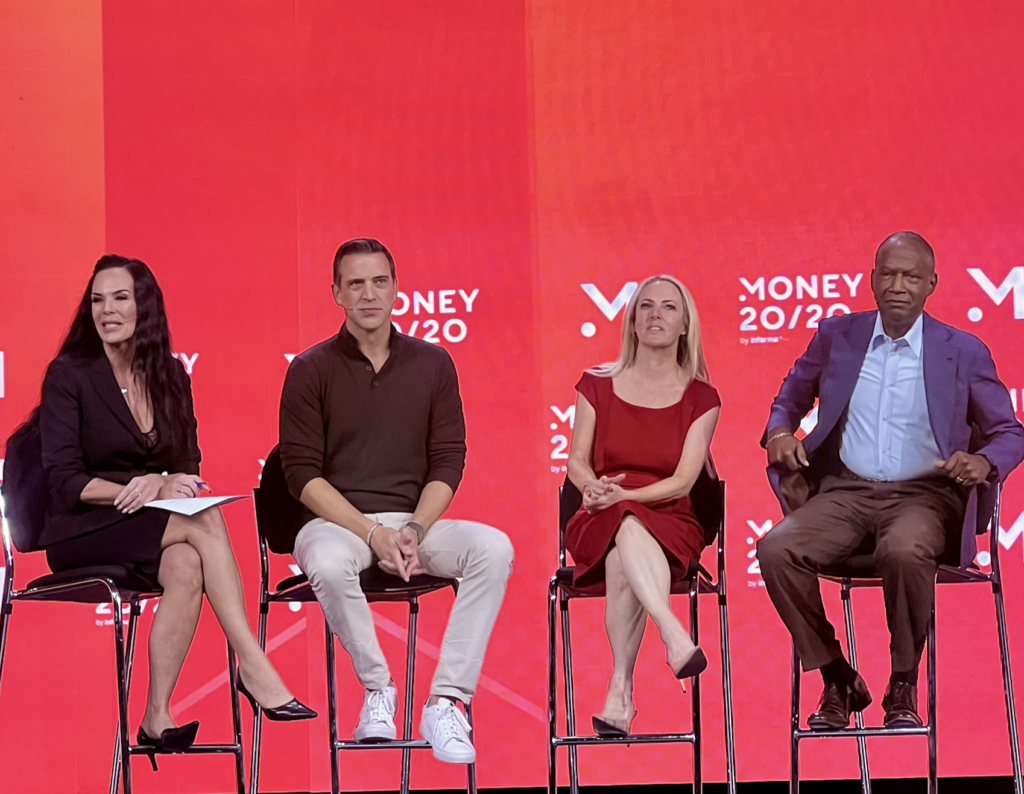
Arguing their cases in the debate were:
- Kathryn Davis, president and CEO of Valley First Credit Union
- Maurice Smith, the retired CEO of Local Government FCU and Civic FCU, who also has served on community bank boards
- Stephen Bohannon, founder and chief strategy officer with Alkami
The session, titled, “The Presidential Debate,” was moderated by Brandi Stankovic, principal with Strategic Advisory Solutions. Below is some of what was discussed:
Stankovic: Who is best positioned to lead the future of financial services?
Davis: I am asking for your vote because I think ownership matters in credit union. We can serve families, small businesses and communities while returning value to the people who in fact own the credit union. Are credit unions perfect? No. We know we’ve got some gaps. But I think at the end of the day when technology becomes available to everyone, there’s alignment trust and cooperation and that’s the real advantage that our model has. So, our future is not acting more like everyone else; it’s leaning in and modernizing what makes us different.
Smith: I’m going to ask for your vote because if you think about banking, serving a community isn’t just about consumers and businesses, it’s churches and other organizations that make communities what they are. Community bankers believe we have the stuff to make our communities grow.
Bohannon: I am asking for your vote because the consumer has already voted. Consumers didn’t wait for banks and credit unions to let them know that the convenience of digital was important. They moved to Chime, SoFI, Robinhood and other technology companies that were built around how people actually want to manage money. The app is not just a channel to many people; the app is the bank. The data and AI can know a customer at scale and anticipate what they need and serve them 24/7 in real time. You have the relationships and the charters. We built the experience people were asking for and solved the problem.
Stankovic: What does a community bank uniquely own when credit unions also claim community and fintechs claim personalization:
Smith: It’s right there in the name of the FI: community bank. It’s not just helping consumers, but also businesses. When we think about the economic system in your community, we are the OG of financial institutions. Community banks support communities. Much has changed, but the needs of consumers have remained the same. The need a safe place for their money, they need a relationship they can trust. The role of the community bank is to help your communities grow and we have a number of product and services that have proven over the years that can help people prosper.
Bohannon: I agree with a lot of that. I think what is missing is what is the definition of the community. We are all part of the Amazon community. We think about community with geographic borders. But people have different affinity groups now that they identify with more than with physical location. I think community is now defined differently.
Smith: People ask, ‘Where are you from?’ I could say Amazon. Most of us could say ‘Netflix.’ But community is something personal. When I think about community I’m thinking about people who live in proximity to me, not just what is on my phone. What matters to the consumer or business is who they have a real relationship with, not a virtual relationship.
Bohannon: Chime has 10 million customers now; that’s up something like 20% year over year. SoFi has 16 million members; that’s up over 30% year over year. Revolut didn’t exist 12 years ago, and it is up to 70 million customers. So, I think what these companies have proven is that they know how to serve customers and customers want what they have. The last remaining step is, ‘Let’s just go ahead and get our charter and get regulated,’ and by the way, why share all these profits with our bank partners when we’re doing all the heavy lifting?
Davis: I think credit unions win on community. We were founded by people in the community, and we are returning those profits to the community. True, on the charters, but where are the people going to see you when they have questions? They want to see someone in their communities.
Stankovic: Can the data know when someone deserves a loan and is a good risk when the data says know?
Bohannon: I think that is a misnomer that the experience or even the gut instinct of a particular loan officer or banking officer at a financial institution can stand in for innovative data, especially now. It is a misnomer that somehow using data (for decisions) would result in fewer approvals I think that’s absolutely ridiculous. In fact, what you see out there are companies like Zest AI and others that are great about alternative underwriting by using much more datasets on the consumer side. Maybe a FICO score cut off or, on the business side, maybe they even have a very thin file.
The amount of data that you have available to you in the building can actually result in many more approvals and loans then just simply using the old models. The other thing you have to keep in mind, too, is that you have to stay with either risk profile.
So, this so the idea that you know John or Jane or whomever and that your gut instincts say, ‘I think we should give these guys a chance,’ well, that can last only so long until you have all these bad loans that come back. So, you got to have something much more quantitative and what’s so great about having more data, especially powered by AI, and that is you can actually result in many more loans and more banking offers being presented than you would otherwise.
Stankovic: What does a community bank uniquely own. when a credit union also claims community?
Bohannon: I think people generally aren’t as loyal as we like them to be. They are loyal to their own time and money.
Smith: I disagree. I think what people want is a choice. They want technology at their fingertips; I will give you that. But they also want a personal relationship. I want to have a real, honest conversation with someone who will look me in the eye and help me deal with the challenges I am having. We have digital services at the bank, as well, but we give customers a choice.
Davis: I feel credit unions are in the middle of both. Credit unions are community on steroids. But where we are different is some of our products are very uniquely positioned for our members, who own us. You won’t find a 40-year mortgage at a bank. You will find small dollar loans at a credit union that aren’t there to make money, they are there to serve our community. You don’t have to come in, we have the technology, but if you need to come in, we are there.
Stankovic: Community banks say they finance the businesses that build communities. Then why do those same banks refer the deals they won’t do back to credit unions?
Smith: Sometimes we have concentration risk. So, we look to a partner in the community to meet that need. Or we can’t be the kind of partner we want to be to that customer. After all, we only care about the welfare of our customers.
Stankovic: Who wins when the consumer does not care about the model? If we swapped logos, would our members notice?
Smith: Consumers don’t care about the name of their institution, until they do care. When something goes wrong, a relationship on my phone is not going to meet the challenges a local business might face. You don’t get that from an algorithm. You get that from a real human being who figures out what you need and helps find solutions.
Davis: I think credit unions have some similarities there, and I think credit unions do an exceptional job across generations and with financial education, which is different from the bank or fintech. And if you serve underserved communities like my credit union does, we meet them where they are.
Bohannon: There is a reason institutions are consolidating: they have to scale. That person you helped for hours may mean there are 10 other businesses waiting behind them, but you didn’t help them because you spent so much time on that first business. You can’t scale that.
Stankovic: It sounds like there is no relationship with a fintech.
Bohannon: There is a relationship there. How well do you think Amazon knows you? Pretty well. I’m not looking to be friends with my banker; I just want to do my banking. Our job is to serve them in the most effective way possible, and that’s with scale.
Davis: I’m going to go back to the ownership model. We don’t need the margins you need. Our members are the owners and that allows us to serve them in a better way.






One Response
It’s Fintechs – no contest- community banks for local businesses.
Credit unions lead in out of touch and BMI