
NEW YORK — Credit unions and community banks enjoy stronger customer relationships than large banks, but younger consumers’ willingness to switch institutions and impatience with slow service threaten that advantage, according to new research from Glia.
The banking artificial intelligence provider’s 2026 Banking AI Consumer and Leader Survey drew on responses from 2,000 U.S. bank and credit union customers and 200 senior financial institution leaders.
Glia found that 57% of community bank and credit union customers described their institution as a trusted partner, compared with 48% of big-bank customers. Customers of community institutions also were more likely to describe their relationship as “very warm,” at 52%, compared with 43% of big-bank customers.
However, the survey identified a generational gap in trust and loyalty: Just 44% of Generation respondents described their primary bank or credit union as a trusted partner, compared with 57% of Baby Boomers.
Younger Consumers More Likely To Switch
Among the findings, according to Glia:
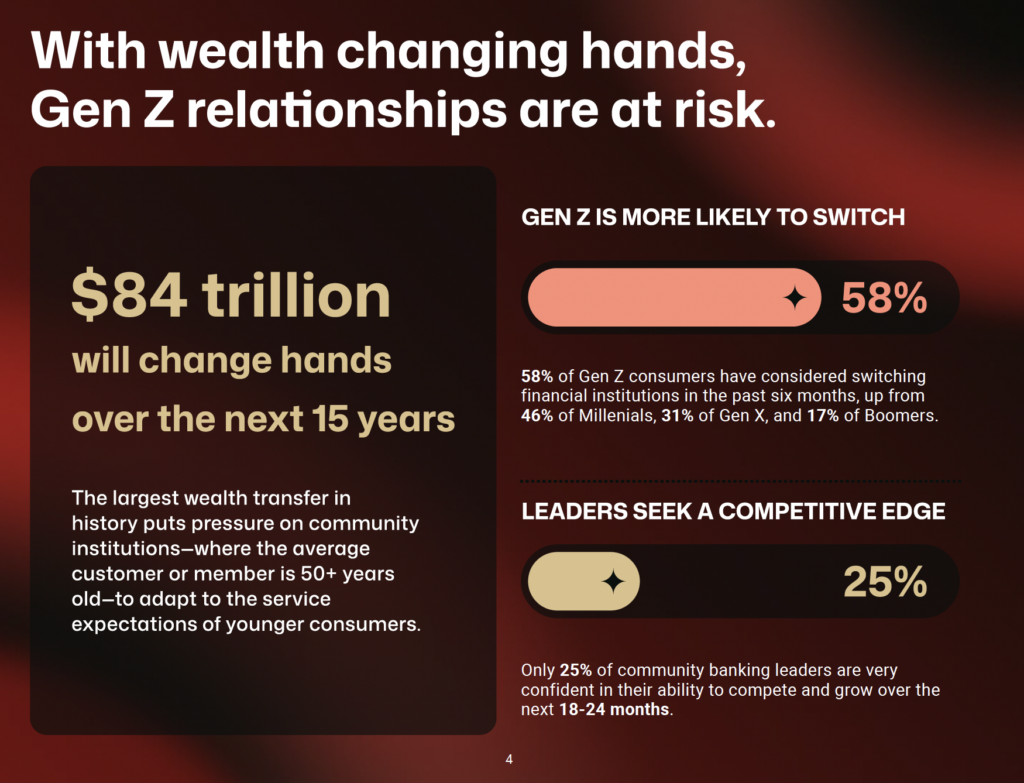
- 58% of Gen Z consumers considered switching financial institutions in the past year, compared with 17% of baby boomers.
- 55% of consumers overall said a 10-minute wait for service would threaten their loyalty.
- 42% of consumers overall said they would be more likely to switch after three or more frustrating service experiences.
- 63% of Gen Z consumers said they would be likely to switch after three or more frustrating experiences, compared with 37% of baby boomers.
- Gen Z consumers were nearly three times as likely as baby boomers to consider switching after a 10-minute wait.
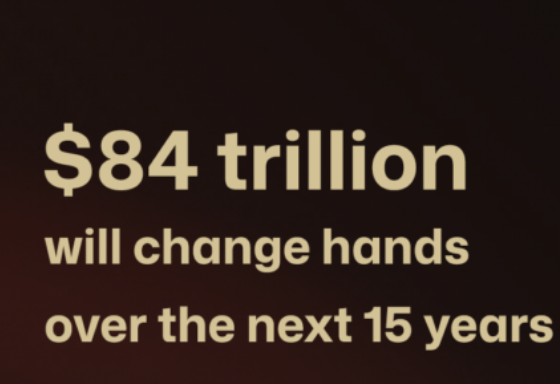
Glia said the findings underscore retention challenges as an estimated $84 trillion in wealth changes hands over the next 15 years.
“The Great Wealth Transfer creates a pivotal moment of opportunity — and risk — for community institutions,” said Dan Michaeli, Glia’s co-founder and CEO.
Michaeli said institutions need to combine the personalized relationships they have developed with the fast, convenient service younger generations expect.
AI Use Grows, But Human Service Still Matters
Younger consumers also reported substantially greater use of AI for financial tasks, according to the survey.
Among Gen Z respondents, 46% said they often or very often used AI tools to analyze their finances or help make financial decisions. That compared with 37% of millennials, 14% of Generation X respondents and 5% of baby boomers.
Still, digital expectations have not eliminated demand for branches. Glia found that 27% of Gen Z consumers made a branch their first stop when seeking customer service, compared with 33% of baby boomers.
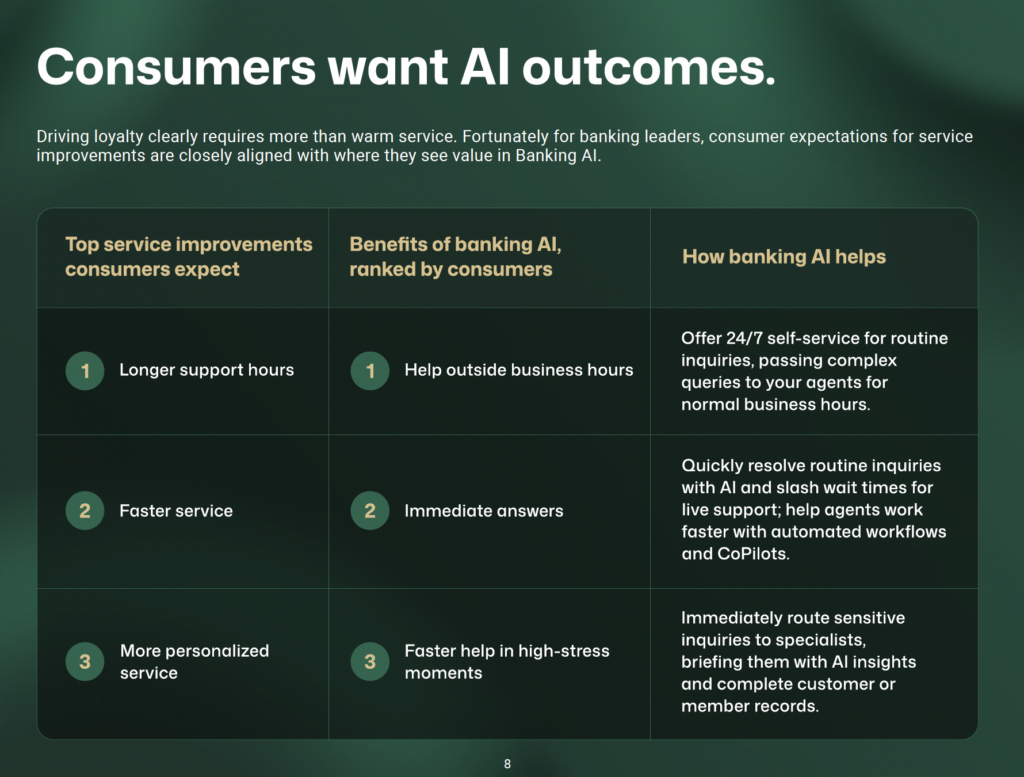
Consumers were most receptive to AI handling routine interactions while continuing to prefer human assistance for more complex needs, Glia said.
Digital Competition Concerns Leaders
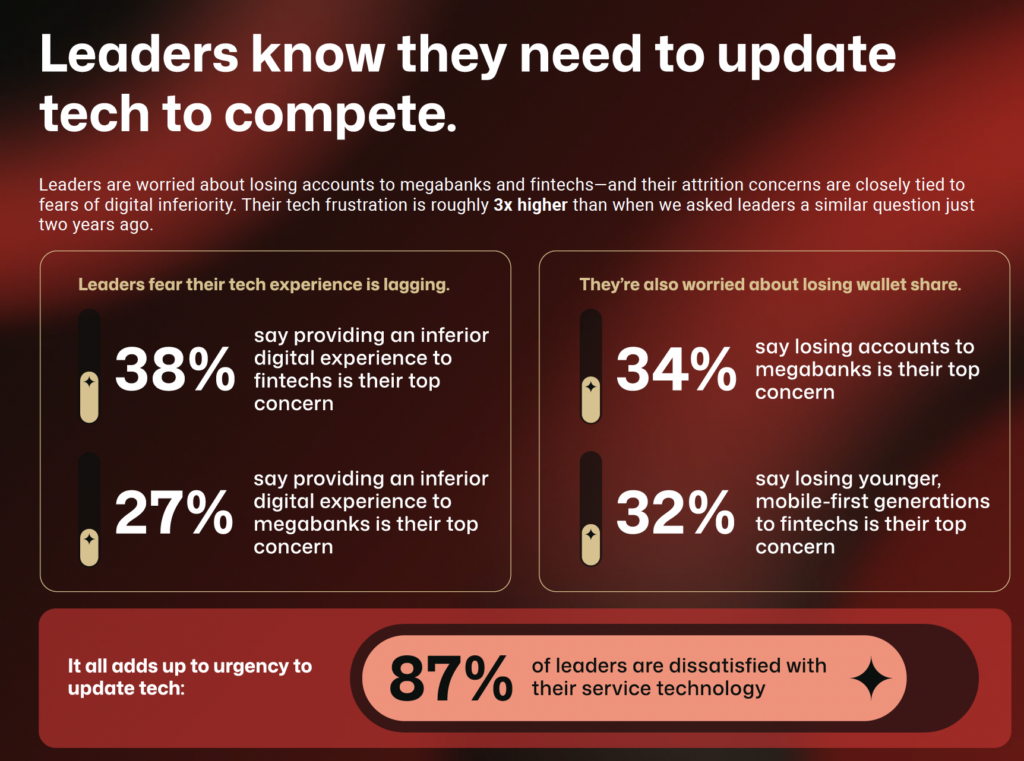
Among financial institution leaders surveyed, 27% identified an inferior digital experience as a top concern when competing with megabanks. That share rose to 38% when competing with fintech companies.
Glia, which said its platform serves more than 700 regional and community financial institutions, markets AI tools that connect customer interactions, institutional knowledge and workflow automation.
The company also reported that leaders at institutions using Glia were twice as satisfied with their AI technology as their peers, 21% more likely to deploy AI across customer and agent interactions, and 42% more likely to identify personalized service as their primary goal for AI adoption.
The report can be downloaded here.