

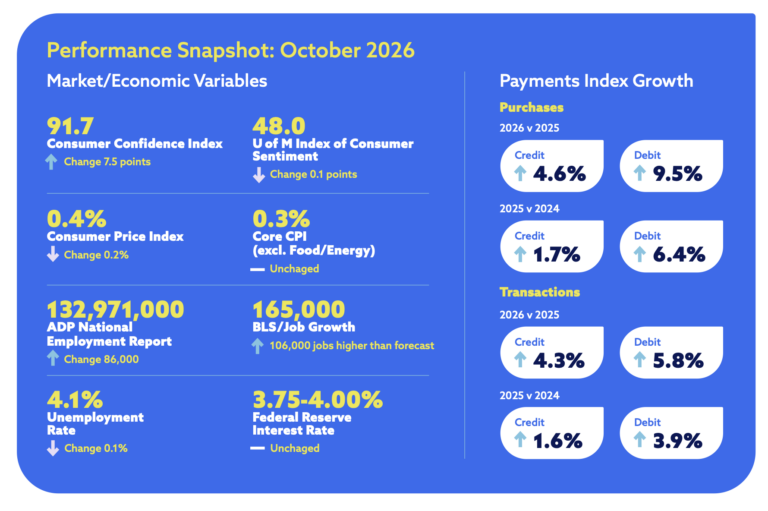
TAMPA, Fla. — Debit card purchases increased 9.5% in October from a year earlier, more than double the 4.6% increase in credit card purchases, according to the November 2026 Velera Payments Index, which found consumer spending remained strong heading into the holiday shopping season.
The payments credit union service organization said growth was driven primarily by spending in its goods and gasoline categories, despite continuing concerns over inflation and affordability. Its latest report also highlighted the expanding role of money services, including peer-to-peer payments, financial technology applications and buy now, pay later providers.
Key Trends in Card Spending
- Debit purchases: Up 9.5% year over year in October.
- Credit purchases: Up 4.6% from October 2025.
- Money services: Accounted for 14.6% of all debit purchases, up from 13.3% a year earlier, as consumers increasingly moved funds to fintech companies and other third-party platforms.
Velera said the shift toward digital money movement represents a fast-growing portion of debit card activity. The category includes transactions associated with peer-to-peer payment services, fintech apps, buy now, pay later providers and other services that move money outside traditional bank and credit union channels.
Labor Market Supports Spending
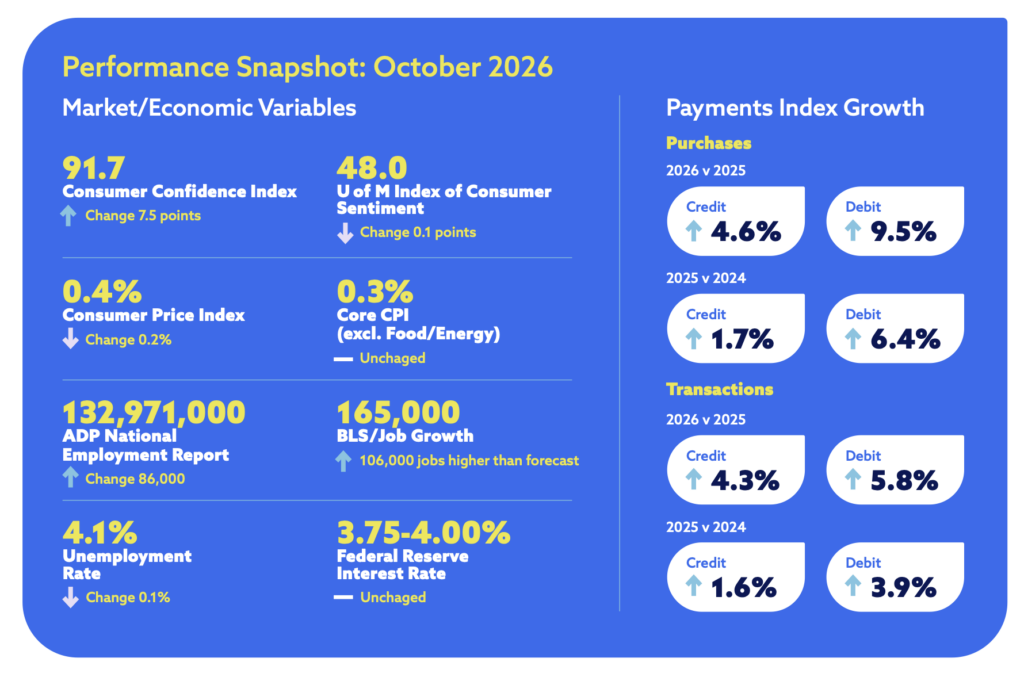
The report pointed to job growth, low unemployment and moderate wage gains as supports for consumer spending. Velera cited Bureau of Labor Statistics figures showing employers added 165,000 nonfarm jobs in October, compared with an average monthly gain of 48,000 over the preceding year and expectations for 59,000 new jobs. The unemployment rate declined to 4.1% from 4.2%, while average hourly earnings rose 3.1% from a year earlier.
A separate ADP report showed more modest private-sector hiring of 86,000 jobs, with annual wage growth of 3.2%. Although the hiring estimates differed, Velera said both pointed to a labor market capable of supporting continued household spending.
Mixed Consumer Confidence, Persistent Inflation
Consumer sentiment indicators offered a less consistent picture. The University of Michigan’s consumer sentiment index registered 48.0 in October, essentially unchanged from September but down 10.4% from a year earlier. Respondents continued to cite affordability, high interest rates and inflation expectations as concerns.
By contrast, the Conference Board’s Consumer Confidence Index climbed to 91.7 from 84.2 in September, reflecting better assessments of business conditions, employment and gasoline prices. Still, the report said the board’s Expectations Index remained below a level historically associated with recession risk, while consumers continued to question their purchasing power.
Velera cited an October Consumer Price Index increase of 0.4% from the previous month, down from September’s 0.6% increase. Core consumer prices, excluding food and energy, rose 0.3%. Shelter, food and energy remained major contributors to price growth. The report said the Bureau of Labor Statistics did not publish official year-over-year inflation rates in that release because of the October 2025 government shutdown.
The Federal Reserve left its benchmark interest rate unchanged at 3.75% to 4% at its October meeting. According to Velera, expectations ahead of the Fed’s Dec. 8-9 meeting had shifted toward a 0.25-percentage-point rate increase as inflation pressures persisted and the labor market remained resilient.
Financial Strain Remains a Holiday Risk
The strength in spending does not mean all households are financially secure, according to Taylor Nelms, vice president of research and insights at the Financial Health Network. The organization’s 2026 U.S. Financial Health Pulse found 17% of households were financially vulnerable, up from 15% and matching the highest share recorded in nine years of data collection.
Only 68% of households surveyed said they paid all their bills on time in 2026, Nelms said, adding that financial strain extends across income and demographic groups.
“Affordability and cash flow are pressure points to watch this holiday season,” Nelms said. She added, “Holiday spending will test the resilience of a wide range of households this year.”