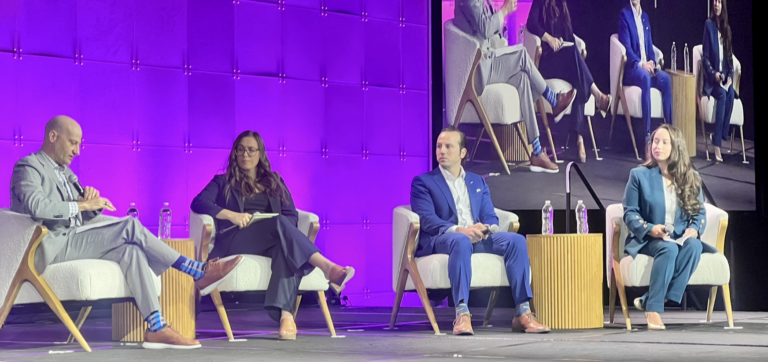
PALM DESERT, Calif.–Four credit union advocates offered a view from the state level on what this week’s elections will likely mean for CUs.
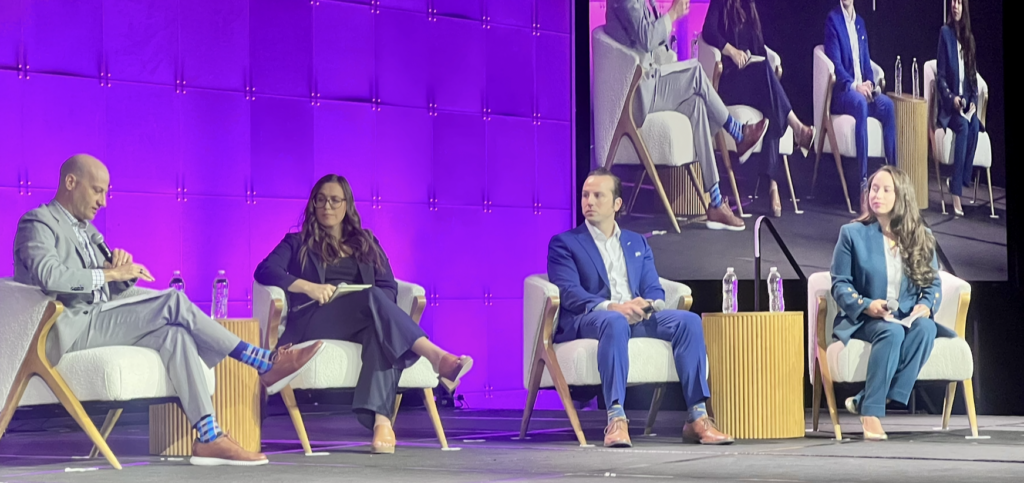
The insights were shared during the California and Nevada leagues’ REACH Conference by:
- Jeremy Empol, president and CEO of California’s Credit Unions and Nevada’s Credit Unions
- Robert Wilson, EVP with California’s Credit Unions and Nevada’s Credit Unions
- Angelica Pappalardo, Political Advocacy Manager at the California, Nevada, and Utah Credit Union Leagues
- Stepanie Cuevas, Senior Vice President, Federal Government Affairs at California & Nevada Credit Union Leagues.
Cuevas noted that while there are still some races yet to be called, it appears the new Congress will move from 218/214 Republican/Democrat in the House to 177258, and from 53/45 in the Senate to 44/56. California’s Rep. Maxine Waters (D) is expected to chair the House Financial Services Committee.
Wilson said he sees plenty of opportunity in the change taking place in both Congress and the state legislature but doesn’t expect the new administration of Governor-elect Xavier Becerra to be much of a directional change. He said credit unions had a good relationship with Becerra when he was the state’s attorney general and when he was in Congress, adding that Becerra is a member of numerous credit unions.
In Nevada, Wilson said he sees both “pros and cons” with incoming Governor Aaron Ford, a Democrat, who will succeed Republican Joe Lombardo, and overall believes there will be “opportunities,” as credit unions are “well-positioned” in the Democratic caucus. Wilson described the relationship with Ford as “great.”
Worry Over Collateral Damage
Looking forward, Wilson said his concerns are around credit unions becoming “collateral damage” as the Democrats in Congress and the California Assembly pursue what’s expected to be an aggressive pro-consumer agenda.
“The Democrats won on oversight, oversight, oversight, mostly focused on the Trump administration, but it’s going to permeate beyond that to many hearings,” said Cuevas. “As an industry, we really need to own the narrative. We now have rural Democrats who are more moderate, and Democratic Socialists who have been elected, so we will need to drill down on that messaging. That’s why it’s important that you continue to do what you do, those everyday activities credit unions do go a long way in showing the credit union difference.”
Cuevas said she expects the newly elected officials will focus on junk fees, fair lending and AI governance.
Kill Switch Bills Coming
While credit unions are worried over how oversight regimes will change, Empol joked that CUs should be glad they are not in the crypto or AI space, as that is going to be a focus. In the California Assembly he expects an AI “kill switch” bill to be introduced by every elected official. “They are going to go after the big fish to fry, and right now that is not credit unions,” said Empol.
Cuevas said she expects both the Clarity Act—which the Republicans have struggled to move in the current Congress—and the Credit Card Competition Act will become a focus once again. One question: who will champion the CCCA with its two primary sponsors—Sen. Roger Marshall and Sen. Dick Durbin—exiting Congress.
But it isn’t just at the federal level where credit unions need to be wary when it comes to interchange legislation. Indeed, the threats have been far more prevalent at the state level.
“There has been an interchange bill introduced more than 100 times in the states,” said Wilson. “It has only passed once. What we’re seeing in California is a third of the legislature has turned over. There were retirements, people terming out. Now we have a new crop of people to educate on interchange. Fortunately, we have headed this off with the candidate interviews. Interchange is something we have talked about with candidates multiple times. But interchange is a complex issue. We are going to have to educate legislators.”
Closing Thoughts
The session closed with “closing thoughts” from each of the four panelists.
- “When it comes to the Democrats, we’ve always found them to be very open to the charter and they love the community work we do,” said Empol. “With regulation, they believe in belts, suspenders and vests. They like to regulate and put consumers first. On the Republican side, they have always been more pro-deregulation, and when it comes to tax status, we have moderated those pieces of legislation.”
- “All politics is local,” said Cuevas. “Don’t forget the power you have. Two, it is our goal now to educate and anticipate what is coming. Three, if you are not at the table, you are on the menu. So, we need to keep our voices amplified.”
- Wilson: “With this blue wave I would say this is something we are used to in California and we embrace. There may be some fear mongering on this front in the media, but there is a lot of good that can come out of this. I would echo Stephanie and urge everyone to get involved.”
- “Our political voice is only as impactful as our participation,” said Pappalardo. “We need everyone to stand up and stand out and connect with your local officials. It’s incredibly impactful when you share your member stories.”