
LAS VEGAS–All the promise of AI is being countered by AI-empowered fraud, which is hitting financial institutions, merchants and consumers at scale. What is the latest, and where is the fraud landscape being reshaped in ways credit unions need to be aware of? Three people have offered some answers.
During a session at the Money 20/20 show titled, “How to Fight Fraud Perpetrated by an AI-Enabled Attacker,” insights were shared on the types of AI-driven fraud that are most common, what the best case is for effectively responding, and more.
Participating in the panel to discuss the topic were:
- Pedro Sanzovo of Plaid
- Brigette Korney of Adven
- Will Wilkinson of Persona
The session was moderated by Sarah Mamula of the Financial Technology Association.
Below is some of what was discussed:
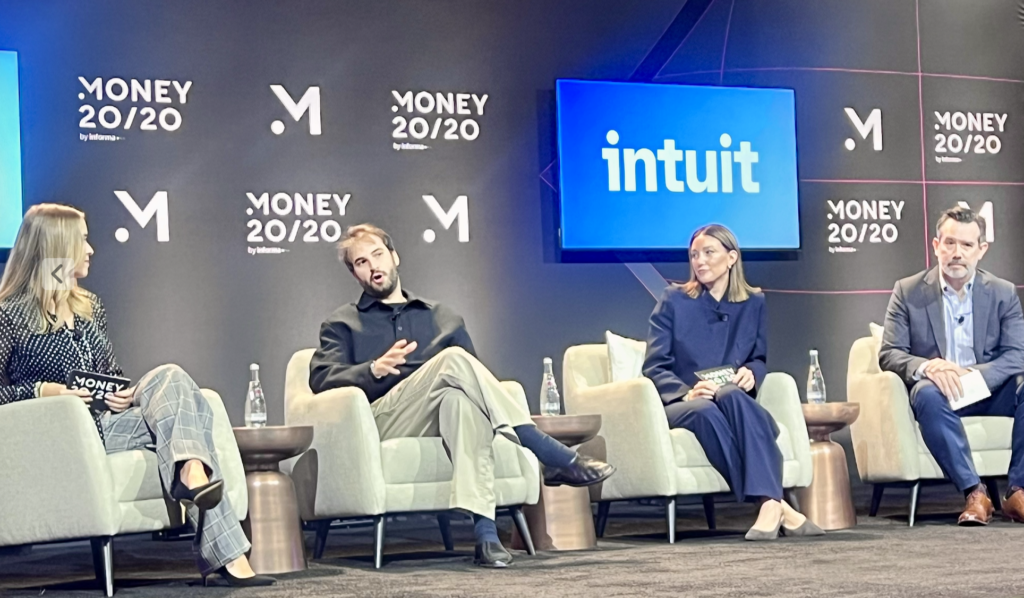
Mamula: What’s happening in fraud and AI has been a hot topic at Money 20/20. Last year, there was more than $21 billion in online fraud reported to the FBI. When you look at accounts, what does AI driven fraud look like?
Sanzovo: Over last two to three years a lot has changed in the fraud space, and at the same time very little has changed. What has changed is the significant ramping up of fraud at much lower costs. Instead of fighting a few groups, you’re fighting an army. There is identity fraud and intent fraud. Identity fraud saw a ramp up in deep fakes. Wha has surprised me is a big ramp up in intent fraud, which is humans taking advantage of their own identities to commit fraud. You can now ask an LLM how to file for a chargeback, how can I do a credit bust-out. It’s super-easy to create fake documents to corroborate claims being made.
At Plaid we are trying to figure out what are artifacts fraudsters can’t fake.
Mamula: From a merchant perspective, what are you seeing?
Korney: Merchants are also seeing ramp ups in both identity and intent fraud. We have come a long way in the sophistication. Five percent of identities have led to 58% of the fraud losses. So, we need to be more precise in how we are finding them. We tell merchants, ‘Don’t take trust at its word.’ You need to examine this across the customer journey.
Mamula: What is reality of deep fakes? Does the threat live up to the hype, or not?
Wilkinson: It’s a little bit of both. We looked at more than 27 million selfies over the first half of the year, and 86% were classical presentation attacks, holding something up to the camera. My colleague calls it ‘fraud slop’; for instance, holding a picture of Keanu Reeves up to the camera. Injection attacks are still something simple like a video feed injected into the feed. Only about 25% used AI, and when they were really, really good it was targeted at high-value targets
AI is really about adding fraud at scale. My message would be not to let your attention or budget be dominated by attention to deep fakes. You still have to catch the cheap attacks at scale.
Mamula: We have talked about the doom and gloom. How is AI preventing fraud? Where can we be optimistic?
Korney: I think AI is changing how we’re going about it, and in deciding where we want to get a human in the loop. My favorite example is how we’re trying to get good customers through is authentication that uses the best evidence. For merchants, you still need to consider fraud throughout the journey.
Sanzovo: AI or not, the reality is kind of the same with trash in, trash out. If data isn’t reliable and you don’t connect all elements, you’re not going to have good predictability.
Plaid really grew as an open finance play. We have consumers moving data from point A to B. It has allowed us to create this data graph. The fundamental is bank account information. That is information you can’t really deep fake. It gets really, really expensive for fraudsters to create data from the get-go. That is data we can rely on, and then you can leverage AI on top of it. We have done a lot of experiments on the algorithms we use to truly extract value at scale.
Mamula: What can you trust from the camera?
Wilkinson: A quarter of selfies are AI generated means, which means you can’t trust an image. The transition is toward treating the image as one signal among many different signals.
First, you have to check how the device got there. And you have to look not at one photo at a time, but across the whole universe of user submissions, and the hundreds of millions of photos. One deep fake photo may be perfect, but fraudsters, tend to reuse backgrounds and templates, and AI is really good at finding those patterns and anomalies.
Lastly, you need to layer in other signals that are harder to fake, other forms of authoritative evidence. User history, account history, has this person been using this device a long time?
Ultimately, you need really, really high trust signals like cryptographically signed credentials that are impossible for an AI to fake.
Mamula: With the increased pace of transactions, can all of this detection keep up?
Korney: Yes, it has to keep up. We need all these inputs to make the transaction smarter before it gets to payments. Real-time payments may have raised the stakes, but that doesn’t change all these other types of fraud we’re trying to stop.
Sanzovo: The way I think about it is it is always a phased approach–collecting the data, cleaning up the data. Then you can discuss your algorithmic approaches, and how you are going to tailor the data to achieve your business results.
Mamula: There are many bills before Congress on fraud and scams. But there isn’t one national strategy that unifies industry, government and law enforcement. What would that look like?
Wilkinson: At this juncture, especially when the financial system is transforming so quickly, it makes things like a digital identity infrastructure more and more important.
You have to think back to what made the Internet secure in the first place. It was built to identify machines, not people. Effectively, we need a certificate authority for people. People need to have a piece of evidence they can present online that says they are who they say they are. We’ve made a start into it with mobile driver’s licenses, and there are some good policy initiatives to promote that. That’s a first step.
Increasingly, I think it means giving companies a little more responsibility in the financial system. All of our regulations were written quite a few years ago. Financial regulations that say financial institutions can do certain things, and that needs to apply to their vendors if you want them to do it–things like being able to share risk signals.