WILMINGTON, Del.–Issuers’ success rates in chargeback disputes involving a group of major streaming subscription brands plunged by about 35 percentage points in less than a month, even as the number of disputes changed little, according to a new analysis by Quavo Labs.
The research found banks and credit unions had prevailed in 92% to 96% of disputes involving the tracked streaming brands for 11 consecutive months before their win rate dropped to 58% in July. The decline unfolded over 26 days, according to Quavo Labs, which analyzed dispute patterns using a data set encompassing more than 25 million cases.
Ron Rybicki, vice president of data and analytics at Quavo Labs and author of the analysis, said the change was difficult for individual financial institutions to recognize because dispute volumes remained relatively steady. Without a broader view, issuers might have blamed weaker evidence, an increase in so-called friendly fraud or changes in card network rules.
The company said its new Quavo Labs research hub is intended to make industry-level intelligence available to banks and credit unions and identify emerging fraud and chargeback trends that might not be apparent within a single institution’s portfolio. Quavo describes itself as an AI-powered dispute technology provider for financial institutions.
What the Data Reveal
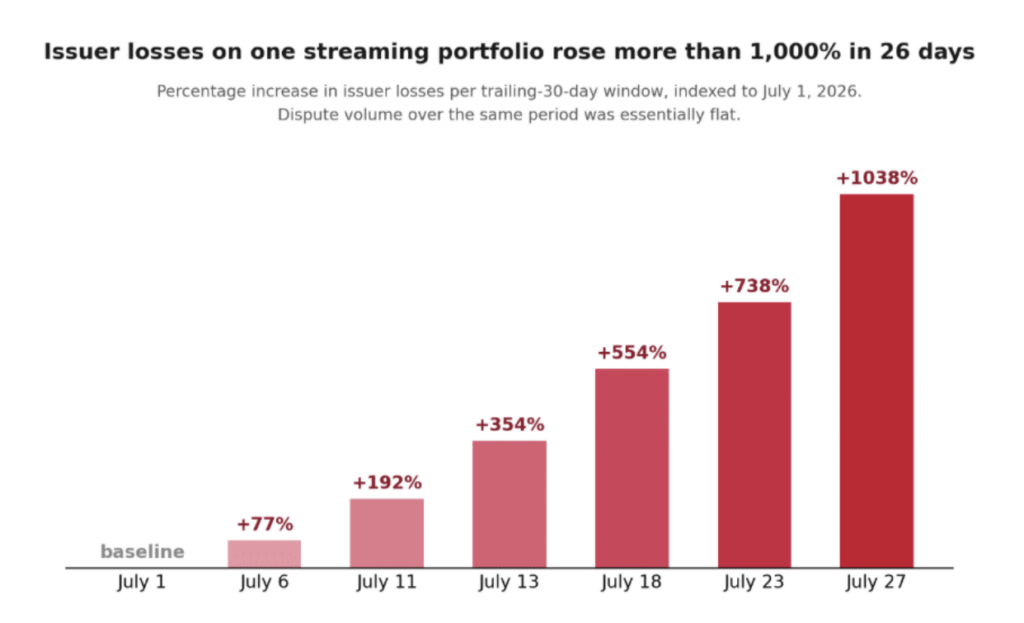
Quavo said resolved dispute volume rose about 10% from one 30-day period to the next, while issuer losses increased more than 1,000%, an elevenfold jump in less than a month. The company said losses increased each day during the period.
The pattern was especially pronounced among related streaming brands under common ownership. Streaming companies often operate multiple merchant accounts, including several accounts for an individual brand. Quavo said all the accounts it examined among a group of sibling brands shifted within the same three-week period.
One account’s issuer win rate fell from nearly 100% to a range of 52% to 65%; another dropped from 98% to 60%; and a third declined from 89% to 44%. Quavo said the coordinated timing suggested a change in merchant dispute practices at the parent-company level rather than unrelated decisions by individual teams.
The change was not widespread across all digital subscriptions. Issuer win rates in the broader category moved only from 28% to 25% during the same period, according to the analysis. Quavo said that comparison made an industrywide rule change a less likely explanation and instead pointed to a company-specific strategy shift. It warned that other streaming companies could adopt similar approaches.
Why Merchants May be Fighting More Claims
Quavo noted that major streaming services have repeatedly raised subscription prices between June and October over the past three years, making late summer and early fall a recurring period for increases. The analysis said merchants may now be more inclined, and better equipped, to contest subscription chargebacks.
Streaming disputes frequently involve first-party fraud allegations or automatic-renewal complaints in which the customer originally subscribed but later contests a charge, Quavo said. Merchants may be able to rebut those claims using subscriber account records, viewing history, device activity and contract terms.
Rybicki identified three possible drivers of the changing approach.
- First, streaming parent companies have spent about two years combining related brands under shared billing platforms and subscriber agreements, with clearer language addressing renewals, trial periods, cancellations and refunds. Those systems can allow a parent company to change dispute handling across several brands at once.
- Second, Quavo said card network dispute-ratio thresholds tightened in April 2026, raising the costs for merchants that exceed specified limits through per-dispute fees.
- Third, streaming providers that once emphasized subscriber growth have increasingly focused on profitability, customer retention and protecting revenue.
The analysis characterized those factors as possible explanations, not independently established motives for the particular streaming company’s actions.
What Quavo Recommends for Issuers
Quavo urged financial institutions to revisit recovery forecasts, provisional-credit policies and case-routing rules that assume issuer win rates above 90% for streaming chargebacks. A model based on those historical outcomes may now overstate likely recoveries by roughly 35 percentage points, the company said.
The analysis also cautioned that the entire impact may not yet be reflected in a 30-day reporting window and that issuer win rates could fall below 58%.
Quavo recommended collecting stronger information at the start of a dispute, including when and how a subscriber canceled, prior use of the account and whether credentials were shared within a household. It also suggested reviewing weak card-not-present fraud claims before initiating chargebacks, because a merchant’s well-documented rebuttal may be difficult to overcome later.
The company said issuer reporting should link merchant accounts, affiliated brands and parent companies rather than assessing each merchant account separately. What might appear to be eight isolated anomalies could represent one coordinated shift in a parent company’s strategy, the analysis said.
About the Data
Quavo said its technology draws on more than 25 million disputes annually across more than 650 issuers and brands, with information anonymized and reported in aggregate. The company said that scale enables it to identify trends across institutions and translate them into decisions involving claim intake, recovery strategies and case routing.
The findings are the first example published through the new research hub. Quavo said quarterly benchmarking may leave financial institutions months behind fast-moving changes in merchant behavior, with losses accumulating before a shift becomes clear.