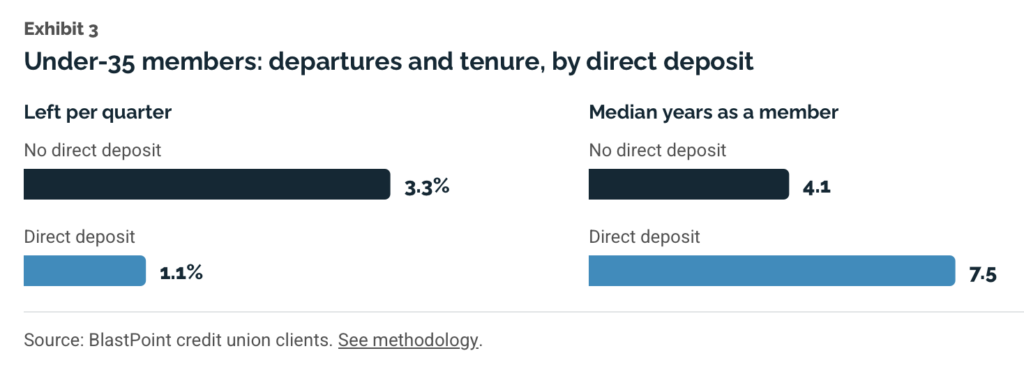
PITTSBURGH–Credit union members younger than 35 without direct deposit left their institutions at three times the quarterly rate of peers with the service, according to a BlastPoint analysis that identified account engagement as a stronger distinction than age alone.
Across nine credit union clients with sufficient historical data, under-35 members without direct deposit left at an average rate of 3.3% per quarter, compared with 1.1% for those with it, BlastPoint reported in its November research note. Departure rates were lower for members with direct deposit at all nine institutions, with differences ranging from twofold to sevenfold.
The company cautioned that the findings reflect its own clients, rather than a representative industry sample, and do not establish that direct deposit caused members to stay.
What Broader Analysis Reveals
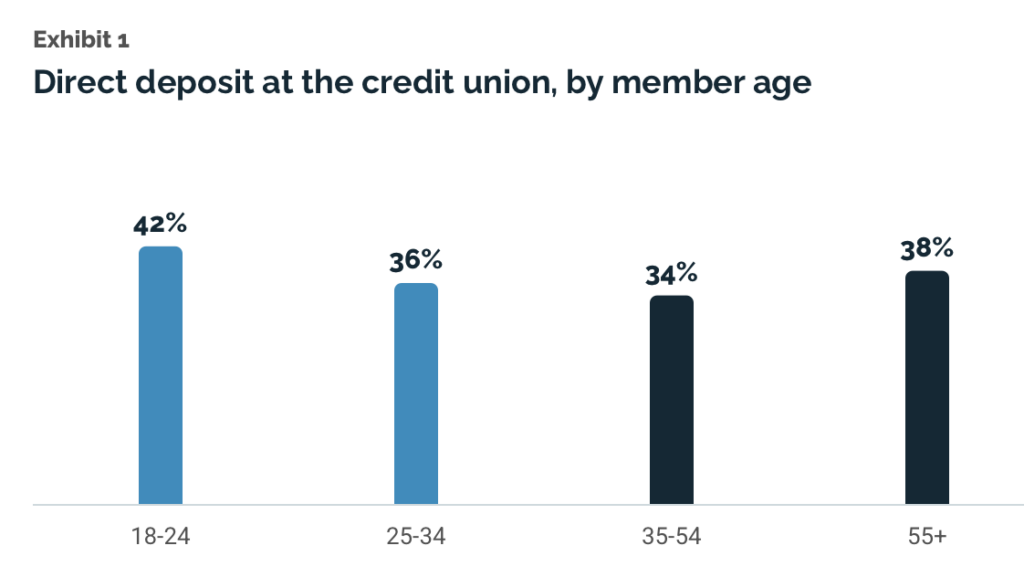
In a broader analysis of 13 clients, BlastPoint found that 38% of members under 35 had direct deposit, matching the share among members 55 and older. Members ages 18 to 24 had the highest participation, at 42%, followed by those 25 to 34 at 36%. The rate was 34% for members ages 35 to 54.
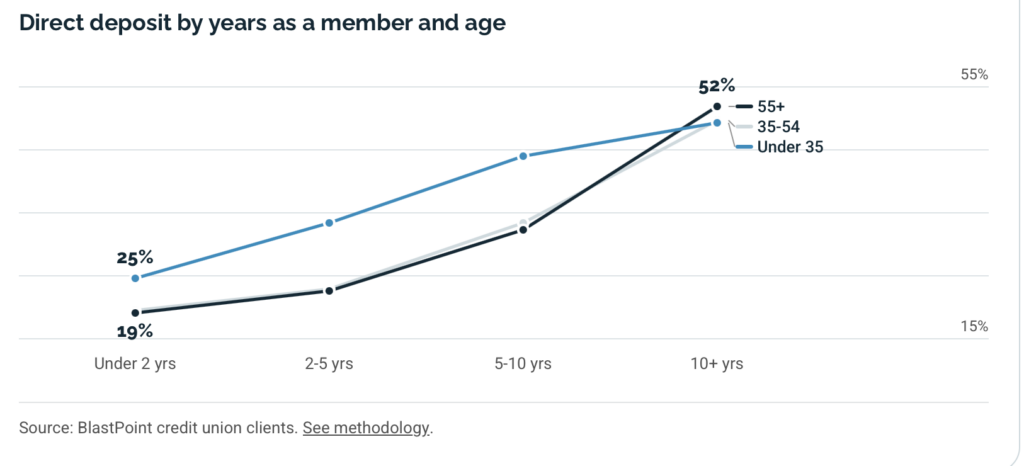
Younger members also adopted the service earlier in their relationships. Among members with less than two years of tenure, 25% of those under 35 had direct deposit, compared with 19% of those 55 and older, the company said.
Under-35 members with direct deposit had a median membership tenure of 7.5 years, compared with 4.1 years for those without it. Checking account ownership also differed sharply: 91% of younger members with direct deposit had checking at their credit union, compared with 36% of those without direct deposit, according to BlastPoint.
The Recommendations
The company recommended that credit unions identify younger members without direct deposit and examine their checking, deposit, tenure and household information together to guide outreach.
But institutions first need to understand what their records measure, BlastPoint said. Five of its 18 credit union clients did not provide a usable direct-deposit field. At four others, the indicator rarely switched off after being activated, making it a record of past enrollment rather than necessarily current deposits.
At one credit union, using a recent-deposit measure instead of an enrollment indicator reduced the share of under-35 members recorded as having direct deposit from 66% to 48% in the same year.
BlastPoint projected that roughly one in eight younger members without direct deposit could leave over the next 12 months if the measured quarterly rates persist. The company described that estimate as a forecast, rather than an observed finding.
About the Research
The research used an Oct. 27, 2026, data snapshot and departures from October 2025 to October 2026. Each credit union received equal weight in averages. Direct deposit included Social Security and pension payments for older members. Groups with fewer than 100 members were excluded, as were institutions where many departing members subsequently returned.