


BEND, Ore.–Mid Oregon Credit Union here was featured by the Wall Street Journal as a prime example of how corporate America is getting hit by “healthcare sticker shock—and companies are passing a greater share of the cost on to workers.”
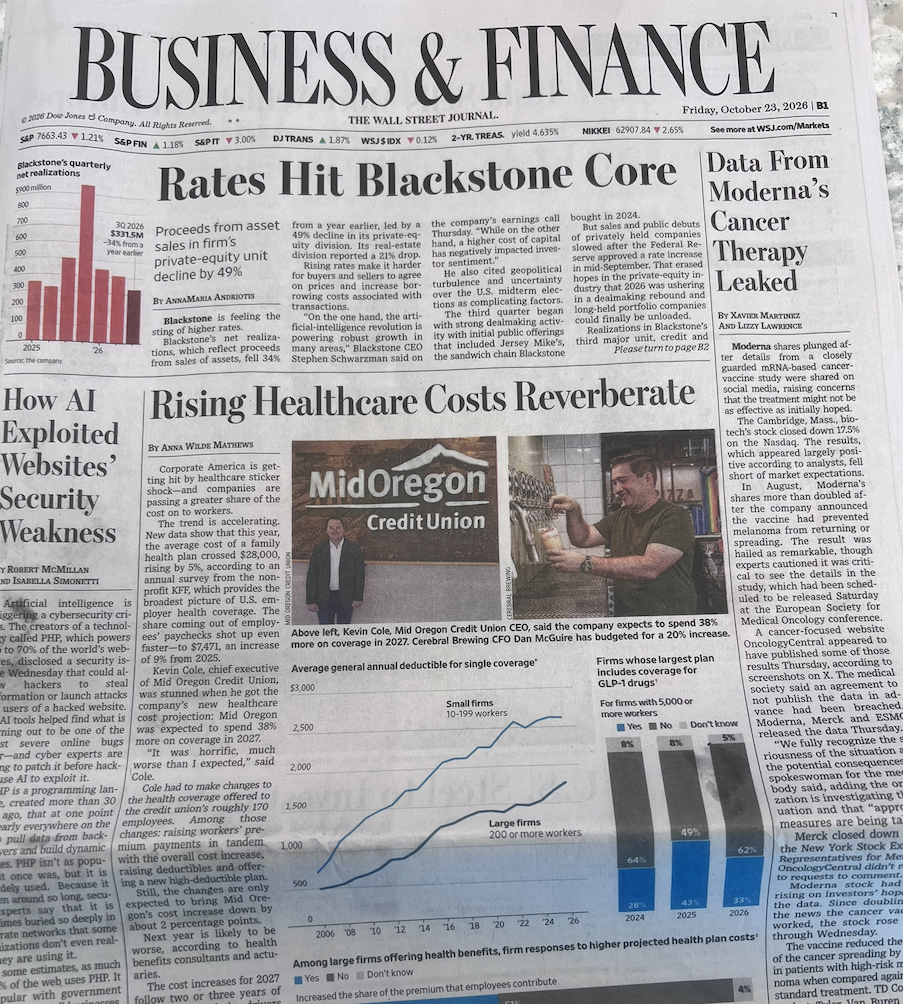
Mid Oregon was included as part of an article that noted new data shows that this year, the average cost of a family health plan crossed $28,000, rising by 5%, according to an annual survey from the nonprofit KFF, which provides the broadest picture of U.S. employer health coverage. The share coming out of employees’ paychecks shot up even faster—to $7,471, an increase of 9% from 2025, the Journal reported.
Kevin Cole, chief executive of Mid Oregon Credit Union, was the first person quoted in the piece, which said he was stunned when he got the company’s new healthcare cost projection: Mid Oregon was expected to spend 38% more on coverage in 2027.
“It was horrific, much worse than I expected,” Cole told the Wall Street Journal.
The Journal reported that Cole and the $917-million Mid-Oregon had to make changes to the health coverage offered to the credit union’s roughly 170 employees. Among those changes: raising workers’ premium payments in tandem with the overall cost increase, raising deductibles and offering a new high-deductible plan.
Still, the changes are only expected to bring Mid Oregon’s cost increase down by about 2 percentage points, the Journal reported.
‘Likely to Get Worse’
The article went on to caution that next year is likely to be worse, according to health benefits consultants and actuaries, adding that the cost increases for 2027 follow two or three years of steep rises, and the drivers aren’t going away. Hospitals have been able to raise some prices and use artificial-intelligence tools to boost billing, it added.
“High-cost drugs for an array of conditions, including cancer and weight loss, are driving up spending,” the Journal reported. “Some employers are reacting by dropping coverage for popular GLP-1 weight loss drugs, though some are now helping to fund pretax accounts that workers can use to buy them on their own.”
The Journal also interviewed the owners of a Denver brewery for its response to higher health care costs.






One Response
Hi,
Healthcare costs are becoming a big concern, so it is helpful to compare options and understand the costs before choosing a service. I use this page to compare medical weight loss programs and their pricing https://rolandmedicalweightloss.com/comparison/compare-roland-medical-weight-loss-programs/