
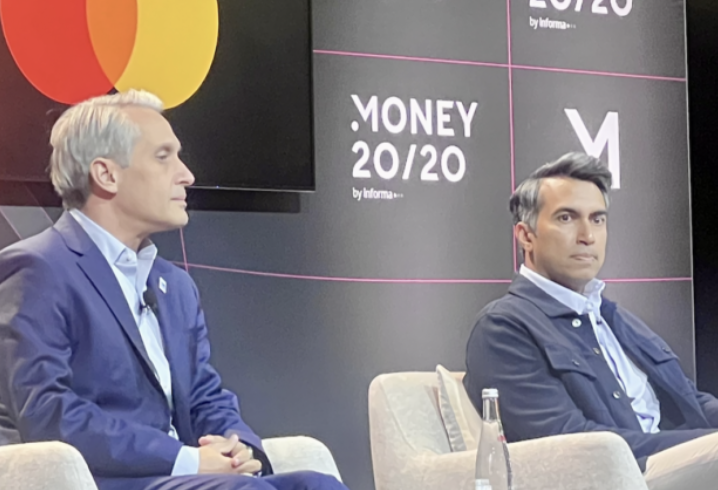
LAS VEGAS–For decades, the credit card has been a cornerstone of payments, generating $250 billion in annual revenue for issuers. But the card ecosystem is shifting, and two people—one with one of the biggest issuers in the country, the other with one of the biggest rewards programs, have shared how they are responding and what they believe lies ahead.
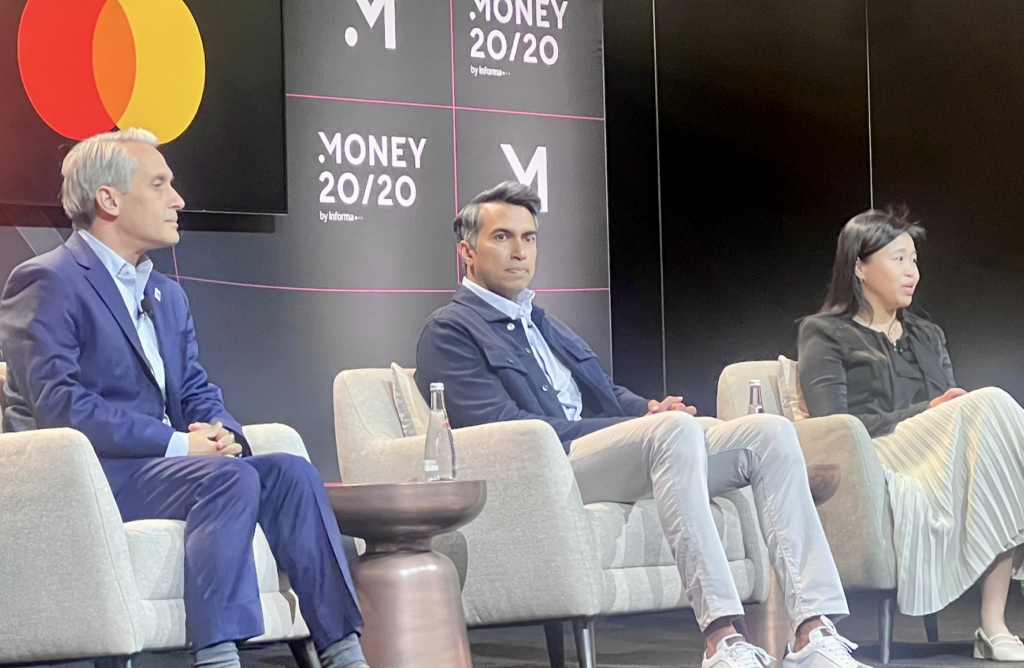
The insights were provided by Jarad Fisher, VP with United Airlines and president of its huge rewards program, MileagePlus (who also played a role in creating the Apple Card); and Maran Nalluswami, EVP, chief strategy and business officer with Synchrony, during a Q&A at the Money 20/20 conference in Las Vegas.
Felicia Tan, a partner with McKinsey & Co. and moderator of the discussion, noted there are several shifts taking place in the credit card space, including:
- How people shop: One in two people is now using AI to make purchasing decisions
- The economics: Costs related to rewards programs consume 80% of interchange revenue and are eroding the card P&L
Below is a look at some of what was discussed:
Tan: As you look at the evolving dynamics of how consumer behavior is shifting, what opportunities and challenges do you see?
Fisher: As you think about AI in particular and the impact it is having on cards and loyalty programs, the risk of disintermediation is real. The first effect it has is on acquisition. Moving the consumer away to an agent means everyone needs to stay close and keep a close watch. Also, the ability to reinforce benefits and provide recognition to customers is something that will need to evolve.
In agentic commerce, we are in the very, very early days–in the first or second batter of the first inning. We have to keep a close watch, the winners here will be some of the brands that don’t dive all the way in and do too much, too fast. Instead, they will use some small use-cases to engender trust and get people to use them.
Agentic AI really good right now at apologizing, and consumers are going to be very hesitant to hand over their money to these tools in their current phase. The winners are going to be those that start slow.
Tan: What is one good use-case?
Fisher: From our vantage point, one small use-case that makes perfect sense is connecting the airline journey with a rideshare, for example. As we more deeply integrate different components of the journey, knowing when you should be flying and when you should be booking a car, as well as should things change it should automatically be able to make adjustments; that is something we think consumers be excited about. This also applies to even the size of the car to be reserved or rented.
If you begin to do those things with repetition, you will be able to get people excited about what’s yet to come.
Tan: How do you think agentic AI changes the trust equation?
Nalluswami: We are a financial payments company, and we have the biggest brands in the world, as well as the small mom and pops. We have 500,000 merchants and 100 million consumers. The concept of trust is part of our foundation. I think, overall, the concept of trust hasn’t changed from who were to who we are as a financial services provider.
What has changed is the medium: agents. Do you trust your agent to bring the right product back to you, to use your credentials and payment form and to leverage the best payment form. So, this concept of trust has changed in that aspect.
Also, now, what if the agent makes a mistake? Who is liable? Who do you turn to? That is still evolving. The winners will be the brands you can trust.
We have a Synchrony Marketplace and now we have a Synchrony plug-in with ChatGPT to allow us to better understand what the consumer is doing and how merchants are authorizing an agent into their site. This is evolving, but brands are all over it. They are moving slowly as they figure it out.
Tan: As you think of these shifting dynamics, what is the role of card in the future?
Fisher: The role of credit cards and loyalty programs continues to evolve, and that’s what makes this so exciting. At least from a cards perspective, we have begun to continue to make the card an integral part of the MileagePlus loyalty program. We think of it as a simple ladder. It’s good to fly United, it’s better to be a part of MileagePlus, and it’s best to be with one of our MileagePlus partners. We have worked to make this wholly integrated, so they don’t feel separate.
In terms of how this evolving, it’s coming back to identifying the assets that are unique to your own brand. We have something our partners don’t have, like behind-the-scenes tours and early access to (events). We are using the spend on the card to unlock the value of the card.
The other place where it is evolving is from just an accumulation of mileage and points to offering experiences that are more joyful and delightful. You can point that back to Covid. People only live once and they are diving in to wanting to go big with these moments, and they are also leaning into Instagram and social. It’s one thing to get access to an exclusive dinner; it looks so much better when it’s online. And that’s something brands can’t ignore.
Tan: What are some of the assets brands aren’t fully optimizing?
Nalluswami: The asset I think we have is access to data. With 100 million cardholders, one in four Americans has one of our products. The amount of data we get to see across brands is very, very powerful. We have been using LLMs for decades, including underwriting. We can have up to 9,000 attributes on a single consumer. Credit bureau scores are a very small part of our decision-making.
That merchant needs us to say yes. One of the things we take a lot of pride in is how we leverage that data and how do we say yes more. We also use our data for personalization so we can personalize things for the brands to better communicate to their consumer.
The other thing I would say is, it’s not just about the assets we have today, it’s really about how you partner with really smart technology partners. What’s really critical to look at is the assets you can partner with, because the world is moving way too fast to do it ourselves.