

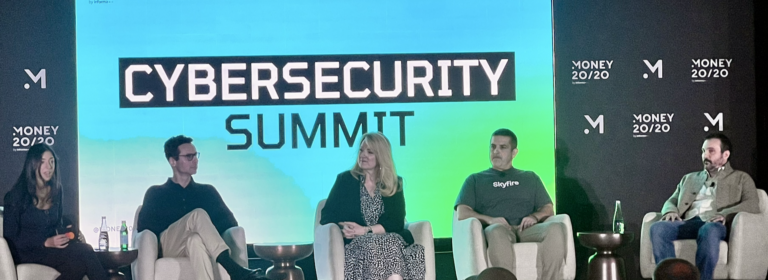
LAS VEGAS–In what one person described as an “arms race,” the lack of guardrails around agentic AI means that for credit unions and the broader market, the upcoming holiday season is going to be a real-time test of payments, chargebacks, fraud, identity and even issues that have yet to emerge, according to four people who are in the thick of a marketplace evolution unlike any ever seen before.
During a discussion at the Money 20/20 conference titled, “Who Let the Bots Pay: The Missing Guardrails of Agentic Commerce,” four experts weighed in on the environment credit unions and other financial institutions, along with merchants, payments companies, business and consumers are all racing to embrace even as they are unsure what lies along the way.
Offering their insights were:
- Amir Sarhangi, founder and CEO of Skyfire
- Kathleen Peters, chief innovation officer at Experian
- Gareth Davies, chief product officer at Okta
- Shaun Flagg, cloud engineer, Fastly
Sabrina Tharani Libby of Mastercard served as moderator.
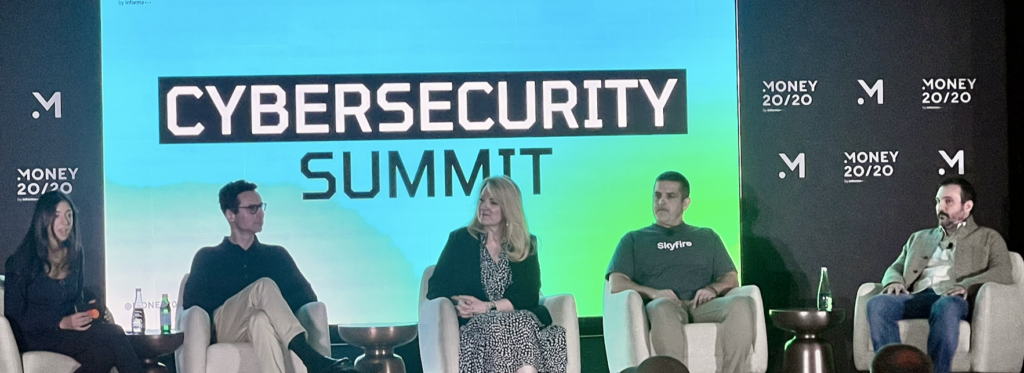
Here is what was shared:
Tharani Libby: For the last 30 years, Internet and all transactions on the Internet all operated on assumption that there is a human on the other end of the transaction? What is the single biggest thing in today’s infrastructure that needs to change?
Davies: Fundamentally, commerce is based on trust. You need to know each side of the equation. For a millennium, we’ve been operating with humans. Identity isn’t just an access problem; it’s an enablement problem. Some are choosing to block the bots, like Amazon. Now, you have to know who are the agents, are they able to interact with our APIs, and what do they have authority to do? There is a lot of uncertainty.
Peters: As we think about what’s changing with agents, I’m excited about the convenience and the automation, but one of the things we are going to need to be figuring out is how do we get to this autonomous state, and how do we bridge that? How do we make sure the agents have the necessary information to manage the risk as we all go running toward this new world?
Sarhangi: We were pretty early in the agentic commerce space and have been at it for two years. Initially, we started with how does an agent get access to a wallet and how does it spend? Then we realized pretty quickly the problem was around trust and what authorizations does the agent have. Merchants really want to know is this? Is this really my customer and does it have the permissioning it says it does.
Flagg: We are in a special place in working with our partners and customers to understand the character of what’s coming through the network. Looking at what your security posture is going to be involves parsing out who is a good bot and who is not. Identity and trust are very important. You have to verify and then authorize. We have a really nice view of what we can do from a firewall perspective to understand whether the signals are good or bad.
Tharani Libby: Let’s talk about intent. How should the ecosystem verify that an agent is doing what a person or business intended for it to do?
Davies: Agents inherently are nondeterministic. There has to be an understanding of the intent mandate. The merchant doesn’t know what the user put into their agent and we need a mechanism to enshrine what the human put into the agent. First off, we need the ability for the merchant to recognize the agent as legitimate. We need standards to emerge. We also need to understand what it is able to do on behalf of the user.
Increasingly, we have moved to an agents as principles model where the agent has its own sovereign identity. We need to be able to identify anomalous behavior by the agent and have the ability to stop it. The agent’s goals need to be enshrined in code and if it deviates you have to be able to stop that in real time.
Tharani Libby: With transaction authorization, how do we make sure the agent is doing exactly what we want it to do?
Peters: The challenge we are going to face is one we are going to face a lot in this upcoming holiday season. Even in the last few weeks there’s been an explosion in the use of Muse (and agentic AI), so understanding exactly what the mandate of the human is is a little tricky right now. Merchants need to be able to evidence that intent. Sometimes it’s a rogue agent; other times it’s fraud or abuse.
In this upcoming holiday season, there are going to be a number of parties testing where the weaknesses and gaps are. Who is going to be liable for making that right? It all comes down to trust. We are all very comfortable shopping online now, but when it first became available we all wondered about trust. That trust was built in the remediation of things going wrong.
Sarhangi: It’s amazing how quickly this is evolving. In many cases transactions are happening and merchants just don’t know. If you want to get any meaningful scale here and get value from the traffic and drive personalization–all of this is still unknown.
Tharani Libby: How can we start to tell a legitimate bot from a malicious one?
Flagg: We can identity from signals, there is all kinds of fingerprinting we can do. But it’s continually evolving and it’s an arms race. There are still DDOSs occurring. Are the good bots scrapers or crawlers? Content publishers are now not getting traffic, because ChatGPT or Claude crawled the information and the person never visits the (original) site.
Davies: You see data now that like 60% of internet traffic is bots. Up to 40% of a brand’s traditional Google search traffic no longer lands on a website. If almost half of your customer base you just spent 15 years optimizing search and you’ve invested in and you have this cloud data warehouse, suddenly, where the hell has it gone? But we are also hearing that when the user comes to the site as a result of that agent, you see a two to four times conversion.




