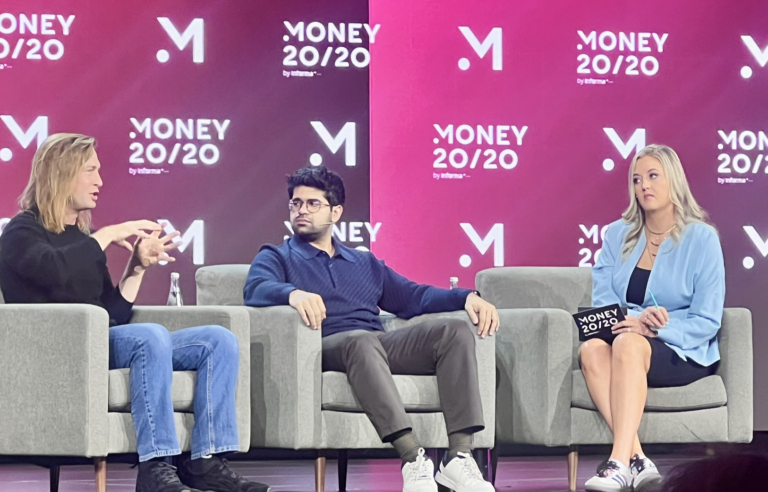
LAS VEGAS–A forecast for the “next frontier” of AI, particularly when it comes to financial services, was shared by two people here who are very much at the forefront of exploring the new landscape.
The viewpoints were shared during a session at the Money 20/20 conference titled, “The Intelligence Layer: How Ai s Rewiring Financial Services,” and featured as presenters:
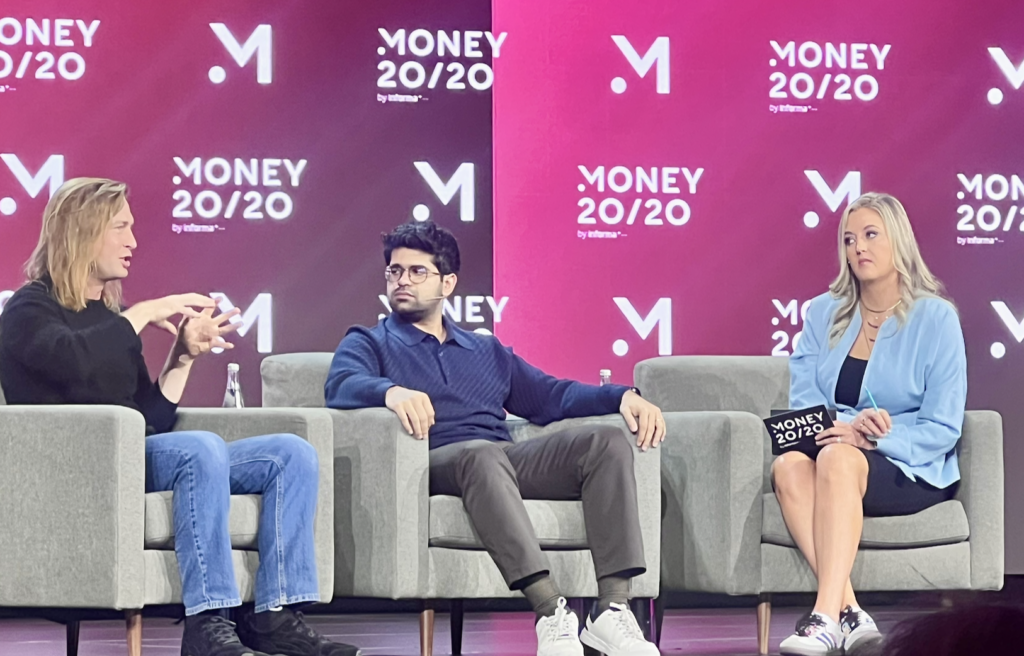
- Arvind Srinivas, co-founder and CEO at Perplexity
- Zach Perret, co-founder and CEO at Plaid
The session was moderated by Scarlett Sieber, chief strategy and growth officer at Money 20/20.
Prior to the Q&A, Srinivas and Perplexity said they are now expanding their “Personal CFO” solution outside the United States.
Below is a look at some of what was discussed:
Sieber: What is different with AI this year than when we were discussing this last year?
Perret: In the last 12 months we have started to see agentic financial analysis tools. It turns out the chat interface is a truly incredible function in terms of what a consumer can do with their finances. A financial advisor might take days or even weeks to answer some complex questions you have. With AI, you can do this in a matter of minutes. That was step one. Step two is going to be, ‘Now, execute it for me.’
I think it’s a big financial evolution for financial management. It’s not the death of financial analysts. It’s going to bring financial management to the next (cohort) of people.
Sieber: When you think about where we are with AI in financial services? Where is there real progress vs. hype?
Srinivas: There is progress in getting an overview of what is actually happening. Many budgeting tools are software built for everyone that doesn’t take you into account. That’s why you want to use the personal CFO (from Perplexity and Plaid). It now brings this to your own personal life and is a good starting point.
Once they start doing that, they move on to more complex questions: what are the implications for my portfolio? Help me construct a portfolio. You can bring in data from the web and other services and help you make decisions. That is the real recurring use case.
Making a purchase has always been easy. The hard part is knowing what to buy with trust and accuracy.
Perret: There are two categories of big challenges we’re seeing. The first is what we’re seeing within agentic AI. Right now, its purchase analysis, other kinds of analysis. The next wave of things is going from analysis to action. Instead of analyzing the trades, it’s executing the trade.
The question is, ‘Will the entirety of your financial life live withing a single harness?’ I think if I were building a neobank I would want to build my version of that. It may have richer information and a specific use-case for that user. I want all of that to happen within my four walls.
There is going to another wave of chatbots. We’re seeing incredible gains behind the scenes that will benefit consumers. We’re going to see way better fraud prediction and a huge improvement in predictive analysis.
Sieber: Who owns the customer relationship? If AI is picking your bank, picking your mortgage, who owns the customer?
Perret: AI is not going to make every choice. That would mean the banks have just given up. There is a range of interactions. First, it comes from building the best product. Second, it’s about enabling the customer to do what they want to do.
Over time, I think in the general-purpose harnesses there will be certain things you want to do in your bank, through Perplexity; and certain things you don’t. It’s crazy to think there will be nothing available through the harnesses, and crazy to think everything will be available.
Seiber: Where have you seen most change in the last six months and what is most surprising?
Srinivas: I think the biggest change is Ai has moved from answering questions to actually being able to get your work done, including serious, long-horizon tasks. AI now has access to all your connectors. It is transforming how work is done and information is accessed. The time duration of work AI gets done is going to keep increasing. The accuracy is going to keep improving.
What I’m excited about over the next few years is AI is moving from a tool that answers with what is already known, to something that can predict the unknown to a reasonable degree of accuracy. That is where the frontier lies.