
SALT LAKE CITY — More than three-quarters of U.S. adults are concerned about allowing artificial intelligence tools to move money or conduct financial transactions on their behalf, while majorities favor safeguards for AI access to banking information and a cautious approach to digital asset regulation, according to a new American Bankers Association survey.
The findings, released by the ABA at its 2026 annual convention in Salt Lake City, are based on an Oct. 9-12 national poll conducted by Morning Consult on the association’s behalf.
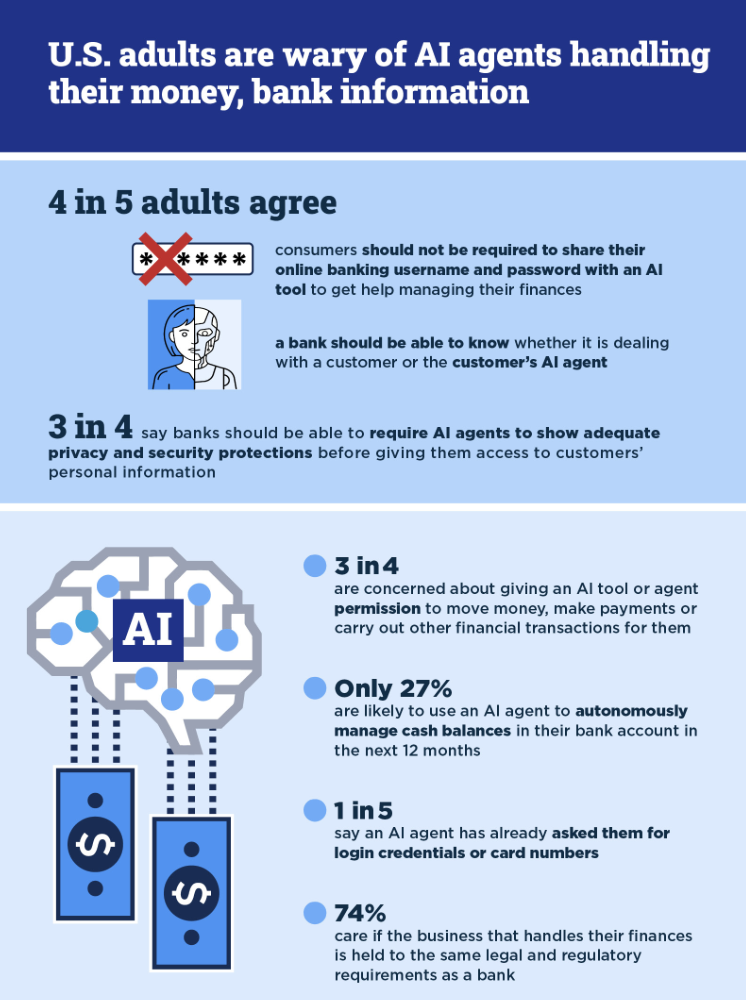
The survey found 77% of adults were concerned about authorizing an AI agent to transfer money, make payments or conduct other transactions. Only 27% said they were likely to use an AI agent to autonomously manage bank account cash balances in the next 12 months, compared with 61% who said they were unlikely.
“While agentic AI has the potential to be a compelling consumer tool, this survey shows that Americans are not ready to hand over their financial decisions to AI agents,” ABA President and CEO Rob Nichols said in the association’s release. He said consumers want banks to protect them from risks involving AI access to sensitive information.
Consumers Favor AI Security Safeguards
The ABA reported several findings about financial privacy and security:
- 79% agreed consumers should not have to share online banking usernames and passwords with an AI service to receive help managing finances.
- 80% agreed banks should be able to distinguish between a customer and the customer’s AI agent.
- 76% agreed banks should be allowed to require AI agents to demonstrate adequate privacy and security protections before accessing customer information.
- 74% said it matters whether a business handling their finances is subject to the same legal and regulatory requirements as a bank.
- 19% said an AI agent had asked them for financial account login credentials or debit or credit card numbers.
On AI-directed transactions, 52% said they were very concerned and 25% somewhat concerned. Regarding autonomous cash management, 11% said they were very likely to use an agent and 16% somewhat likely; 47% were very unlikely and 14% somewhat unlikely, according to the ABA.
Digital Asset Legislation Draws Caution
The survey also asked about cryptocurrency and stablecoin regulation amid debate over the Clarity Act. The ABA said 66% agreed Congress and the administration should avoid digital asset rules that could undermine the existing financial system, particularly community banks; 14% disagreed.
In another question, 68% said they would be concerned if banks had less funding available for loans to people and businesses in their communities. And 61% agreed Congress should prohibit crypto companies from offering interest-like stablecoin rewards if those rewards risk drawing deposits away from local banks and reducing community lending; 16% disagreed.
Those questions described potential risks to bank deposits and lending. The results measure respondents’ reactions to that framing, rather than independently establishing that proposed legislation would produce those outcomes.
“As Congress considers the next steps for digital asset rules, consumers are sending a clear message that they don’t want legislation that could weaken community banks and undermine the economy,” Nichols said in the ABA release.
Digital Asset Ownership Remains Limited
The association also reported that:
- 17% said they currently own digital assets, including cryptocurrencies, stablecoins or non-fungible tokens; another 13% said they had owned them previously.
- 59% said digital assets were not too relevant or not at all relevant to their daily financial lives.
- 60% said they were unlikely or very unlikely to buy, hold or use digital assets in the next 12 months, compared with 28% who were likely or very likely
About the Survey
Morning Consult surveyed 4,402 U.S. adults online Oct. 9-12, 2026, dividing respondents into two representative groups of 2,191 and 2,211 for different question sets. Responses were weighted by age, race and ethnicity, gender, education and region. The ABA reported a margin of error of plus or minus 1 percentage point for the full survey; it did not provide separate margins of error for the split samples in the information released.
The ABA said the results are part of a continuing series examining consumers’ views of banks and financial services. The association also recently released survey findings on bank fraud prevention and policy responses to fraud.